dental implants
Dental Implants: A Conservative Guide to Treatment, Costs, Risks, and Your Next Step

Start with the decision an implant evaluation must resolve
Dental implant treatment begins with a question, not a promise: does the proposed replacement make sense for your tooth loss, your treatment preferences, and the stages you are prepared to discuss? You do not need to decide from the word “implant” alone. You need enough detail to understand what would be placed, what would happen first, what could change the sequence, what alternatives should be considered, and how the complete financial plan would be handled.
A conservative evaluation gives you a way to organize those questions. It does not determine your suitability from a search result or from a general description. A dentist must assess your individual situation and explain the findings that support any recommendation. Your role is to leave with a clear account of the proposed treatment rather than a vague assurance that an implant will solve everything.
Use the evaluation to resolve five decisions:
- What part of the tooth is missing, and what replacement would be attached to the implant?
- What stages are proposed, and which parts depend on healing or other findings?
- What discomfort, diet changes, recovery questions, and follow-up expectations should you plan around?
- What risks and alternatives belong in the same conversation?
- What will each stage cost, what may insurance address, and what responsibility may remain with you?
That range gives you a practical starting point for discussing more than one replacement path, without treating any option as predetermined.
The useful next step is an individualized evaluation or treatment estimate. Until that discussion happens, treat timelines, fees, coverage, and suitability as questions to resolve rather than outcomes to assume.
Your first appointment will be more useful if you ask for plain answers to these questions:
- What would the implant support in your case: a crown, bridge, or denture?
- What stages are expected, and what could make the sequence different?
- What will you need to do during healing, and what recovery limitations should you plan for?
- What risks, maintenance needs, and warning signs should you understand?
- Which alternatives fit the same missing-tooth problem, and what trade-offs come with each?
- Can you receive a written estimate that separates the examination, placement, restoration, and any other proposed stages?
A focused list keeps the conversation tied to your decision. It also gives you a clear boundary: no treatment choice should be based only on a general description of implants.
Understand what a dental implant replaces
A dental implant replaces the root portion of a missing tooth; it is an artificial tooth root, commonly made from titanium, that is placed in the jawbone to support a replacement tooth or bridge. The visible replacement is a separate part of the plan.
That distinction matters because “getting an implant” can describe several connected steps rather than one finished tooth. The implant is the part placed in the jawbone. A later restoration supplies the visible tooth or teeth.
A single missing tooth is typically restored with a customized crown. Multiple missing teeth may be restored with a bridge or denture.
Your consultation should therefore identify the whole replacement, not only the implant post. Ask the dentist to show you which component is being proposed, what it supports, and whether the estimate includes the connected parts. If a discussion covers only placement but not the final tooth, bridge, or denture, the plan is not yet complete enough for you to compare.
The word “root” also explains why treatment is staged. The implant must be placed in the jawbone before the planned replacement can be attached, unless the proposed approach uses a different sequence. Bone can grow around an implant during osseointegration, which is the process that holds the implant in place. That biological stage is one reason your personal schedule cannot be inferred from a general treatment outline.
Your component checklist should include:
- The implant placed in the jawbone.
- The abutment or connecting component, if included in the proposed plan.
- The crown, bridge, or denture that replaces the visible tooth or teeth.
- The stages that occur before and after placement.
- The maintenance and follow-up discussion attached to the finished restoration.
Ask for each component by name in the treatment conversation. That simple step helps you distinguish the surgical portion from the completed replacement and gives you a better basis for discussing fees, timing, and alternatives.
Match the restoration to the number and pattern of missing teeth
The replacement design depends on what you are trying to restore: one missing tooth, several missing teeth, or a larger pattern of tooth loss.
An implant-supported denture is another design to discuss when several teeth are missing. That description tells you what the attachment changes; it does not tell you which design is appropriate for your mouth.
Use the pattern of missing teeth as the first organizing question:
- For one missing tooth, ask how the proposed crown will be customized and what the complete crown-and-implant plan includes.
- For several missing teeth, ask which restoration the dentist is considering and why.
- For a broader replacement, ask how the proposed denture design would attach, what components it includes, and what alternatives remain available.
Westborough Dental Care documents that it offers implants and crowns, as well as dentures and Invisalign clear aligners. You can use that service scope to ask for a direct comparison, but you should not assume that every listed service is suitable for your situation.
The useful action is to ask for the proposed restoration in a complete phrase: “implant-supported crown,” “implant-supported bridge,” or “implant-supported denture,” if that is what the dentist recommends. A clear name makes it easier to ask about the stages, the expected maintenance, the alternatives, and the cost of the entire plan.
Your decision is not simply whether you want an implant. Your decision is which replacement design, if any, addresses the missing-tooth pattern you want to discuss. Ask the dentist to explain the reason for the proposed design and to identify the alternative that would be compared with it. Keep the comparison specific to your findings rather than treating one restoration as a universal choice.
Map the usual treatment sequence without treating it as a personal timeline
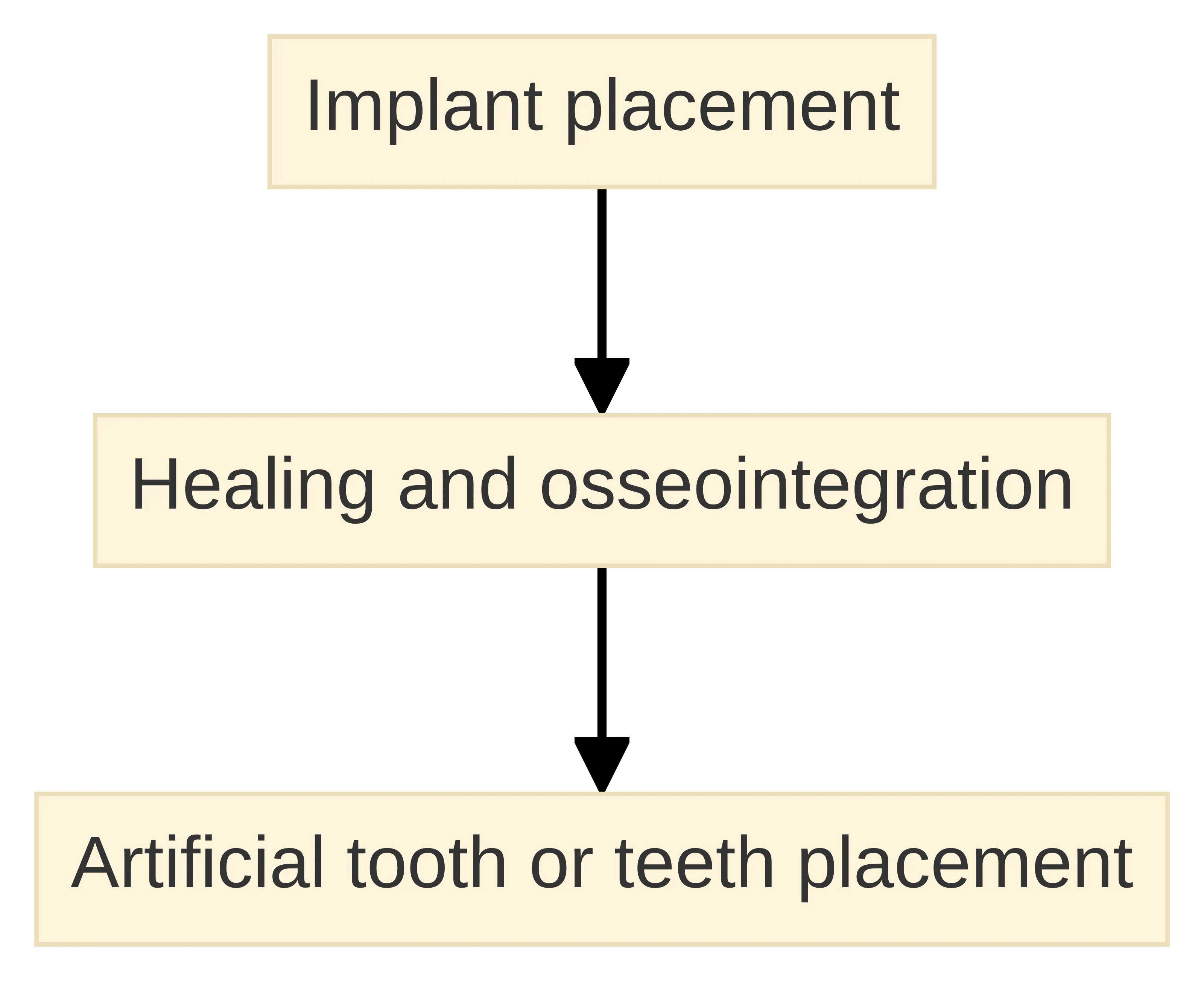
Implant treatment generally involves placement of the implant, healing and osseointegration, and placement of the artificial tooth or teeth. This sequence is a map for your questions, not a personal schedule.
The first phase is surgical placement of the implant in the jawbone. The second phase is healing, including osseointegration, during which bone can grow around and hold the implant in place. The third phase is placement of the artificial tooth or teeth.
Some patients may wait up to several months before replacement teeth are attached, while other patients may have the implants and replacement teeth placed in one visit. Those are different examples of sequencing, not a promise about what will happen in your case. Ask which sequence is being proposed for you and what condition would lead the dentist to change it.
Your treatment map should answer four practical questions:
- What happens during the evaluation and planning stage?
- What is placed first, and what must happen before the restoration is attached?
- What healing period or appointment gap should you discuss?
- When will the finished crown, bridge, or denture be placed and checked?
A treatment plan that names only the surgery leaves out the restoration and the time between stages. A plan that names only a final tooth leaves out the placement and healing questions. Ask for both parts in writing so you can understand the proposed sequence before you make a decision.
Westborough Dental Care documents that it plans dental implants digitally using an in-house Cone Beam CT scanner and places them with a surgical guide for higher precision. The documented process describes planning and placement; it does not establish your candidacy, healing time, or final result.
Westborough Dental Care also documents that it handles implant placement, the abutment, and the final crown in-house using digital surgical guides. If you request an evaluation there, ask how those documented stages would apply to the restoration being considered and what parts of your plan remain dependent on individual findings.
Your direct action is to leave with a sequence you can repeat back: evaluation, proposed placement, healing or integration discussion, restoration, and follow-up. If any step is unclear, ask for that step to be added to the written plan before comparing fees or committing to treatment.
Use the evaluation to test whether implants fit your situation
An implant evaluation should connect your examination and images to a specific treatment proposal. It should also explain what the proposed restoration is meant to replace, what sequence is expected, and which findings could change that sequence. You cannot determine those answers from the general definition of an implant.
Use the appointment to test the proposal rather than to collect a yes-or-no label. Ask the dentist:
- Does the evaluation explain the condition of the proposed site, relevant health history and medications, and any additional steps that may be needed before the proposed sequence?
- What restoration is being considered, and why does it match the number and pattern of missing teeth?
- Which stages are included in the proposed plan?
- What findings could delay, alter, or rule out the proposed sequence?
- What alternatives should be compared before you decide?
- Which questions about healing, maintenance, risks, and fees still need answers?
Westborough Dental Care documents that its first visit lasts about 60 to 90 minutes and includes a comprehensive exam, a full series of digital X-rays, a cleaning if gum health allows, and a written treatment plan. Those are the practice’s published first-visit details; they are not a determination that implants will be recommended.
A written treatment plan is useful only when it is specific enough to discuss. Ask whether it identifies the proposed implant location, restoration, stages, estimated timing, and fees. Ask which parts are provisional. Then take time to consider the plan rather than treating the existence of a plan as a reason to accept it.
To keep the evaluation understandable, record each answer in four parts: finding, effect on the proposed plan, question still open, and decision point. For example, note what the examination and digital images show about the proposed site; then ask whether that finding affects the restoration, the sequence, or the need for an additional step. Record relevant health history and medications that the dentist says belong in the planning discussion, without trying to interpret them yourself. If the dentist identifies a condition that could alter the sequence, ask whether it changes the timing, the restoration, the follow-up, or only the estimate. This record helps you distinguish a clinical finding from a decision you still need to make. It also makes a later financial conversation more precise: you can ask which proposed stage responds to which finding, rather than comparing a single total without context. The purpose is not to create your own candidacy test. It is to leave the evaluation knowing what was assessed, what remains uncertain, and which answer would change your next step.
Your boundary is straightforward: an evaluation can explain the findings and options, but you should not self-diagnose eligibility. Request the dentist’s reasoning in plain language, ask what would change the recommendation, and compare the complete plan with alternatives before deciding whether to proceed.
Ask what discomfort, healing, and recovery will mean for you
Discomfort and recovery should be discussed as practical parts of the proposed sequence, not treated as details to handle later. Implant placement is a surgical phase, and the healing period includes osseointegration before the replacement teeth may be attached in some cases.
The available patient guidance says that a dentist may recommend soft foods, cold foods, and warm soup during healing. That guidance does not establish what you will need, how long your recovery will take, or how comfortable you will be. Ask for instructions tied to the procedure being proposed.
Your recovery questions should cover:
- What discomfort should you expect after each planned stage?
- What instructions will you receive for food, activity, and oral care?
- How will you know whether healing is progressing as expected?
- Who should you contact if a concern arises after placement?
- What appointment marks the transition from healing to restoration?
- What could extend the period before the replacement tooth or teeth are attached?
Ask the dentist to separate the immediate period after placement from the longer healing stage. Those are different planning questions. You also need to know whether a temporary replacement or change to your routine is part of the proposed plan, rather than assuming that the finished restoration will be available immediately.
Your direct action is to request written recovery instructions and a contact pathway before placement. Do not use a generic recovery description as your personal timeline.
Your comfort concerns belong in the first conversation, especially if dental treatment makes you anxious. State what worries you: the procedure, the healing period, eating, speaking, time away from work, or uncertainty about what happens next. Ask which parts of the plan are fixed and which depend on healing or examination findings. A calm discussion cannot promise a particular experience, but it can turn a vague fear into questions you can answer before deciding.
Balance potential benefits with long-term risks
The potential value of an implant depends on the replacement it supports and the problem you are trying to address. Dental implants are artificial tooth roots placed in the jawbone to support replacement teeth or bridges. Implant-supported dentures attach to implants rather than resting directly on the gums and may improve stability for chewing, eating, and speaking.
Those descriptions identify possible functions of the treatment. They do not guarantee that you will receive a particular result, feel a particular level of stability, or avoid future treatment. Ask what benefit the proposed restoration is intended to provide in your situation and how that benefit will be assessed.
The risk discussion should be equally concrete. One review notes that peri-implantitis can occur during a patient’s lifetime. Peri-implantitis may damage tissues around an implant and can cause bone loss, periodontal pocketing, or loss of osseointegration.
Ask the dentist to explain:
- Which complications are relevant to the proposed treatment?
- What symptoms or changes should prompt you to contact the practice?
- What maintenance and follow-up will be recommended?
- What could require repair, replacement, or additional treatment?
- How would a problem affect the proposed restoration or treatment sequence?
A risk conversation is not a prediction that a complication will occur. It is a way to understand what you are agreeing to monitor and what future care could involve. Keep the risk beside the proposed benefit rather than discussing the benefit alone.
Your decision should include a clear boundary around long-term claims. A reported survival range does not mean an implant will last for a particular period in your mouth, and the possibility of peri-implantitis means that the finished restoration still belongs in an ongoing care discussion. Ask for an individualized explanation of expected care without treating any estimate as a guarantee.
Read implant survival evidence in the right context
Implant survival statistics describe groups and defined study situations, not a guaranteed result for your treatment. One review reports implant survival rates of 92.8% to 97.1% while noting that peri-implantitis can occur during a patient’s lifetime. That range should prompt questions about the population, follow-up period, implant type, restoration, and definition of survival before you use it in a personal decision.
A separate systematic review of 24 studies found a 1-year survival rate of 96.7%, with a 95% confidence interval of 92.8% to 99.3%, after replacement of previously failed implants. That result applies to replacement implants at sites of previous failures, not necessarily to every implant case.
The two figures cannot be treated as interchangeable. They address different evidence contexts. The first is a reported range concerning dental implant survival. The second concerns one-year survival after replacement at sites where implants had previously failed. Neither figure is a personal forecast.
When a provider or article gives you a percentage, ask:
- What exactly does the percentage measure: survival, function, repair-free time, or something else?
- Which patients and treatment situations were included?
- How long were the implants followed?
- Does the result concern initial placement or replacement after failure?
- What conditions or complications were included in the analysis?
- How does the cited situation compare with the plan being proposed to you?
The systematic review found no statistically significant survival difference between immediate and delayed placement or between immediate and delayed augmentation in the analyzed failed-implant replacement cases. That finding belongs to those reviewed replacement cases; it should not be used as a universal rule for your treatment timing.
Your direct action is to ask the dentist to explain whether any survival figure applies to the proposed treatment and what it leaves out. Use statistics to frame the conversation, not to replace an evaluation.
Make maintenance and warning signs part of the treatment decision
Implant maintenance is part of the treatment decision because peri-implantitis can occur during a patient’s lifetime and may damage the tissues around an implant, including through bone loss, periodontal pocketing, or loss of osseointegration.
The evidence establishes why you should ask about ongoing care; it does not provide a personalized maintenance schedule or a complete list of warning signs for you. Ask the dentist to explain the follow-up plan for the implant, abutment, and final crown, bridge, or denture. Ask how the practice will assess the surrounding tissues and what changes should lead you to contact the office.
Your maintenance conversation should answer these questions:
- What appointments are expected after the restoration is placed?
- What daily or professional care does the proposed restoration require?
- Which changes in comfort, fit, tissue condition, or function should you report?
- What happens if the restoration needs adjustment, repair, or replacement?
- Which costs belong to routine care, and which could arise from an unexpected problem?
Do not accept “long-lasting” as a complete maintenance answer. Ask what care is expected and what the practice wants you to monitor. Then include those responsibilities in your financial and scheduling decision.
Your practical boundary is to leave with a follow-up plan, not only a placement date. If the discussion does not cover maintenance, warning signs, and the route for reporting a concern, ask those questions before you decide whether the proposed treatment fits your routine and expectations.
Compare the complete plan with alternatives
The alternatives differ in their components and sequence. They may also differ in the appointments, care, fees, and future decisions you need to discuss. The available descriptions do not establish a universal winner, so compare the option that has actually been proposed with the alternatives your dentist considers relevant.
Ask for the comparison in the same format for each option:
- What does the option replace?
- What is attached to the implant, tooth, gum, or other support?
- What stages and appointments are expected?
- What healing or recovery questions apply?
- What maintenance is required?
- What risks or limitations should you understand?
- What does the complete estimate include?
- If a damaged natural tooth is involved, can it be preserved, and what trade-offs should you compare with extraction and implant replacement?
Westborough Dental Care documents that it offers implants and crowns, dentures, and Invisalign clear aligners. That list can help you ask which services are relevant to the concern you want addressed, but it does not establish that Invisalign or any other listed service is an alternative to an implant in your case.
A conservative comparison does not mean rejecting implants. It means making sure the proposed treatment earns its place beside the alternatives. Request the explanation before you focus on a single price, a single statistic, or a single technology feature.
When a natural tooth is still present or damaged, make preservation an explicit branch of the comparison before discussing extraction and implant replacement. Ask whether the tooth can be preserved, what trade-offs the dentist wants you to consider, and how the preservation option would differ in stages, maintenance, risks, and complete fees. If replacement is the proposed path, ask why it addresses the problem better than the preservation path for the findings identified in your evaluation. Do not turn that question into a self-directed recommendation; its purpose is to ensure that extraction is not treated as an unexamined starting point. For other alternatives, use the same comparison headings: what is replaced, how it is supported, what appointments are expected, what care follows, and what responsibility may remain. A side-by-side record can show whether two options differ in treatment burden, ongoing care, or financial uncertainty, even when the initial descriptions sound similar.
Your comparison should end with a reasoned choice or a clear reason to pause. If the proposed implant design addresses your stated concern and the stages, risks, maintenance, alternatives, and financial responsibility are clear, you can decide whether to continue the discussion. If one of those areas remains unclear, ask for that information before authorizing treatment.
Request a complete financial and insurance picture
Implant costs should be discussed as a complete treatment plan rather than as the price of a single implant post. Ask for a written estimate that separates the evaluation, planning, placement, healing-related stages, abutment, crown, bridge, denture, imaging, and any other proposed service. The exact items depend on the plan recommended for you.
Your insurance responsibility also needs a specific conversation. Westborough Dental Care documents that it verifies benefits before treatment, accepts 14 in-network PPO carriers, files out-of-network insurance claims, and publishes its UCR fees openly. These are practice-level processes; they do not establish your coverage, deductible, coinsurance, exclusions, or final patient responsibility.
Ask these financial questions before you commit:
- Which services and stages are included in the estimate?
- Which charges are separate from the implant placement itself?
- Which services will the practice submit to insurance?
- What benefit information has been verified, and what remains subject to the plan’s determination?
- What amount may be due from you at each stage?
- What happens financially if the sequence changes or an additional service is proposed?
- Which fees apply to follow-up, maintenance, adjustment, repair, or replacement?
A written estimate should distinguish an estimate from a guarantee. Treatment findings, the selected restoration, and your insurance plan can affect the amount you pay. Use the document to identify open questions, not as permission to assume that insurance will cover every part of implant treatment.
Your direct action is to request the complete financial picture before authorizing the first treatment stage. If the estimate combines several stages into one unexplained amount, ask for a clearer breakdown.
Read the estimate in two passes. First, test completeness: can you identify the examination, planning, placement, healing-related visits, abutment, final restoration, imaging, and follow-up items that apply to the proposed plan? Second, test uncertainty: which amounts are based on verified benefits, which are practice fees, which depend on the selected restoration or sequence, and which still require insurer confirmation? Mark each item as included, separate, estimated, or unanswered. This does not calculate coverage, but it gives you a list to take to the practice and insurer. If an estimate changes after the evaluation, compare the revised document with the original rather than relying on a verbal total. Ask what changed in the proposed treatment and what changed only in the financial assumption. That distinction helps you understand whether a new amount reflects a different stage, a different restoration, or unresolved coverage. Keep the estimate with the written treatment plan so the clinical and financial decisions remain connected.
Your insurance card belongs in the financial conversation. Westborough Dental Care documents that it verifies benefits before treatment and files out-of-network claims for patients. Bring the plan information and ask which figures are confirmed, which are estimates, and which decisions remain with your insurer. Keep the practice’s fee information and your insurer’s explanation separate so you can see the difference between the billed amount, the allowed amount, and the amount discussed as your responsibility.
Know what Westborough Dental Care documents about its process
For implant planning in South San Francisco, the practice documents digital planning with an in-house Cone Beam CT scanner and placement with a surgical guide for higher precision. The practice also documents that it handles implant placement, the abutment, and the final crown in-house using digital surgical guides.
The first visit is an opportunity to understand the proposed plan; it is not a promise that implants will be recommended or that treatment will begin that day.
The practice also documents the following financial and administrative details:
- Benefits are verified before treatment.
- Fourteen in-network PPO carriers are accepted.
- Out-of-network insurance claims are filed for patients.
- UCR fees are published openly.
- New patients are accepted, with appointment requests available online or by calling directly.
These details give you concrete subjects to discuss in South San Francisco: the proposed restoration, the digital planning process, the stages handled in the practice, the written treatment plan, benefits verification, and the fee breakdown. They do not answer your individual suitability, healing, risks, final result, or final financial responsibility.
You can ask the practice to explain which of those services relates to your situation and how the alternatives compare. Keep the provider-specific information separate from general implant evidence so you know which statements describe the practice and which describe broader clinical information.
Your provider-focused question list can be short and specific:
- What restoration is being proposed, and what components are included?
- How would digital planning and the surgical guide fit into the proposed sequence?
- Which stages would be handled in the practice, and which appointments would follow?
- What will the written treatment plan and estimate show?
- What has been verified about benefits, and what remains uncertain?
- Which alternatives should be compared before you decide?
Use the answers to understand the process, not to convert a published service description into a promise about your case.
Prepare for the first visit
Your first visit will be easier to use if you arrive with the records and questions needed for an implant discussion. Westborough Dental Care instructs first-time patients to bring an insurance card, a list of current medications, and prior dental records or X-rays.
Your preparation list should include:
-
Your insurance card.
-
A current list of medications.
-
Prior dental records or X-rays.
-
The location and pattern of missing or damaged teeth you want to discuss.
-
Questions about the proposed restoration, stages, discomfort, recovery, risks, maintenance, alternatives, and fees.
-
A request for a written treatment plan and a stage-by-stage estimate.
Plan enough time to ask questions rather than treating the visit as a quick price check.
Bring your concerns into the room plainly. If you are worried about discomfort, healing, cost, insurance, or the number of appointments, say so at the beginning. Ask the dentist to explain any technical term before you make a decision. Take notes on what is proposed, what is uncertain, and what requires a separate answer.
Your direct action is to leave with three documents or clear next steps: the proposed treatment plan, the financial estimate, and the instructions for what happens after the visit. If you do not yet have enough information to decide, use the appointment to identify the missing answer rather than forcing a choice.
Choose the next step after the questions are answered
Your next step is an implant evaluation when you want an individualized explanation of the proposed restoration, treatment stages, risks, recovery questions, alternatives, and financial responsibility. Westborough Dental Care documents a first visit with an exam, digital X-rays, a written treatment plan, and a process for verifying benefits before treatment in South San Francisco.
Bring your records, medication list, insurance card, and questions. Ask for a complete plan that distinguishes what is known from what depends on your examination and healing. A qualified dental professional must decide individual suitability; your part is to understand the recommendation well enough to give informed agreement or ask for another option.
If the proposed plan answers the treatment, recovery, maintenance, alternatives, and cost questions, you can decide whether to continue. If those answers are incomplete, pause and request the missing details before authorizing treatment.
Questions to ask before requesting an implant evaluation
What should I expect during the dental implant evaluation process?
During the dental implant evaluation, you can expect a comprehensive examination, digital X-rays, and a discussion about your specific treatment plan, including the proposed restoration, stages of treatment, and any necessary follow-up.
How long does the dental implant process usually take?
The dental implant process generally involves several stages: surgical placement of the implant, a healing period for osseointegration, and finally, placement of the artificial tooth or teeth. The total duration can vary, with some patients receiving their replacement teeth in one visit, while others may wait several months.
What should I bring to my first visit for a dental implant evaluation?
For your first visit, you should bring your insurance card, a list of current medications, and any prior dental records or X-rays. Additionally, prepare a list of questions regarding the proposed treatment, costs, and recovery expectations.
How does Westborough Dental Care handle insurance for dental implants?
Westborough Dental Care verifies patients’ insurance benefits before treatment, accepts several in-network PPO carriers, and files out-of-network claims for patients. It’s advisable to discuss your specific coverage and any potential out-of-pocket costs during your evaluation.
Need help applying this?
Talk to a billing specialist who knows your payer mix.
Westborough Dental Care welcomes new patients in South San Francisco. Book a visit to meet Dr. Zoulas and the team.
Schedule a meeting