
dental implants
Dental Implants: Questions to Ask Before Your Evaluation

Start with the decision an evaluation must resolve
A dental implant evaluation should replace uncertainty with a clear discussion about your tooth replacement options, the proposed treatment stages, the financial details, and the care that would follow. You do not need to decide whether an implant fits your situation from a general description alone. You need enough information to understand what would be planned, which alternatives should be considered, and which details require an individualized assessment.
A focused consultation question set can help you organize the appointment around decisions rather than promises. Bring questions such as:
- What concern would the proposed treatment address?
- Which components would be included, and which stages would occur first?
- What information would the evaluation use to shape the plan?
- What alternatives should you compare before deciding?
- What could affect the treatment sequence, comfort, recovery, maintenance, or timing?
- Which fees belong to placement, the abutment, the crown or other replacement tooth, imaging, or examinations?
- What might your dental plan cover, and what could remain your responsibility?
- What follow-up would the proposed plan require?
The purpose of these questions is not to force a decision during the appointment. The purpose is to leave with a plan you can understand, a financial picture you can examine, and a next step that does not depend on guessing.
A dental implant evaluation is the appropriate place to discuss your individual circumstances, not a self-assessment based on a checklist. Start by learning how implant treatment is structured, then use the remaining questions to test whether the proposed approach makes sense for you. If an answer affects your decision, ask for it in plain language and ask where it appears in the written plan.
Understand the three implant components and treatment phases
For a single missing tooth, the replacement tooth is a customized dental crown designed around size, shape, color, and fit. When more than one tooth is being replaced, custom-made bridges or dentures may be considered as the replacement teeth.
The three named components do not automatically tell you which combination would be proposed for your situation. Ask the dental practice to identify each component in plain language and show how each one appears in the written plan. A clear component list gives you a better foundation for discussing fees, coverage, maintenance, and follow-up.
Ask whether the proposed estimate treats the implant, abutment, and replacement tooth as separate services or as parts of a combined plan. That distinction matters when you compare an estimate with an insurance benefit explanation or with another proposed approach.
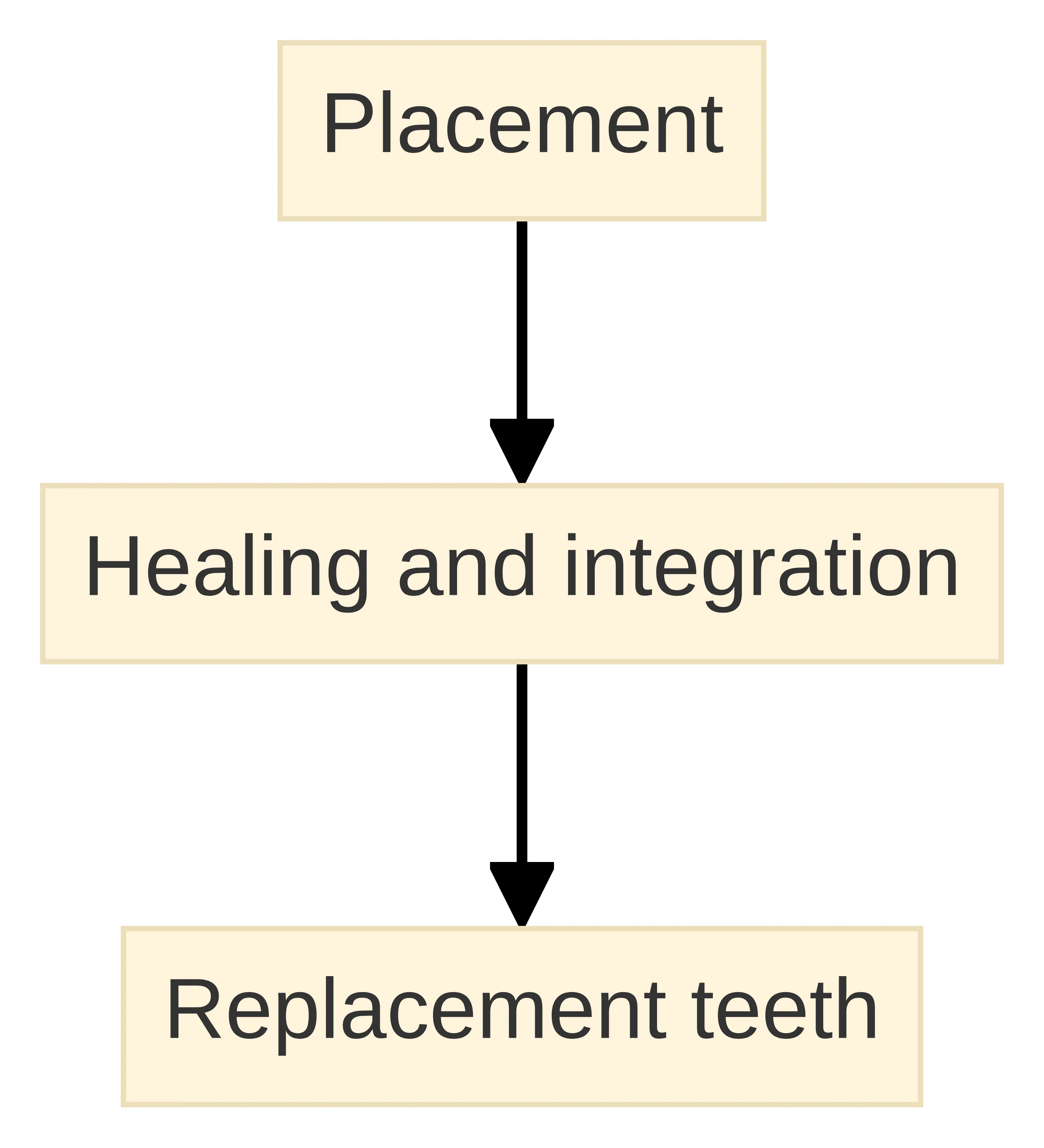
Implant treatment generally has three phases:
- Placement: The implant is surgically placed in the jawbone.
- Healing and integration: The bone heals around the implant in a process called osseointegration.
- Replacement teeth: The artificial tooth or teeth are attached after the treatment plan reaches that stage.
Healing time varies. Some patients wait up to several months before replacement teeth are attached, while others may receive implants and replacement teeth during one visit. That difference is a reason to ask about your proposed sequence rather than assume that every implant follows the same calendar.
The phase structure also gives you a practical way to organize the appointment. Ask what would happen at each stage, which stage each fee belongs to, and what information would determine when the next stage could occur. You can then distinguish the surgical placement from the later restoration instead of treating the entire process as one unexplained procedure.
A treatment-phase question list can include:
- Which phase would begin first for me?
- What would the replacement tooth be: a crown, bridge, or denture?
- Which parts would be completed during each visit?
- What would determine whether replacement teeth are attached after healing or during one visit?
- What should I expect regarding comfort, eating, recovery, and follow-up after each stage?
- How would the proposed replacement be designed around fit, shape, color, and size?
- Which parts of the plan could change after an evaluation or during healing?
These questions ask for a plan without asking you to predict your own suitability. They also separate the implant itself from the restoration that completes the tooth replacement. Write down the answer to each question in the same order as the phases so you can compare the clinical and financial parts of the plan.
Use the evaluation to map the proposed plan
A treatment plan should connect your concern with the proposed procedure, components, sequence, and follow-up. At our practice, the first visit includes a comprehensive exam, a full series of digital X-rays, a professional cleaning if gum health allows, and a written treatment plan. Ask which parts of that first-visit process apply to an implant evaluation and whether additional planning information would be needed.
The written plan should give you something concrete to discuss. Ask the dental practice to explain the proposed treatment in the same order you would experience it, from evaluation through placement, healing, restoration, and follow-up. If a term is unfamiliar, ask for its meaning before moving on. If the plan names a component without explaining its purpose, ask how that component fits into the replacement.
A useful plan discussion can cover:
- The dental concern the proposed treatment is intended to address.
- The recommended procedure and the reason it was selected.
- The components included in the proposed restoration.
- The information or images used during planning.
- The expected sequence of visits and decision points.
- The alternatives that should be considered.
- The care, maintenance, and follow-up associated with the proposed plan.
- The questions or findings that still need to be resolved before treatment begins.
A personalized treatment plan should connect the recommendation with your dental health, your goals, and the specific tooth replacement being discussed. Ask which part of the plan responds to each goal. That makes it easier to identify a recommendation you understand rather than simply accepting a procedure name.
Before leaving the evaluation, summarize the plan in your own words and ask whether each part is accurate. Then request a written explanation of the proposed stages and the financial items connected with them. Keep a separate note for questions that require more information, another appointment, or a decision about an alternative. This gives you a practical basis for comparing options without treating a general implant description as a personal recommendation.
Separate candidacy questions from assumptions
Candidacy for implant treatment is an evaluation question, not a conclusion you should draw from a symptom, a missing tooth, or a general online description. Ask what the dental practice needs to examine before recommending a plan and which findings could change the proposed procedure, sequence, timing, or restoration.
Use neutral questions rather than trying to fit yourself into a generic eligibility list:
- What would you need to evaluate before recommending implant treatment?
- What features of my dental health affect the proposed plan?
- Would the treatment address one missing or damaged tooth, or more than one tooth?
- What could make the plan more complex or change its order?
- Which alternatives should I compare before choosing an implant?
- What should I understand about comfort, recovery, maintenance, and follow-up?
- Which questions require another appointment or additional planning information?
The answers should relate to your circumstances. A broad statement about implants cannot settle those questions for you.
A favorable answer to one question is not proof that the entire treatment will be appropriate. Knowing that a customized crown may be used for a single-tooth replacement does not tell you whether that restoration is the proposed option, how the stages would be ordered, or what the complete cost would be. Each point belongs in the consultation discussion.
The same boundary applies to timing. A description of healing or a possible one-visit approach cannot predict the sequence for your care. Ask what the proposed plan assumes, what could change it, and which questions must be answered before treatment begins.
Your concerns about anxiety, discomfort, recovery time, or maintenance belong in the appointment. Ask for an explanation of the care associated with the proposed approach and the follow-up expected after each stage. Those answers can help you decide what information you need, but they do not determine the treatment plan by themselves.
Ask what technology changes in the planning conversation
Dental implant planning at our practice uses an in-house Cone Beam CT scanner for digital planning, and implant placement uses a surgical guide for higher precision. We also handle implant placement, the abutment, and the final crown in-house using digital surgical guides.
Those details give you specific subjects to discuss rather than a reason to assume a particular result. Ask what information the imaging provides for your proposed plan, which decisions the digital planning supports, and how the surgical guide would be used during placement. Ask where those planning details appear in the written treatment explanation.
Technology questions can include:
- What does the Cone Beam CT scan show for this evaluation?
- How does the scan inform the proposed implant position or treatment sequence?
- What does the surgical guide do during the placement stage?
- Which parts of the treatment are planned digitally?
- How would the technology affect the written plan, the number of visits, or the information you receive?
- Which parts of the implant, abutment, and final crown would be handled in-house?
- What questions should you ask about expected care and follow-up after digitally planned treatment?
The goal is to connect a tool with a decision. A technology label matters less than understanding what it changes in the plan being proposed to you. If the technology does not change a decision you need to make, ask what practical information it adds to your consultation.
A digital planning discussion should sit alongside questions about alternatives, treatment stages, comfort, recovery, and maintenance. Ask for the complete plan rather than evaluating the technology separately from the care it supports. You should be able to explain what the imaging and guide are being used for before you compare plans or decide whether to proceed.
Build a complete cost question before comparing coverage
Implant treatment cost is easier to discuss when you separate the care into component fees instead of asking for one unexplained total. Ask whether the estimate identifies implant placement, the abutment, the final crown or other replacement teeth, diagnostic imaging, examinations, and any additional services included in the proposed plan.
At our practice, we publish our UCR fees openly. Use the fee information as a starting point for questions about which charge belongs to which service and whether the proposed estimate includes every stage under discussion. A fee list and a personal treatment estimate answer different questions: the first describes charges, while the second should connect those charges to the plan proposed for you.
A complete cost discussion can cover:
- The fee for implant placement.
- The fee for the abutment.
- The fee for the final crown, bridge, or denture, if proposed.
- Imaging and examination fees.
- Any separate visit, laboratory, or planning charges included in the plan.
- The amount expected before treatment begins.
- The amount expected at each later stage.
- The difference between the estimated charge, insurance payment, and your final responsibility.
- What could change the estimate and how that change would be discussed.
Ask for the proposed charges in writing before consenting to treatment. The point is to see what the estimate includes and which items still depend on evaluation or plan details. If a charge is described as an estimate, ask what event or decision could cause it to change.
A cost comparison should use the same scope for every proposed plan. One estimate may include imaging or the final crown while another may list those components separately. Ask the same component questions of each practice so that the comparison is based on the treatment being proposed, not on two totals that describe different services.
Keep three figures separate in your notes: the total charge for the proposed care, the amount an insurance plan may pay under its terms, and the amount you may owe. A lower headline figure is not necessarily a lower complete cost if it leaves out a component or stage.
Treat insurance verification as a question, not a promise
Some plans may exclude dental prosthetics, limit annual benefits, or restrict coverage for preexisting conditions or teeth missing before enrollment. Implants are commonly excluded from dental plans, although more carriers have begun offering implant coverage in recent years.
Those possibilities make verification a financial question, not a promise that a particular service will be paid. Ask your plan and dental practice to distinguish coverage for the implant, abutment, crown, imaging, examinations, and other proposed services. A benefit that applies to one component does not automatically apply to every component.
Before treatment, ask for the plan’s limitations, exclusions, deductibles, copayments, and coinsurance to be explained. Also ask:
- Does the plan exclude implants or dental prosthetics?
- Does the plan apply an annual coverage cap?
- Does the plan restrict coverage for a tooth missing before enrollment or another preexisting condition?
- Which component codes or services are being reviewed for coverage?
- Is the estimate based on an in-network or out-of-network benefit level?
- What amount could remain after the plan processes the claim?
- What happens if the plan denies or limits a claim?
We provide verification of benefits before treatment. We accept 14 in-network PPO carriers and file out-of-network claims for patients. These practice services can help organize the coverage discussion, but your plan’s terms still determine the benefit decision and your final responsibility.
A written benefit explanation should be compared with the written treatment estimate before treatment. Do not treat benefit verification as a guarantee of payment. If the plan limits or denies a claim, ask what part of the proposed care the decision affects and what financial responsibility remains.
Bring a focused implant consultation checklist
An implant consultation checklist should help you move from the proposed concern to the proposed plan, cost, and follow-up. Save these questions on your phone or bring them on paper:
About the proposed treatment
- What concern would this treatment address?
- What are the proposed implant, abutment, and replacement tooth or teeth?
- Would a crown, bridge, or denture be used for the replacement?
- What alternatives should I compare before deciding?
About planning and technology
- What information will the evaluation use to shape the plan?
- Would Cone Beam CT or another form of imaging be part of planning?
- What would the surgical guide do during placement?
- Which parts would be handled in-house?
About stages and timing
- What happens during placement, healing, and attachment of the replacement teeth?
- Would the replacement teeth be attached after healing or during one visit?
- What could change the order or timing of the stages?
- What care and follow-up would each stage require?
About comfort and recovery
- What should I expect after each proposed stage?
- What questions should I ask about discomfort, eating, recovery, and returning to normal activities?
- Which concerns should prompt me to contact the practice during follow-up?
About cost and coverage
- Which component fees are included in the estimate?
- What does the insurance review include?
- Which exclusions, limits, deductibles, copayments, or coinsurance could affect my responsibility?
- What amount would be due at each stage?
A focused list gives you a way to record answers without relying on memory. It also makes it easier to notice which questions still need a direct answer before you decide. Leave space beside each question for the answer, the document that supports it, and any follow-up you still need.
The consultation should also give you room to explain your goals and concerns. Ask whether the proposed plan is tailored to your dental health, whether the recommended procedures match those goals, and what outcomes to discuss. Ask the provider to distinguish a recommendation from an alternative so you understand what you are comparing.
Clear communication is part of making an informed decision because you need to understand the plan before comparing it with alternatives. If an answer feels incomplete, repeat the question in a more specific form: ask which component, which stage, which fee, or which follow-up the answer refers to.
Prepare the information that makes the first visit useful
The information you bring to a first visit can make the implant discussion more specific. Please bring your insurance card, a list of current medications, and any prior dental records or X-rays to your first visit at our practice.
Write down the tooth or teeth you want to discuss, what happened to them, and the questions that concern you most. Include concerns about anxiety, discomfort, recovery time, treatment stages, maintenance, cost, or insurance. These notes do not determine the plan, but they help keep the conversation connected to what you need to understand. Bring a support person’s questions too if someone else will help you weigh the decision.
We accept new patients and appointment requests through online booking or by phone. When you contact our practice, have your main implant question ready and ask what information to bring for the evaluation. A prepared appointment can focus on the decisions that matter to your situation instead of spending the visit reconstructing your dental history.
Request an evaluation when the questions are ready
Implant treatment involves named components, distinct treatment phases, individualized planning, and financial details that vary by proposed care and insurance plan. Your next step is to bring those questions to an evaluation, ask for the plan and costs in writing, and compare the answers with your goals and alternatives.
A qualified dental professional must decide whether implant treatment suits your situation after evaluating your dental health. You can prepare for that decision without making it yourself in advance. Bring your records, medication list, insurance information, and focused questions so the conversation can address placement, healing, the replacement teeth, technology, coverage, fees, comfort, recovery, maintenance, and follow-up.
Tooth replacement in South San Francisco or Daly City deserves a direct conversation about your circumstances, the proposed stages, and the complete financial picture. Request an evaluation when your questions are ready and use the appointment to decide what information you need before moving forward.
What should you confirm before scheduling implant treatment?
What are the phases of the dental implant process?
The dental implant process typically consists of three phases: 1) surgical placement of the implant in the jawbone, 2) healing and osseointegration where the bone heals around the implant, and 3) attachment of the replacement tooth or teeth.
What should I bring to my first visit for a dental implant evaluation?
For your first visit, bring your insurance card, a list of current medications, and any prior dental records or X-rays. It’s also helpful to write down your main concerns and questions regarding the implant.
How can I prepare for a dental implant consultation?
Prepare a focused list of questions to ask during your consultation, such as about the proposed treatment, technology used, stages of the process, expected recovery, and cost breakdown.
What should I know about insurance coverage for dental implants?
Insurance coverage for dental implants varies by plan. Some plans may cover part of the costs, while others may exclude implants or impose limitations. It’s important to verify your specific coverage details before treatment.
What questions should I ask about the technology used in dental implant planning?
Inquire about the imaging technology used, such as Cone Beam CT, and how it informs the treatment plan. Ask how the surgical guide will be utilized during the placement of the implant.
What is the expected timeline for dental implant treatment?
The timeline for dental implant treatment can vary. Some patients may receive their replacement teeth in one visit, while others may need to wait several months for osseointegration before the final restoration.
Need help applying this?
Talk to a billing specialist who knows your payer mix.
Westborough Dental Care welcomes new patients in South San Francisco. Book a visit to meet Dr. Zoulas and the team.
Schedule a meeting