
tooth implant cost with insurance
Tooth Implant Cost With Insurance: How to Build a Reliable Out-of-Pocket Estimate

Start with the financial decision, not a headline price
Planning for an implant starts with a more useful question than “How much does an implant cost?” The question is: which treatment components are being proposed, what does your plan say about each component, and what amount could remain your responsibility after those details are considered?
A single headline price can leave out treatment that happens before or after placement. It can also confuse the dental office’s fee with the amount your insurer may recognize, apply to your benefits, or leave for you to pay. Your goal is therefore not to find a universal price. Your goal is to build a written, stage-by-stage estimate that connects the proposed care with the relevant plan rules.
A dental implant uses a metal post to replace a missing tooth’s root, with an abutment connecting the post to an artificial tooth, or crown. Implant placement typically takes place over several months and multiple appointments.
Insurance information should guide your planning, not function as a payment promise. A pre-determination of benefits is an estimate rather than a guarantee, and a dental office may not know every detail of your plan, including your deductible or annual maximum. Before you authorize care, match the proposed components with a written practice estimate and the insurer’s response.
Identify the treatment components behind an implant estimate
An implant estimate becomes easier to assess when each line has a clear subject. Ask the practice to list each proposed service beside its assigned amount instead of presenting the estimate as one total. That is practice-specific information, not a universal description of every dental visit.
For the implant and restoration, ask whether the written estimate identifies these separate parts:
- The implant post, which replaces the root portion of the missing tooth.
- The abutment, which connects the post to the artificial tooth.
- The crown, or artificial tooth, attached through that connection.
The estimate may present these components in different ways. A practice may list them as separate services, combine some items, or describe a staged plan. Do not assume that a single line includes every component. Ask what the line covers and whether another appointment or provider will bill a related part.
Create a simple worksheet with five columns:
- Proposed component or service.
- Practice fee or estimated charge.
- Date or stage when it may occur.
- Insurance question attached to that line.
- Amount still unresolved.
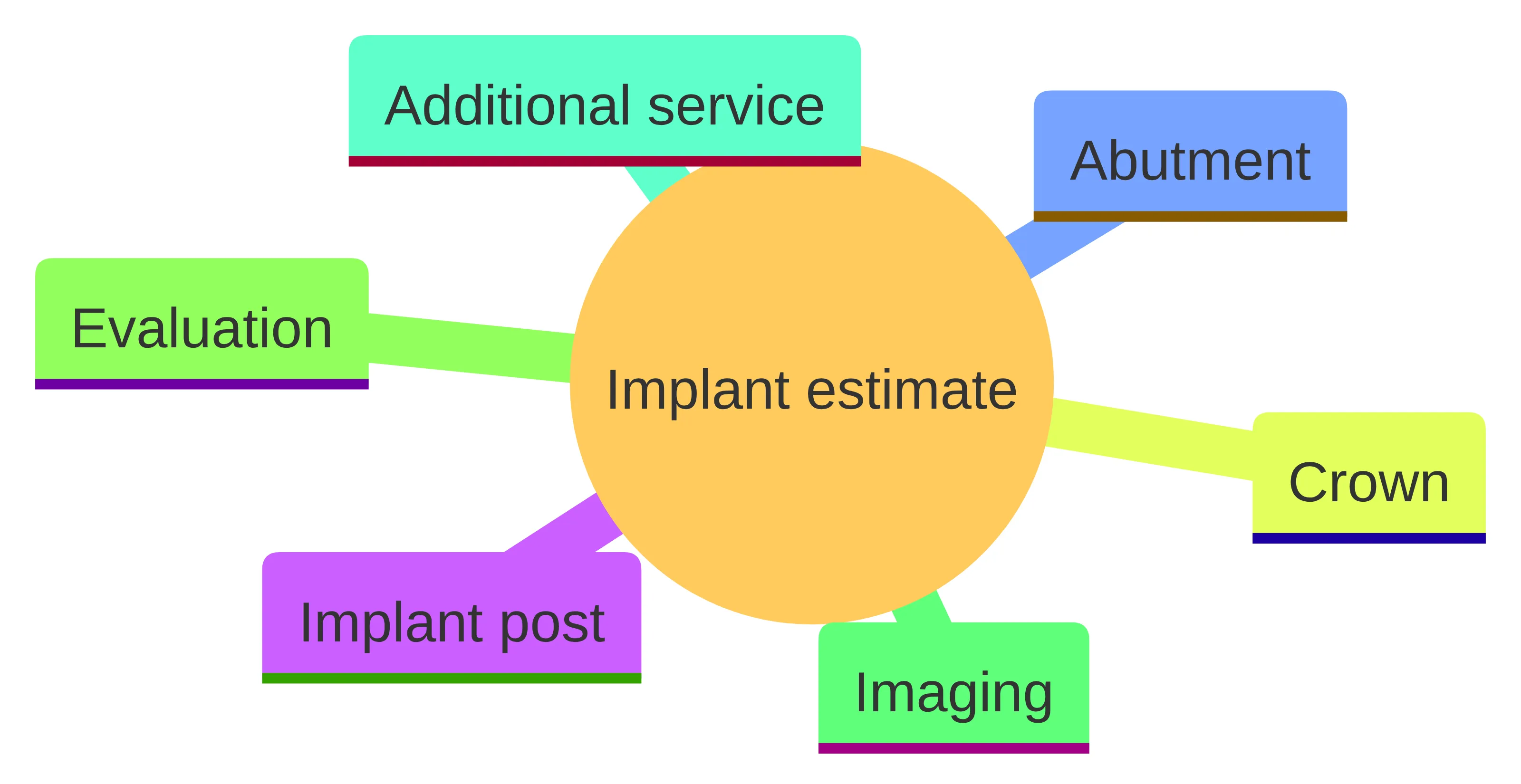
This worksheet does not calculate coverage by itself. It gives you a place to record the answers without blending the implant post, abutment, crown, imaging, examination, or possible additional services into one unexplained total.
For every line, ask: “Is this part of the proposed implant plan, and is it included in the amount shown?” Then ask whether the insurer will consider that specific service under your plan. A practice estimate may be useful for understanding the proposed treatment, but it may not capture every plan detail. Keep the office’s treatment description and the plan’s benefit response in separate columns until you reconcile them.
A complete estimate should let you trace each amount to a service, a stage, and a responsible party. If the document uses a combined label such as “implant restoration,” ask which of the post, abutment, and crown are included and whether the same office or another provider supplies each part. If imaging, examination, or records are listed separately, keep them as separate lines even when they occur during the same visit. Clear labels matter because insurance questions attach to services, not to a vague total.
Build the estimate around multiple appointments and stages
A multi-appointment plan calls for a multi-line estimate. Implant placement typically takes place over several months and multiple appointments, so the date of one service may not be the date of the next service. That timing can affect which benefit information you are using and whether the estimate still reflects the plan rules in effect when treatment is provided.
Use the practice’s proposed sequence as your map. You can organize the conversation into these questions:
- What happens at the evaluation and planning visit?
- Which imaging or examination services are included, and which are billed separately?
- When is the implant post proposed?
- When is the abutment discussed?
- When is the crown discussed?
- Is any additional service proposed before, between, or after those components?
These labels are planning prompts, not a prediction of which services you personally need. The written plan should identify the actual components being proposed for you.
Record the expected timing beside each line. A preauthorization’s outlined benefit may be subject to the allowable benefits in effect on the date of service. That means an insurer response connected with an earlier submission should not be treated as a timeless statement about every later appointment.
For budgeting, total the unresolved amount by stage rather than writing one number at the top of the page. Your worksheet can show:
- What may be due at the evaluation or planning stage.
- What may be connected with implant placement.
- What may be connected with the abutment or crown.
- What remains conditional because a service has not yet been proposed or confirmed.
Use a blank or “awaiting response” label where the amount is not known. Do not convert an unknown amount into zero, and do not treat a benefit estimate as cash that has already been approved.
If you want greater planning clarity, ask whether a pre-determination is available for the proposed treatment and keep its response with the matching written estimate.
Add a date field to every stage, even when the appointment date is only approximate. Note whether the line is planned, submitted, answered, or still pending. This gives you a practical way to spot a response that applies to an earlier stage but not to a later one. When treatment spans several months, ask which information needs to be refreshed before each stage rather than carrying one early response across the entire plan.
Separate proposed components from possible additional services
A proposed implant component and a possible additional service belong in different parts of your worksheet. A bone graft, for example, may restore jaw structure after trauma, tooth loss, or gum disease and may improve eligibility for an implant. That does not mean a bone graft is part of every implant plan or that it should be added to your estimate without a specific recommendation.
Ask the dental practice to identify whether a bone graft is:
- Proposed now.
- Being considered only after further evaluation.
- Not part of the current plan.
If it is proposed, ask for its own description, timing, fee, and insurance question. If it is only a possibility, mark it as conditional. This keeps a possible service from quietly becoming part of your expected total while still leaving space for the plan to change if the dental professional recommends it.
Evaluation and imaging should remain separate lines in the estimate. Ask which services relate to the implant discussion and which are routine practice components. Keep routine services outside the implant treatment total unless the written plan connects them.
Use two headings in your notes: “Proposed treatment” and “Possible additional services.” Under the first heading, list only what the written plan identifies. Under the second, list questions that need a dental professional’s answer. This simple boundary helps you compare insurance information against a defined plan instead of against a collection of hypothetical charges.
If an additional service changes from possible to proposed, give it a new line rather than editing it into an existing component. Record why it was added, when it would occur, and whether the insurer needs a separate submission. A bone graft may affect implant eligibility, but that clinical question and its financial effect should remain tied to the specific recommendation instead of being assumed from the word “implant.”
Read the plan for implant coverage, exclusions, and limitations
A plan described as full-coverage dental insurance may not include implant benefits. Coverage depends on the specific plan. Read the plan’s covered-procedure language rather than relying on the plan label, and look for specific language about dental implants.
Review three parts of your plan documents:
- Covered procedures: look for language that addresses dental implants or the proposed components.
- Exclusions: check whether implants or related services are listed as not covered.
- Limitations: look for conditions that restrict how the benefit applies.
If the plan does not mention implants in the covered list, check the exclusions and limitations as well. The absence of a familiar plan label does not answer the implant question; the relevant wording does.
Your possible responsibility can also be affected by plan details such as the deductible and annual maximum. A dental office’s estimate may not capture every detail of your plan. Ask the insurer how those details apply to the particular components and dates in the proposed plan, then record the answer beside the corresponding line item.
Read the plan in the same order as the treatment estimate. If the estimate lists a post, an abutment, and a crown, do not stop after finding the word “implant.” Ask about each listed component. If the estimate includes an evaluation or imaging service, ask whether the insurer handles that service under the same benefit category or under different plan rules. Keep the insurer’s wording with your notes instead of paraphrasing it into a broader promise.
The practical result is a coverage map, not a yes-or-no label. For each line, mark the answer as covered under the stated conditions, excluded, limited, or awaiting a plan-specific response. Use the unresolved categories honestly. They show where a benefits conversation is still needed.
Keep four separate fields for each service: the practice amount, the plan’s stated treatment category, the conditions attached to the benefit, and the amount still unresolved. This prevents a covered-procedure reference from being mistaken for a final payment amount. It also gives you a precise question when the plan language is unclear: ask which condition applies to which component and date.
Ask whether a missing-tooth exclusion applies
A missing-tooth exclusion may prevent coverage when the tooth was lost or extracted before the current dental coverage started. This is a plan-specific issue, so the fact that your plan mentions major services or full coverage does not answer it by itself.
Ask the insurer these focused questions:
- Does the plan contain a missing-tooth exclusion or clause?
- Does it apply when the tooth was lost before the current coverage began?
- Does it apply when the tooth was extracted before the current coverage began?
- What date or record does the insurer use to assess that condition?
- Which proposed components are affected if the exclusion applies?
Write the answers using the insurer’s terms and keep the date connected with the coverage question.
Do not treat the missing-tooth question as proof that the entire plan will or will not contribute. Implant benefits are not standard in most plans described as full-coverage dental plans, and the plan’s exclusions and limitations still control the specific situation. Ask for the answer against your proposed treatment, then place it beside the affected estimate lines.
If you do not know the exact loss or extraction date, record that as an unanswered question rather than guessing. Ask the practice whether prior records or X-rays may help document the treatment history, then ask the insurer what information it accepts for the exclusion review. Keep this issue attached to the affected tooth and proposed component, not to the entire treatment estimate by default.
Request benefits verification before authorizing treatment
Benefits verification gives you a plan-focused starting point before treatment. We provide verification of benefits before treatment. Use that step to connect your insurance information with the proposed implant components and to identify questions that still require an insurer response.
Before the conversation, have your treatment worksheet ready. Include:
- The proposed component or service.
- The practice’s description of that component.
- The expected stage or appointment.
- The amount shown on the written estimate.
- The plan question attached to that line.
Ask for the response in the same order. A list of general plan benefits is harder to use than an answer that identifies how the proposed services relate to the plan.
Ask whether the response addresses dental implants specifically, whether it addresses the abutment and crown separately, and whether exclusions or limitations affect the proposed treatment. Ask how the deductible and annual maximum factor into the response. A dental office may not know all of those plan details, so the insurer’s plan-specific explanation matters.
Record the date of the verification, the name or department that provided it, and the exact question answered. Then mark each estimate line as addressed or unresolved. This is an organizing method, not a guarantee that the amount shown will be paid.
Keep the distinction clear: benefits verification helps you investigate the plan, but a pre-determination is still an estimate rather than a guarantee of payment. Do not authorize treatment on the assumption that a preliminary response fixes your final responsibility.
Use benefits verification as a sequence rather than a single yes-or-no call:
- Give the practice the proposed services and your insurance information.
- Match the response to each treatment line.
- Mark missing, conditional, or unclear answers.
- Send the remaining questions to the insurer.
- Keep the response with the written estimate.
This process separates information gathering from authorization. It also shows you exactly which part of the financial picture still needs a direct answer.
Use predetermination to reduce uncertainty without treating it as a guarantee
Ask the practice and insurer whether a pre-determination can be prepared for the proposed components. Give the request a defined scope: identify the implant-related services, the expected sequence, and the written estimate lines that should be considered. If a response addresses only one component, do not apply it automatically to the rest.
Use the response in three passes:
- Match each insurer response to the corresponding estimate line.
- Mark any line that has no matching response.
- Record the assumptions, conditions, and unresolved plan details beside the response.
Timing remains part of the calculation. Ask how the insurer handles a response when an appointment occurs later, especially when the proposed treatment extends over several months.
Your decision point is not “Did the insurer approve the entire implant?” Instead, ask whether you understand which parts of the proposed plan have an insurer estimate, which conditions remain, and which amount is still unresolved. If those answers are incomplete, continue the cost conversation before authorizing care.
A useful pre-determination packet should have a defined scope. Keep the treatment description, the component or service being considered, the anticipated stage, and the practice amount together. When the response arrives, check whether the insurer addressed that same scope. A response to a single submitted service cannot automatically answer an unsubmitted service or a later stage.
Distinguish preauthorization from predetermination
Preauthorization and predetermination are different payer processes, so do not assume the terms mean the same thing. Ask which process the insurer is using and what the response represents for your proposed treatment.
Use precise questions:
- Is this response a preauthorization or a predetermination?
- What services and codes does it address?
- Is the stated benefit an estimate, a condition-based response, or another type of payer communication?
- Which allowable benefits apply on the date treatment is provided?
- Does the response address every stage or only the submitted stage?
Keep the answer attached to the document you received. A familiar word used loosely can lead you to compare unlike responses.
The date-of-service point deserves special attention. The benefit outlined in a preauthorization can be affected by the allowable benefits in effect when treatment is provided rather than only by the benefits in effect when the request was submitted. Ask how that condition applies if your implant plan moves from one appointment to another.
If the insurer or practice uses both terms, write each term in your worksheet exactly as provided and give each response its own line. Do not merge them into one general category called “insurance approval.” That small distinction keeps your expectations tied to the actual communication you received.
When a response includes conditions or a date-of-service qualification, copy those details into your notes beside the affected line. Do not reduce the response to a percentage or a single word such as “approved.” The condition may be the part that determines whether the amount applies to the appointment you are planning.
Compare a line-item estimate with the insurer’s response
A written practice estimate and an insurer response answer different parts of the cost question. The practice estimate describes the proposed treatment and the amounts the practice associates with it. The insurer response describes how the plan may treat submitted services under stated conditions. Use both documents to compare the proposed treatment with the plan information.
| Shared question | Written practice estimate | Insurer response |
|---|---|---|
| What does this document identify? | The proposed service, component, stage, and practice amount. | The plan’s response to the submitted service or proposed treatment. |
| What should you match? | The implant post, abutment, crown, evaluation, imaging, or other listed service. | The same component, service description, and relevant conditions. |
| What may remain unresolved? | Plan details such as the deductible, annual maximum, exclusions, and limitations. | The practice’s final bill, a service not submitted, or a later date of service. |
| How should you use it? | Treat it as the treatment-side line-item record. | Treat it as plan information to compare with the matching line. |
| What should you not assume? | That the practice amount alone determines your final responsibility. |
Start at the top of both documents and compare one line at a time. If the practice estimate names a crown but the insurer response mentions only an implant, mark the crown as unresolved. If the insurer response mentions a deductible or annual maximum that the practice estimate does not show, add that information to your responsibility notes rather than changing the practice fee.
When the documents do not line up, sort the difference into one of four categories:
- Different treatment descriptions.
- Different stages or dates.
- A service appearing on only one document.
- A condition or limitation appearing in only the insurance response.
Then ask a focused question about that category. Avoid asking only, “What is my total?” A total can change when one missing component or condition is added.
Finish by writing three numbers only when the documents support them: the practice amount, the insurer’s estimated contribution, and the remaining amount shown or calculated under the stated assumptions. If one of those is unavailable, label it as unresolved. A pre-determination remains an estimate rather than a guarantee, so keep that qualification beside any amount you record. When more than one stage has an insurer estimate, also record the deductible and annual maximum assumptions beside each response before adding estimated contributions. Do not treat separate responses as one combined benefit figure if their assumptions differ or if the insurer has not explained how the stages relate. In that situation, leave the combined amount unresolved and ask for a stage-by-stage explanation. This preserves the difference between an amount that appears in a document and a total you can responsibly use for planning.
For example, if your written estimate contains separate lines for the implant post, abutment, crown, and imaging, compare each line with the insurer’s response separately. If only the post appears in the response, do not spread that answer across the abutment, crown, or imaging. Mark those lines as unanswered and ask whether they require separate benefit treatment or a separate submission. The point of the comparison is not to manufacture a total; it is to show which parts of the total have support and which parts remain open.
Ask the practice and insurer the same cost questions
Using parallel questions helps you find gaps between the treatment plan and the benefit response. Ask the practice to describe the proposed care, then ask the insurer how the plan treats those same services. Keep the questions concrete enough that each answer can be placed beside a line on your worksheet.
Ask the dental practice:
- What components are included in the proposed implant plan?
- Is the implant post listed separately from the abutment and crown?
- Which examination or imaging services are included in the first visit?
- Is a bone graft proposed, conditional, or not part of the current plan?
- Which stage or appointment does each amount belong to?
- Which services will have a separate estimate if the plan changes?
- Can you provide the treatment description and amounts in writing?
- What information should be sent for benefits verification or a pre-determination?
We provide verification of benefits before treatment, and our first visit includes a written treatment plan along with the listed examination and imaging services. Ask for the written information that lets you compare those practice details with the insurer’s response.
Ask the insurer:
- Does the plan specifically address dental implant benefits?
- Which proposed components are covered, excluded, or limited?
- Does a missing-tooth exclusion apply to the date the tooth was lost or extracted?
- How do the deductible and annual maximum affect the proposed services?
- Is the response a preauthorization or a predetermination?
- Does the response apply to every stage or only the submitted services?
- What conditions apply on the date of service?
- What amount does the plan estimate you may owe under the stated assumptions?
A full-coverage label does not answer these questions because implant benefits depend on the specific plan. Ask for the response against the actual proposed treatment, not a general description of the policy.
After both conversations, reconcile the answers in writing. Put the practice’s description in one column, the insurer’s response in another, and your unresolved question in a third. If the answer changes because the service date or treatment stage changes, record that condition instead of compressing it into a single expected percentage or total.
Ask the same question in the same order whenever you move between the practice and insurer: What service is being discussed, at what stage, on what date, under which plan condition, and what amount remains unresolved? This wording makes vague answers easier to identify. If either side answers only part of the question, preserve the unanswered parts instead of treating the conversation as complete.
Prepare documents for the implant cost conversation
Keep digital or paper copies of the documents you use. Give each page a simple description, such as “practice estimate,” “benefits response,” or “plan exclusion.” Put the date beside each response. If a later appointment involves a different component or date, you can see which document answered which question.
Our first visit produces a written treatment plan, with a professional cleaning if gum health allows. Bring your questions and records so the visit can distinguish the information needed for evaluation from the separate financial questions that still require plan-specific answers.
Create one folder for the proposed treatment and one for insurance communications. In the treatment folder, keep the written plan, component descriptions, and practice amounts. In the insurance folder, keep plan language, verification notes, and any preauthorization or pre-determination response. This arrangement makes it easier to compare matching documents without treating an administrative message as a replacement for the treatment estimate.
Keep administrative practice information separate from the implant total
Practice information can help you plan how to begin the conversation, but it is not the same as an implant price or a coverage determination. We provide verification of benefits before treatment. We accept 14 in-network PPO carriers, and we file out-of-network claims for patients.
Those administrative facts do not establish that your plan covers an implant or that a specific component will produce a specific patient responsibility. Implant benefits depend on the specific plan, and a full-coverage plan may not include implant benefits. Keep carrier participation, claim filing, benefits verification, and treatment pricing in separate sections of your notes.
A carrier list tells you where the practice has in-network participation; it does not identify the benefits attached to your individual policy. Claim filing tells you how paperwork may be handled; it does not determine whether a service is covered or what amount remains. Keep those facts in an administrative section of your worksheet, away from the line-item calculation for the proposed implant treatment.
Use the written plan to decide whether you are ready to proceed
Before authorizing treatment, make sure your notes answer these questions:
- What implant-related components are proposed?
- Which services belong to each appointment or stage?
- Is a bone graft or another additional service proposed, conditional, or outside the current plan?
- What does your plan say about implants, exclusions, limitations, and a missing-tooth exclusion?
- Have you received benefits verification for the proposed treatment?
- Is there a pre-determination, and have you kept its estimate separate from a payment guarantee?
- If you received a preauthorization, do you understand how the date of service may affect the outlined benefit?
- Does every insurer response match a line on the written practice estimate?
- Which amount remains unresolved?
A reliable planning record does not promise a particular price. It shows exactly what has been proposed, what the plan may address, what conditions apply, and what you may still need to ask. If the documents do not line up, pause the financial decision and ask for the missing explanation rather than treating the gap as an amount you will automatically owe or the insurer will automatically pay.
Once you have the written treatment plan, the benefits information, and the questions that remain, you can request a consultation focused on both clinical planning and your expected financial responsibility.
What should you confirm before authorizing a tooth implant?
What factors influence the cost of a tooth implant with insurance?
The cost of a tooth implant can vary based on several factors, including the specific components of the treatment (such as the implant post, abutment, and crown), the dental practice’s fees, and the details of your insurance plan, including coverage limits and exclusions.
How can I verify my dental insurance benefits for an implant?
You can verify your dental insurance benefits by contacting your insurer directly and asking for a benefits verification specific to the proposed implant treatment. It’s helpful to have a written estimate from your dental practice to reference during this conversation.
What is a missing-tooth exclusion in dental insurance?
A missing-tooth exclusion means that your dental insurance may not cover the replacement of a tooth that was lost or extracted before your current coverage began. It’s important to check if your plan includes this exclusion and how it may affect your implant coverage.
How does a pre-determination of benefits work for dental implants?
A pre-determination of benefits is an estimate provided by your insurer regarding what they may cover for your dental implant treatment. However, it is not a guarantee of payment, and the actual coverage may vary based on the specifics of your treatment and the plan’s rules at the time of service.
What questions should I ask my dental practice about the implant treatment plan?
You should ask about the specific components included in the treatment plan, whether the implant post, abutment, and crown are listed separately, and what additional services may be required. It’s also important to inquire about the estimated costs and how they relate to your insurance coverage.
How can I prepare for the financial aspects of my implant treatment?
To prepare for the financial aspects, create a worksheet that outlines each proposed component of the treatment, the associated costs, and the questions you have about insurance coverage. This will help you keep track of what is covered and what your potential out-of-pocket expenses may be.
Need help applying this?
Talk to a billing specialist who knows your payer mix.
Westborough Dental Care welcomes new patients in South San Francisco. Book a visit to meet Dr. Zoulas and the team.
Schedule a meeting