
negative reviews on dental implants
Negative Reviews on Dental Implants: How to Decide What Deserves Follow-Up

Treat a negative review as a question, not a verdict
A negative dental implant review describes one person’s experience, not the typical result of treatment or a complete assessment of a practice. The useful question is not whether the review sounds alarming; it is what the complaint was, when it happened, what part of treatment it involved, and whether the concern received a clear response.
A practical first pass separates four different questions:
- What happened? Look for a concrete complaint rather than a general statement that treatment was bad.
- When did it happen? A concern during healing is different from a problem after the restoration has been in use.
- What was the person expecting? Disappointment about duration, discomfort, appearance, or cost may reflect an expectation that was never made specific.
- What happened afterward? A review that explains how the practice responded gives you a different question to investigate than a review with no treatment details.
This approach keeps a strong emotional reaction from deciding for you. Save the review’s date and details if they raise a concern, then use those details to frame a dental conversation.
Patient expectations can be unrealistic, and a systematic review reported that dentists remained the main information source for implant patients in the cited literature. A consultation can clarify what treatment is intended to address, which alternatives exist, how long treatment may take, and what its disadvantages may be. If a review gives you a specific concern, carry the concern forward as a question rather than treating the post as a final judgment.
Name the concern behind the complaint
Dental implant complaints become easier to assess after you place them in a treatment stage. Implant consultation guidance identifies diagnosis, alternatives, surgical and restorative steps, possible bone grafting, treatment duration, costs, discomfort, limitations, maintenance, and follow-up as topics for discussion. Use those topics to sort what a review is actually describing.
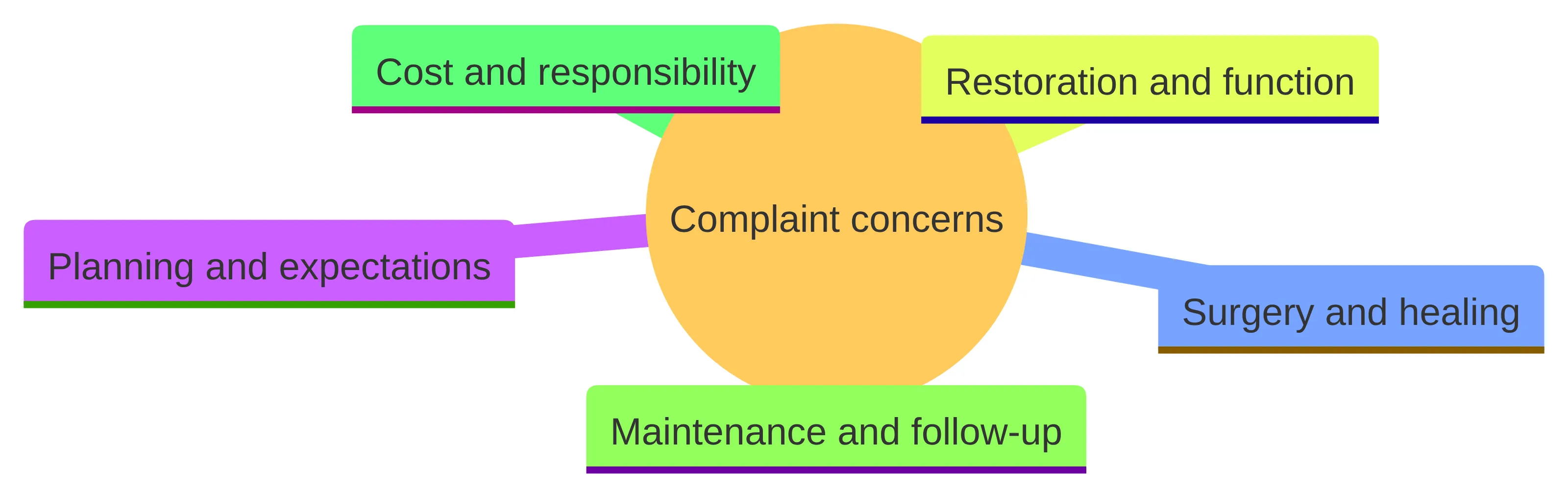
Use these complaint categories as a reading tool:
- Planning and expectations: The review may concern the original diagnosis, the expected result, treatment length, or the difference between an implant and alternatives such as a bridge, partial denture, or no treatment.
- Surgery and healing: The concern may involve the surgical steps, possible bone rebuilding, expected discomfort, medication instructions, or the period before the replacement tooth is finished.
- Restoration and function: The complaint may relate to the restorative stage, the crown, the purpose of each treatment step, or a result that did not match the person’s understanding of the plan.
- Maintenance and follow-up: The review may describe home oral hygiene, follow-up appointments, biological complications, or uncertainty about what happens after treatment is completed.
- Cost and responsibility: The concern may involve the estimated cost, factors that changed it, maintenance expenses, or financial responsibility if treatment fails.
A category does not tell you whether the care was appropriate. It tells you which question needs a more precise answer.
A review that says “the implant failed” leaves several possibilities open because failure can be discussed at different points in treatment. Write down the complaint in plain language, then identify the stage, the time from placement, the symptoms or practical problem described, and the action taken afterward. Take that short summary to an evaluation instead of trying to assign a diagnosis from the post.
Read the details that make a review more informative
Review detail determines how much weight a complaint deserves as a question for your own decision. A specific account can help you identify an issue to discuss, while a vague account may still reflect real frustration but gives you little basis for comparing it with your circumstances.
Check five details before drawing a conclusion:
- Specificity: Does the review name the concern, such as unexpected treatment length, a follow-up problem, discomfort, cost, or a change in the restoration?
- Timeline: Does the account say whether the concern arose before the restoration, during healing, or after the implant had been functioning?
- Treatment scope: Does the account involve a single missing tooth, several implants, a graft, a temporary restoration, or a completed crown? Different plans can create different stages and obligations.
- Firsthand detail: Does the person describe personal treatment, or does the review repeat a story about somebody else?
- Response and outcome: Does the review explain whether the practice examined the concern, offered follow-up, discussed alternatives, or clarified responsibility?
These details do not prove that a complaint is correct. They help you decide what to ask and whether the issue relates to the treatment you are considering.
Clinical terms also need a timeline. One cohort study defined implant failure as removal of an implant for any reason and classified failure before loading as early and failure after loading as late. A reviewed analysis described early failure as generally involving disrupted osseointegration and late failure as more often involving peri-implant inflammation or excessive load. These definitions describe study outcomes; they do not allow you to label a complaint from a review.
A useful review note has four lines: the exact complaint, the treatment stage, the time reference, and the follow-up described. If the post supplies none of those details, treat it as a prompt to investigate rather than as a reason to accept or reject treatment.
Look for corroboration without counting stars
Corroboration means finding the same specific question in more than one independent account, not adding up star ratings. A pattern of detailed complaints about a particular stage may deserve attention, but repeated online wording still cannot establish how often that problem occurs or whether it would apply to your treatment.
Use a simple comparison process:
- Record the complaint in concrete terms rather than copying the emotional language around it.
- Check whether the accounts describe the same service, treatment stage, and time period.
- Separate firsthand experiences from comments that repeat another person’s story.
- Look for dates so older accounts are not treated as descriptions of present conditions.
- Note whether the accounts describe an attempted resolution, follow-up, or explanation.
- Check whether several posts appear to repeat the same original account rather than provide independent experiences.
The aim is to find a question worth asking, not to produce a score.
A pattern becomes more useful when the wording is specific and the circumstances are comparable. For example, several independent accounts may raise a question about how treatment length was explained, how follow-up was organized, or how costs changed when additional stages were proposed. Those accounts still do not tell you whether the underlying clinical decisions were appropriate. They tell you what to request in writing during a consultation.
A practice’s response can add context, but a response cannot settle a clinical question for you. Bring a repeated concern to the consultation and ask how the proposed plan addresses it, what limitations apply, and what follow-up would be available if the concern occurred. If the answer remains unclear, compare the explanation and treatment plan rather than relying on the number of stars.
Compare review patterns with what studies can actually show
Clinical studies can help you translate a review into a category, but they cannot confirm what happened to a particular person. One cohort study separated implant removal before loading from removal after loading, while a reviewed analysis associated early failure mainly with disrupted osseointegration and late failure more often with peri-implant inflammation or excessive load. A review describing a loose implant, inflammation, or a restoration problem therefore raises different questions depending on when the problem occurred.
A systematic review of 14 eligible studies grouped reported late-failure factors into patient history, clinical parameters, and clinician decision factors. The review reported associations with factors including radiation therapy, periodontitis, bruxism, prior early failure, posterior implant location, and grade-4 bone.
Expectations can also shape the tone of a review. A clinical review cited peri-implantitis prevalence estimates ranging from 1% to 47% and said bone-loss onset was usually within three years of function among affected implants. The broad range reflects variation in the underlying evidence and definitions, so it is not a personal risk prediction. Unrealistic expectations can occur, which makes a detailed discussion of duration, limitations, alternatives, and maintenance part of the decision rather than an optional extra.
Use clinical information to sharpen your questions. Do not use it to diagnose the person described in a review or to predict your own result. If a complaint appears related to inflammation, loading, healing, smoking, radiotherapy, or another risk factor, ask how that factor would affect the proposed plan and follow-up.
Keep failure numbers in their setting
Failure numbers describe the population, treatment, definitions, and follow-up used in a study. In one Israeli national-HMO study of 158,824 implants in 53,874 patients from 2014 through 2022, the overall failure rate was 2.21% and the early failure rate before prosthetic reconstruction was 1.56%. Those figures came from that registry and may not apply to every implant type or setting.
The same Israeli registry reported failure rates of 2.53% in male patients, 3% in the maxillary molar region, and 3.37% in the central incisor region. The study described the two site-specific rates as approximately double those of other sites, but these were study-specific associations rather than individual predictions. A review mentioning a location or patient characteristic cannot be converted into your personal percentage.
A reviewed analysis reported early-failure incidence of 0.7%–4% in the literature it examined, while noting that definitions and populations may vary. In a separate retrospective analysis of 107 implants, failure patterns were statistically associated with gender, medical conditions, and smoking; lack of osseointegration and lack of primary stability were among the reported patterns. The 107-implant analysis was not a universal rate.
A small 10-year follow-up study of 15 patients reported signs of implant failure in five patients. Four failed implants had pain, discharge, and mobility, while two other implants loosened without intraoral symptoms at about 5 years 4 months and 11 years 6 months. That observation shows why symptoms and timing deserve discussion, but it does not establish population-level symptom frequency.
When a review or article gives you a number, ask six context questions:
- What population was studied?
- Where was the study conducted?
- What implant and treatment stages were included?
- How did the study define failure?
- How long were patients followed?
- Does the setting resemble the plan being considered?
A number without those details can sound more precise than it is. Use the number to frame a conversation, not to decide candidacy or dismiss a concern.
Use risk factors to plan a more careful conversation
Risk factors are reasons to make an evaluation more detailed, not automatic reasons to rule treatment in or out. The late-failure review grouped factors by patient history, clinical parameters, and clinician decisions. Its reported associations included radiation therapy, periodontitis, bruxism, prior early failure, posterior location, and grade-4 bone.
These findings do not decide your eligibility.
Prepare a personal risk discussion by writing down the factors that may affect planning, then ask how each factor changes the proposed sequence, alternatives, maintenance, and follow-up. You can ask:
- Which part of the plan is affected by this history or condition?
- Does the concern change the timing, treatment stage, or monitoring plan?
- What alternative treatments should be compared?
- What signs or changes should prompt follow-up?
- How would the plan change if healing or stability did not proceed as expected?
The purpose is to expose conditions and contingencies before treatment is authorized. It is not to apply a study association to yourself without an examination.
Your symptoms, anatomy, medical history, and treatment options require individual assessment. A review can point you toward the right topic, but it cannot determine whether a particular factor is present, how it affects your plan, or which alternative fits your needs.
Turn credible complaints into consultation questions
Consultation questions turn online concern into information you can use. Implant guidance identifies the diagnosis, non-implant alternatives, implant alternatives, surgical and restorative steps, possible bone grafting, advantages and disadvantages, costs, treatment duration, and factors that may lengthen or shorten treatment as topics for discussion.
Start with the plan itself:
- What diagnosis or missing-tooth problem is the proposed treatment intended to address?
- What are the non-implant alternatives, including no treatment, a partial denture, or a bridge where appropriate?
- What implant approaches or restorative alternatives apply to this situation?
- What surgical steps and restorative steps are planned?
- Could bone grafting or another additional surgical step be needed?
- What is the purpose of each stage?
- What are the main advantages, disadvantages, and limitations of each option?
The answers should connect the review concern to a defined part of treatment. If a complaint involved an unexpected stage, ask which part of your proposed plan could create a similar change and how that change would be handled.
Clarify the timeline before you compare promises:
- How long is the expected treatment from the first stage through the final restoration?
- Which appointments are needed, and how often do they occur?
- What could make treatment longer or shorter?
- What discomfort or period of limited denture comfort should you expect?
- What care is needed after each procedure?
A consultation checklist described a straightforward overdenture case as generally taking 3 to 4 months from implant placement to delivery, but that timeframe is case-dependent and should not be applied to every implant plan. Ask for the sequence that applies to your proposed treatment.
Make long-term care part of the initial decision:
- What home oral-hygiene steps are required?
- What follow-up schedule is expected?
- What follow-up costs should be anticipated?
- What are the consequences of missing follow-up?
- What biological complications could occur?
- Which signs should lead you to contact the practice?
These questions address a common gap in negative reviews: the assumption that treatment ends when the replacement tooth is delivered. Maintenance and follow-up belong in the plan from the start.
Separate the financial questions from the clinical questions:
- What is the estimated cost of each treatment stage?
- Which factors could increase or decrease the estimate?
- Are maintenance costs separate from the initial treatment?
- What kinds of failure or additional treatment would be financially covered, and what would remain your responsibility?
- What happens if the plan changes after an examination or during treatment?
The consultation guidance identifies cost, maintenance, possible biological complications, and financial responsibility for failures as discussion topics. A written, stage-by-stage explanation gives you something concrete to compare if you seek another evaluation.
Bring a short review summary to the appointment: the complaint, treatment stage, timing, and reason it concerns you. Then use the answers to compare plans, not personalities. A clear discussion of alternatives, limitations, follow-up, and responsibility can resolve uncertainty that a review cannot.
Choose the next step from the uncertainty that remains
Your next step should match the kind of uncertainty left after you sort the reviews. Online complaints are useful when they help you form specific questions; they are weak grounds for a treatment decision when they provide no timeline, treatment details, or follow-up context.
Use these boundaries:
- Postpone a decision: If the concern is vague, the treatment plan is unclear, or the proposed alternatives and responsibilities have not been explained, pause before authorizing treatment and request those details.
- Compare options: If several specific reviews raise questions about treatment stages, follow-up, costs, or alternatives, compare complete plans and explanations rather than star totals.
- Contact a dentist promptly: If you have pain, discharge, or mobility around an implant, arrange follow-up rather than using a review to interpret the symptoms. A small follow-up study reported those findings in failed implants, but the findings do not diagnose your condition.
- Schedule an evaluation: If risk factors, anatomy, medical history, or treatment alternatives are central to your concern, take your questions to an appointment where those issues can be assessed.
A qualified dental professional must decide individual suitability after considering your symptoms, anatomy, medical history, and treatment options.
A thoughtful implant decision does not require ignoring negative reviews or accepting them as verdicts. Classify the complaint, check its details and timing, look for specific patterns, keep clinical numbers in context, and leave the consultation with clear answers about stages, alternatives, maintenance, costs, and follow-up. If you are considering care in South San Francisco or Daly City, bring that question list to a qualified dental evaluation.
What should you clarify before deciding what to do about a negative implant review?
How can I assess the quality of dental implant reviews?
To assess review quality, check for specificity, timeline, treatment scope, firsthand detail, and the response from the dental practice. These details help determine the relevance and reliability of the complaint.
What should I ask during a dental implant consultation?
During a consultation, inquire about the diagnosis, non-implant alternatives, surgical and restorative steps, potential need for bone grafting, treatment duration, costs, and maintenance requirements.
What factors might increase the risk of dental implant failure?
Factors that may increase the risk of failure include smoking, previous radiation therapy, periodontitis, bruxism, and certain clinical parameters like posterior implant location and bone quality.
How do I interpret the failure rates of dental implants?
Failure rates are context-specific and depend on the population studied, treatment definitions, and follow-up duration. It’s important to consider these factors rather than applying general statistics to individual cases.
What steps should I take if I have concerns about dental implants?
If you have concerns, consider postponing a decision for further clarification, comparing options based on detailed plans, or scheduling an evaluation to address specific risk factors and treatment suitability.
Need help applying this?
Talk to a billing specialist who knows your payer mix.
Westborough Dental Care welcomes new patients in South San Francisco. Book a visit to meet Dr. Zoulas and the team.
Schedule a meeting