dental implants treatment plan
Dental Implant Treatment Plan: What to Review Before You Agree to Treatment
Start with the restoration the plan is meant to support
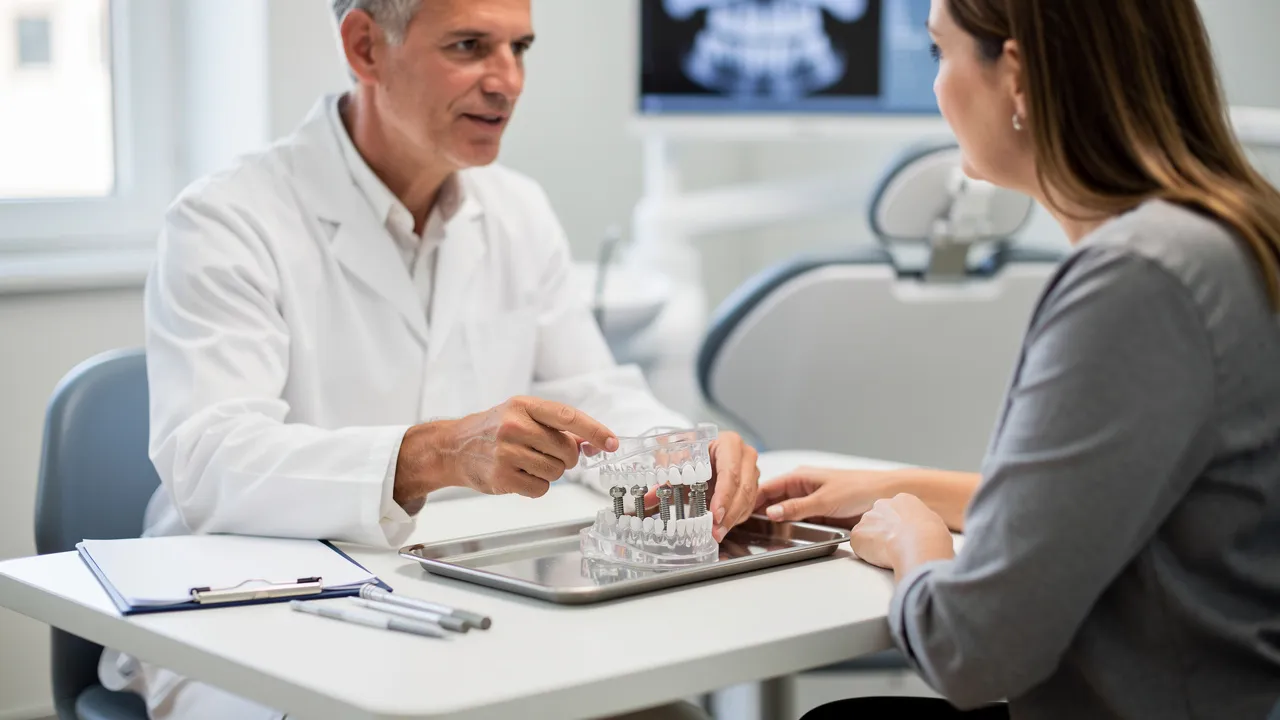
A dental implant treatment plan explains how missing teeth may be replaced with artificial teeth supported by one or more implants. An implant replaces the root of a missing tooth and can support a crown after it integrates with the surrounding bone; neighboring teeth generally do not need to be prepared for that replacement. The planned crown, bridge, or denture should guide the implant position rather than leaving the implant location to bone availability alone. That restorative-first approach keeps the proposed foundation connected to the tooth replacement you expect to use.
The restoration choice changes the questions you need to ask. An implant-supported denture or All-on-4 uses 4-6 implants to anchor a full arch; All-on-4 can be faster and can work with less bone, but that description does not decide whether it fits your anatomy or goals. A systematic review and meta-analysis included 16 randomized controlled trials with 543 participants and 1,595 implants comparing immediate loading with conventional loading in implant-supported removable prostheses. In that analysis, immediate loading had statistically significant lower survival rates than conventional loading in the reported analyses. Ask what restoration is planned, how it will be supported, and why the proposed loading approach fits your case.
A useful review starts with the finished restoration and works backward. Use these checkpoints before you agree to treatment:
- What tooth, bridge, or denture will the implant support?
- Where will the final restoration sit, and how will you clean around it?
- What diagnosis and imaging support the proposed position?
- Which preparation, alternatives, and stages are included?
- What risks, maintenance, and costs remain after placement?
Medical history also belongs in this first discussion. Ask how prior treatment could affect the proposed plan.
What the consultation needs to establish
A consultation typically includes a health review, an oral examination, imaging, and a personalized replacement plan. Your dentist may review your medical and dental history, medications, previous dental treatment, and the reason the tooth or teeth are missing. Imaging may help assess bone volume, bone density, nearby nerves, and sinuses. Bring up conditions or treatment that could affect healing rather than assuming that a routine-looking implant site tells the whole story.
Healthy gums and enough jawbone are described as the main requirements considered when implants may be appropriate, but a dentist must evaluate whether implants fit your situation. Planning also considers anatomical and prosthetic constraints, including bone quality, bone volume, and other restrictions at the site. Three-dimensional imaging and digital tools may help determine implant position while evaluating bone structure, nearby nerves, and bite forces. The final restoration matters here: the plan needs to connect the implant position with the way the crown, bridge, or denture will function and be maintained.
The consultation should leave you with a clear explanation of the proposed diagnosis, restoration, stages, appointment pattern, possible discomfort, alternatives, limitations, and follow-up. Ask which findings are established, which decisions still depend on additional evaluation, and what would cause the sequence to change.
Use imaging to answer planning questions
Implant imaging answers specific questions about the proposed site rather than serving as an automatic step for every person. Initial evaluation may use panoramic and intraoral imaging, followed by cross-sectional imaging when the implant site needs assessment. CBCT is described as the current method of choice for that cross-sectional assessment because it provides the greatest diagnostic yield at an acceptable radiation-dose risk. The decision to use CBCT should be based on your history, examination, and individualized need, with the benefit outweighing the potential risk.
CBCT may be used before bone reconstruction or augmentation to help plan grafting and related surgery. It can also be used when ridge preservation or bone grafting is needed for a bone-volume deficiency before or with implant placement. Radiographic images can create templates that guide implant surgery; guided surgery requires CT or CBCT imaging capable of providing DICOM data. Ask what question each scan is intended to answer, whether the result changes the implant position or restoration, and whether additional imaging is being proposed because of your anatomy or a planned procedure.
Treatment timing and imaging decisions should be discussed together when immediate loading is being considered. A systematic review and meta-analysis of 16 randomized controlled trials included 543 participants and 1,595 implants in comparisons of immediate and conventional loading for implant-supported removable prostheses. When implants were the statistical unit, the immediate-loading group had a statistically significant lower survival rate than the conventional-loading group, with a relative risk of 0.950 and a 95% confidence interval of 0.926-0.974. Ask how the evidence applies to the specific restoration and loading plan being proposed, rather than treating a faster pathway as automatically appropriate.

Identify preparation, alternatives, and decision branches
A dental implant plan can branch after the examination and imaging. If the ridge lacks adequate volume, a bone graft or, in the upper back jaw, a sinus lift may be recommended. When bone loss or active gum disease is present, preparatory treatment may be recommended before implant placement, such as grafting, a sinus lift, or treatment of inflammation. Another implant position, size, or restorative design may sometimes avoid grafting. Planning can also identify health issues that may interfere with healing, so gum disease or insufficient bone may need attention before placement.
The consultation may compare these paths:
| Option | What it may address | What to clarify |
|---|---|---|
| No treatment | Leaving the missing tooth or teeth untreated | Consequences of postponing or declining treatment |
| Partial or complete denture | Replacing one or more missing teeth with a removable option | Stability, comfort, cleaning, and future changes |
| Bridgework | Replacing a missing tooth when bridgework is possible | Support, preparation, cleaning, and restoration design |
| Implant-supported restoration | Supporting a crown, fixed bridge, or removable denture with implants | Bone, gum health, stages, maintenance, and loading plan |
These are decision branches, not a ranking. Ask why one option is being proposed, what it requires, and what boundary would make another option more suitable.
Medical history can change the preparation discussion. A complete evaluation, individualized plan, and informed consent are part of implant planning; diabetes, cardiovascular disease, poor bone quality, and periodontal problems may increase complication risk. Ask how each condition affects preparation, healing, the restoration choice, or follow-up. Do not treat a general list of risk factors as a personal eligibility decision.
Follow the proposed treatment sequence
The implant treatment sequence may include evaluation, any needed extraction or grafting, implant placement, healing and bone integration, abutment placement, impressions, and the final restoration. A typical pathway can be read in stages:
- Preparation: Address an extraction, gum condition, bone deficiency, or other finding when the plan requires it.
- Implant placement: Place the titanium post in the jawbone.
- Healing and integration: Allow the implant and surrounding tissues to heal while the implant fuses with bone.
- Abutment and tissue management: Connect the abutment when stability and tissue conditions support the next stage.
- Impressions and restoration: Use impressions to create and place the planned crown, bridge, or denture.
A temporary crown or restoration might be worn during healing, depending on the proposed treatment.
Published treatment ranges describe separate parts of the sequence rather than a promise for your case. Initial gum recovery is listed as approximately 1-2 weeks, bone integration as commonly 2-6 months, and overall treatment as often 3-9 months; grafting or complex treatment may take longer. Healing may take three to nine months in the cited consent information when clinical conditions require it. Restoration usually waits until the implant is stable, imaging and the surrounding tissues are satisfactory, and healing has occurred, which may take 3 to 6 months.
A straightforward case is described as one in which the desired tooth position is clear, anatomical risks are minimal, and significant hard- or soft-tissue grafting or anatomical modification is not needed. For a straightforward overdenture case, the cited patient information says treatment generally takes 3 to 4 months from implant placement until overdenture delivery. That range applies to the described overdenture situation, not to every crown, bridge, or full-arch plan. Ask which stage controls your schedule and what finding could add an appointment, graft, healing period, or restoration delay.
Connect candidacy and risk factors to the plan
Medical and dental history should be connected to a specific planning decision rather than listed without explanation. HbA1c above 8.0% may be associated with delayed implant integration, while findings about implant failure among people with diabetes varied across the reviewed studies. Ask what your history means for preparation, timing, monitoring, and alternatives.
Smoking is another factor to discuss plainly. A meta-analysis reported an association between smoking and oral-implant failure, with a relative risk of 1.80 and a 95% confidence interval of 1.53-2.11; the analysis included 4,816 oral implants in the smoking group and 8,847 oral implants in the non-smoking group. The figures describe associations in the analyzed groups, not a personal prediction. Before implant treatment, establish effective oral hygiene; the cited guidance also recommends smoking cessation.
Use risk information to improve the discussion, not to approve or reject your own treatment. Ask these questions:
- Which gum, bone, medical, or medication findings affect the proposed plan?
- Does any condition call for treatment before implant placement?
- How could healing concerns change loading, timing, or the restoration?
- What monitoring or follow-up would address the identified risk?
- What alternatives remain if the planned pathway changes?
A clear answer should connect each risk to an action, limitation, additional discussion, or alternative.
Treat maintenance as part of treatment, not an afterthought
Implants require home oral hygiene and professional follow-up. Maintenance planning may include three-month recare intervals, baseline and follow-up radiographs, mobility checks, and home-care tools. Ask for the proposed maintenance schedule, who will provide each check, which imaging may be used, and how maintenance costs are handled. The schedule should be part of the treatment discussion before placement.
Peri-implantitis is an infection around an implant that can cause bone loss and loosening if untreated; possible signs include redness, swelling, bleeding gums, pus, or a bad taste or odor. Possible long-term complications also include loss of retention, wear or corrosion of retentive elements, overdenture fracture, and abutment-screw loosening. Not adhering to supportive peri-implant therapy may lead to a need for more treatment with systemic antibiotics or surgery for peri-implant disease.
The cited guidance reports 77% peri-implant mucositis and 15% peri-implantitis among people with no structured peri-implant therapy; each percentage describes that same population and does not predict your result. More than 80% of implant-supported overdentures were reported to remain in continuous service after 10 years. The denominator is implant-supported overdentures, and the published figure does not guarantee the outcome of an individual case. Use these figures as reasons to ask about maintenance, not as promises about durability.
Read the estimate as an itemized treatment path
Implant costs can vary with the number of implants, preparatory procedures, technology and materials, dentist experience, practice location, insurance coverage, and financing terms. A full-arch implant-supported denture or All-on-4 treatment is reported to often cost roughly $15,000 to $50,000 per arch, depending on factors such as the number of implants, custom bridges, and bone grafting. A published estimate for a complete single-tooth implant typically ranges from about $3,000 to $4,800, including the post, abutment, and crown; extra procedures such as bone grafts or extractions can raise the total. These are published estimates, not a quote for your treatment.
Preparation can change both the sequence and the price. Bone grafting is needed when there is not enough natural jawbone to support an implant. One cited review reports ridge-width loss of 29% to 63% and ridge-height loss of 11% to 22% within 6 months of extraction; each percentage describes the reported ridge change during that period. A bone graft may add $500 to $3,000 to the total case cost, and it may be performed at the same visit as implant placement or months earlier as a separate procedure. Most single implants use local anesthetic only; IV sedation may be considered for anxiety, grafting, or multiple implants and may cost $300 to $700.
Ask whether the estimate separates the components of the proposed path. One published cost breakdown lists a titanium implant post at $1,800 to $2,800, an abutment at $400 to $1,200, and a crown at $1,200 to $2,200. The post is the screw placed in the jaw, the abutment connects the post and crown, and the crown is the visible tooth replacement. A written estimate should show which components, imaging, extraction, grafting, sedation, temporary restoration, follow-up, and maintenance are included or priced separately.
Resolve price differences before agreeing
Published single-tooth estimates vary because their scope can differ. One published cost breakdown lists CBCT 3D imaging, described as a surgical planning scan, at $200 to $500. The same breakdown lists $3,500 to $6,000 for a single tooth without a graft, including the post, abutment, crown, and scan. A published estimate places a complete single-tooth implant at about $3,000 to $4,800, including the post, abutment, and crown, without stating that imaging is included. The two ranges should not be merged into one universal price.
Use the difference to make the estimate more specific:
- Does the total include the post, abutment, crown, and imaging?
- Are extraction, grafting, sinus procedures, or sedation separate?
- Is the proposed restoration a crown, bridge, or removable denture?
- Which appointments and follow-up visits are included?
- What amount is estimated after insurance, and what remains your responsibility?
Bone grafting may be needed when the jawbone is too thin or has shrunk where a tooth is missing. Ask for a written estimate that states exactly what each figure covers before comparing totals.
Prepare questions and materials for the consultation
A consultation question list helps you leave with a proposed path rather than only a procedure name. Ask about:
- The diagnosis and the restoration the implant will support.
- The examination and imaging findings, including bone, gums, nerves, and sinuses.
- Alternatives such as no treatment, a denture, or bridgework when possible.
- The number, frequency, and duration of appointments.
- Implant type and material, expected discomfort, and possible limitations.
- Preparation, placement, healing, integration, abutment, impressions, and final restoration.
- Postoperative care, medications, maintenance, and follow-up.
- Possible complications and what happens if the implant or restoration fails.
- The approximate cost, insurance estimate, financing terms, and failure-related costs.
Ask the dentist to connect each answer to your proposed restoration and to identify which decisions depend on later findings.
Your first visit with us lasts about 60 to 90 minutes. Please bring your insurance card, current medication list, comfortable clothes, and any prior dental records or X-rays. Those materials can help the visit begin with a fuller health and dental history.
We publish UCR fees and provide written treatment plans with cost estimates for free. When we explain complex or expensive treatment, we provide a written take-home plan and an explicit insurance pre-estimate caveat. Ask for the proposed restoration, stages, included services, separate charges, and estimated insurance responsibility to appear in writing.

Know when a dental concern needs prompt help
Sudden pain, implant movement, infection, or damage to surrounding tissues warrant prompt contact with a dental professional. After implant surgery, contact the treating dental team promptly for severe or worsening pain after 48-72 hours, fever or chills, increasing swelling or drainage, a loose implant or prosthesis, new or worsening altered sensation, bleeding that will not stop, or persistent bad taste, odor, or difficulty chewing. Do not wait for a routine follow-up when a symptom is getting worse.
Contact a dental professional promptly for other serious or worsening concerns, and do not delay urgent care or try to self-treat a serious dental problem.
Postoperative instructions may include a liquid diet for the first 6 hours unless your dental team gives different instructions, no strenuous exercise for at least 1 week, prescribed medicines as directed, ice on the day of surgery, rest and fluids during the first 48 hours, and gentle brushing by the seventh day when the dental team reviews it. Follow the instructions given for your procedure rather than applying a general schedule to a different surgery.
Take the next informed step
A clear implant discussion should connect the planned restoration to the diagnosis, imaging, preparation, stages, maintenance, risks, and itemized estimate. Bring your insurance information, medication list, and prior records or X-rays, then ask for the proposed path in writing. We accept new patients and allow appointment requests through online booking or by calling directly. A qualified dentist must decide your individual suitability, treatment plan, and expected outcome after evaluating your clinical findings.
Questions to clarify before reviewing a dental implant plan
How should I compare two dental implant cost estimates?
Compare what each estimate includes, not just the total. Check whether it covers the implant post, abutment, crown, imaging, extraction, grafting, sedation, temporary restoration, follow-up, and maintenance. Published estimates differ in scope: a published cost breakdown lists about $3,500 - $6,000 for a single tooth with the post, abutment, crown, and scan, while another published estimate lists about $3,000 - $4,800 for the post, abutment, and crown without stating that imaging is included. Ask for an itemized written estimate and a separate explanation of insurance responsibility.
What should I bring to a dental implant consultation?
Bring your insurance card, a current list of medications, and any prior dental records or X-rays. Also prepare a short list of health conditions, previous dental treatment, concerns about discomfort or healing, and questions about alternatives, stages, maintenance, and costs. This gives the dentist information needed to discuss a plan without treating general guidance as an individualized decision.
When should an implant problem be treated as urgent?
Contact a dental professional promptly for sudden or worsening pain, implant movement, infection, increasing swelling or drainage, fever or chills, a loose implant or prosthesis, new or worsening numbness, persistent bad taste or odor, or bleeding that will not stop. Do not delay serious care or try to self-treat a potentially serious dental problem.
Need help applying this?
Talk to a billing specialist who knows your payer mix.
Westborough Dental Care welcomes new patients in South San Francisco. Book a visit to meet Dr. Zoulas and the team.
Schedule a meeting