
full mouth teeth replacement cost
Full Mouth Teeth Replacement Cost: Compare Dentures, Implants, and Other Options
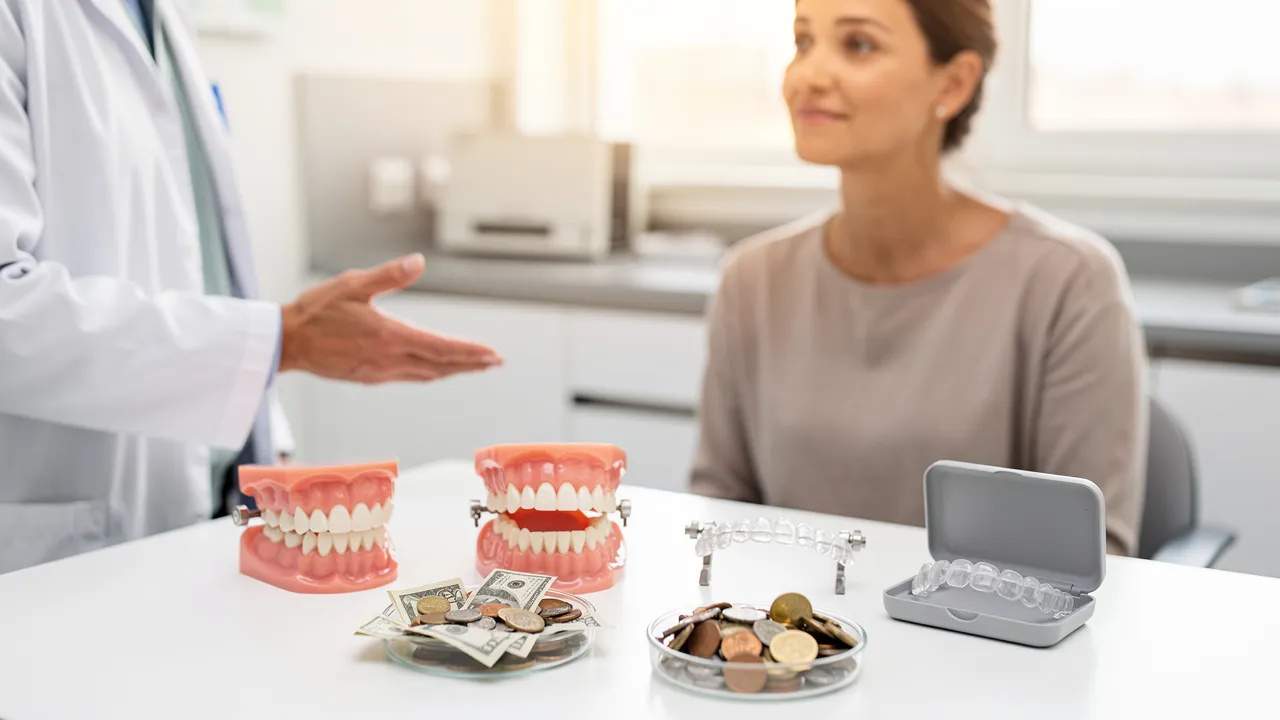
Start by defining what “full-mouth replacement” covers
Full-mouth replacement may involve one arch or both arches, so the first question is whether you need treatment for the upper jaw, the lower jaw, or both. The phrase can describe conventional dentures, removable implant-supported dentures, fixed full-arch restorations, or other restorative work for selected damaged or missing teeth. A price for one arch cannot be compared directly with a price for both arches.
The treatment design also changes the cost structure:
| Approach | Surgery for the replacement itself | Removability | Main cost structure |
|---|---|---|---|
| Conventional full denture | The denture itself does not require implant surgery, although extractions or other preparation may be separate | Removable | A denture fee plus any examination, imaging, extractions, temporary appliance, relines, or replacement |
| Snap-in implant denture | Requires implant placement | Removable for cleaning | A denture and attachment fee plus implants, imaging, surgery, and possible grafting |
| Fixed full-arch restoration | Requires implant placement and a fixed restoration | Not designed for routine removal by you | Implants, surgery, temporary and final teeth, laboratory work, and maintenance |
| Individual restorative work | Depends on the tooth and procedure | Depends on the restoration | A plan built around selected crowns, bridges, inlays/onlays, or implants rather than an entire arch |
Traditional dentures generally cost less upfront than implant-supported dentures. Snap-in dentures generally cost less upfront than fixed implant solutions because they use fewer implants and a removable design. Those comparisons describe the initial treatment path, not a guaranteed total cost over time.
A published guide lists full dentures at $1,500 to $3,600 per arch and implant-supported dentures at $6,200 to $15,000 or more per arch. A separate table lists conventional full dentures at $1,500 to $2,500 per arch, with extractions, an exam with X-rays, and a temporary denture usually separate. The same table lists relines at $200 to $600 every 1 to 2 years and replacement around years 5 to 7. Another published passage describes conventional dentures as potentially needing replacement every 5 to 10 years, so maintenance and replacement timing should be treated as planning questions rather than promises.
A complete single dental implant is estimated at $3,760 to $5,733 in the United States, including the post, abutment, and crown. Full-arch implant treatment is typically priced per arch rather than per tooth, and materials and case complexity affect the amount. These figures help you identify the scale of the options; they do not determine which approach fits your oral health or priorities.
Use published prices as planning bands, not a single answer
Published dental prices available on November 20, 2026 show why treatment scope must sit beside every number. The ranges below are planning bands from different guides, not a universal fee schedule or a personal estimate.
| Replacement approach | Published planning figure | What the figure says about included services |
|---|---|---|
| Conventional full denture | $1,500 - $2,500 per arch in one table; another overview lists $1,500 - $3,600 per arch | Extractions, an exam with X-rays, and a temporary denture are usually separate in the table using the narrower range |
| Snap-in implant denture using 2 implants | $6,200 - $11,700 per arch | Bone grafting if needed, sedation, and 3D imaging are usually separate in the table using this range |
| Snap-in implant denture in another guide | About $3,000 - $7,300 per arch | The treatment definition and included components are not identical to the two-implant table |
| Fixed implant-supported denture | $8,000 - $15,000 or more per arch | Extractions, grafting, and sedation are usually separate in the table using this range |
| Full-arch or All-on-4 treatment | About $20,000 - $35,000 per arch; both arches about $40,000 - $60,000 or more | The guide says these figures include implants, surgery, and a custom set of fixed teeth |
| All-on-4 prosthetic restoration only | $15,176 per arch in a national-average table | Extractions, bone grafting, sedation, and imaging are excluded unless the provider explicitly bundles them |
| All-on-6 prosthetic restoration only | $31,000 per arch in the same table | The figure is for prosthetic restoration and does not automatically include the excluded surgical and diagnostic services |
The snap-in ranges are not interchangeable. A lower figure may describe a different implant count, a denture alone, or a package with fewer services. The fixed-arch figures also differ because some describe a broader treatment package while the $15,176 All-on-4 figure covers prosthetic restoration only. Ask for the arch count and inclusions before comparing quotes.
A full-mouth estimate for both arches should not be created by simply multiplying an attractive per-arch number without checking the treatment plan. A published guide lists full-mouth implants for both arches at $36,000 to $100,000. The different ranges reflect different definitions and inclusion details.
Use the bands to prepare useful questions: Is the amount for one arch or both? Does it include extractions, implants, temporary teeth, final teeth, imaging, sedation, and grafting? Does the figure describe the restoration alone or the complete planned episode of care? A written answer to those questions is more useful than a low headline number.
Compare the trade-offs behind each price band
The main difference between the replacement approaches is not the price alone. Surgery, removability, component maintenance, and future replacement questions all shape the financial path.
| Option | Upfront cost pattern | Maintenance and replacement questions | Practical boundary |
|---|---|---|---|
| Traditional denture | Generally lower upfront cost than an implant-supported option | Fit may change, creating a need for relines or adjustments; replacement timing varies with fit, wear, materials, oral changes, and care | Lower initial cost does not remove the need to budget for later service |
| Snap-in implant denture | Generally lower upfront cost than a fixed implant solution because fewer implants and a removable design are used | Attachments and prosthetic components may need maintenance; the appliance and attachment system should be discussed separately | You still need an evaluation for implant placement and a plan for cleaning and service |
| Fixed implant-supported denture | Higher upfront cost than a conventional denture and generally higher than a snap-in design | Professional cleanings and occasional prosthetic maintenance may add ongoing costs | Ask what happens if a component needs adjustment or repair |
| Individual crowns, bridges, inlays/onlays, or implants | Depends on how many teeth require treatment and which restorations are selected | Each restoration has its own follow-up and replacement questions | Do not treat a selected-tooth plan as equivalent to replacing an entire arch |
Traditional dentures may need relines or adjustments as fit changes, while implant-supported dentures may need maintenance of attachments and prosthetic components. A cost comparison should therefore show both the initial treatment and the maintenance path.
A conventional denture table lists relines at $200 to $600 every 1 to 2 years and a full replacement around years 5 to 7. Those figures describe the table’s planning assumptions, not a deadline for your appliance. A separate published passage places conventional denture replacement every 5 to 10 years, which reinforces the need to ask how fit, wear, materials, oral changes, and care affect the expected interval.
A national-average table lists a single dental implant at $4,507, with a typical range of $3,760 to $5,733, and All-on-4 at $15,176 per arch, with a typical range of $11,640 to $27,500. The same source identifies the All-on-4 and All-on-6 averages as prosthetic-restoration figures rather than automatic all-in prices. Another guide lists full-mouth implants for both arches at $36,000 to $100,000. Keep these figures separate from the broader full-arch estimates because the treatment scope is different.

Build the estimate from every possible line item
Full-arch implant cost can change with the implant count, materials, preparatory procedures, number of arches, bone quality, gum health, and case complexity. A complete estimate should make those variables visible instead of presenting a single number without context.
Ask whether the written plan includes or separately prices each of these items:
- Consultation and examination.
- X-rays, 3D imaging, photogrammetry, or intraoral scans.
- Extractions for teeth that remain in the treatment area.
- Bone grafting or sinus work when the planned site needs preparation.
- Implant posts, surgical-guide fabrication, abutments, and other connectors.
- Temporary teeth and the final denture, bridge, crown, or full-arch prosthesis.
- Laboratory design and finishing.
- Local anesthetic or sedation.
- Follow-up visits, adjustments, maintenance, and the policy for later repairs.
A full-arch estimate may include consultation, imaging, extraction, grafting or sinus work, implant posts, abutments, crowns or prostheses, sedation, and follow-up visits. Ask whether each item is included or separately priced. Some practices quote a low per-implant amount that excludes the abutment, crown, or grafting, while others quote a broader all-in amount.
A 3D CBCT scan appears at $300 - $600 in one full-arch cost breakdown. Some practices include imaging in the treatment fee, while others bill it at the first visit. The same breakdown lists extractions at $150 - $650 per tooth and describes temporary and final prostheses, implant placement, surgical guides, grafting, and laboratory work as possible parts of implant treatment.
When clinically needed, additional procedures can add to the bill. Published ranges include:
- Bone grafting at about $200 - $3,000 in one guide, with another estimate using $500 - $3,000 and another using $300 - $3,000.
- Sinus lifts at about $1,000 - $4,000 in one guide and $1,500 - $5,000 in other published estimates.
- Extractions from approximately $75 - $800 per tooth, with narrower estimates of $100 - $500 or $150 - $650 depending on the source and procedure assumptions.
- IV sedation at $400 - $1,200 in one published guide.
A material choice can also move the total. One guide reports that upgrading from acrylic or PMMA to monolithic zirconia adds $5,000 - $13,000 per arch. Ask what material the estimate assumes and whether the temporary and final restorations use the same material.
Separate treatment cost from insurance and payment exposure
Dental insurance changes your out-of-pocket exposure through deductibles, exclusions, approved-cost rules, annual maximums, and network status. A guide says plans may cover 0-50% of approved implant costs after the deductible, subject to an annual maximum typically between $1,000 and $2,500. For a full-arch case costing $15,000 - $30,000 per arch, the annual maximum may cover only a small fraction of the total bill regardless of the coverage percentage.
The same source reports that about 30% of dental insurance enrollees have plans explicitly covering implants, and that average reimbursement among those plans covers less than 40% of total implant costs. The percentage describes the group of dental insurance enrollees, not a guarantee about your plan. Ask your insurer how implant exclusions, denture benefits, annual maximums, deductibles, waiting periods, and network rules apply to the proposed procedure.
Original Medicare generally does not cover dentures or implants, while a Medicare Advantage plan may cover dentures fully or partially. That distinction is not a promise of payment for a particular plan. Request the applicable benefit information before you use insurance in your budget.
Possible payment methods include CareCredit, Proceed Finance, and HSA/FSA funds. A published guide describes CareCredit promotional 0% periods of 6-24 months and Proceed Finance terms up to 60 months for larger cases. Promotional terms, approval, interest, fees, and eligibility can affect the amount you actually pay, so treat a monthly figure as a financing illustration rather than the treatment price.
Staged treatment across two calendar years can allow use of two annual insurance maximums, but whether that works depends on the plan and treatment schedule. Staging can also change the timing of surgery, temporary teeth, final teeth, and maintenance. Ask the dental professional and insurer to show which services would occur in each stage and how the proposed schedule affects your expected out-of-pocket amount.
Label Westborough’s published fees separately from market estimates
We offer restorative dentistry using crowns, bridges, inlays/onlays, and dental implants to replace or rebuild damaged and missing teeth. That service mix means a consultation can address restorative alternatives when the plan involves selected teeth rather than an entire arch. It does not turn a published service description into a universal full-mouth treatment price.
Our published practice information should be kept separate from the national and market estimates above. We publish UCR fees and provide written treatment plans with cost estimates for free. Our stated cost for implants is $6,500, and our stated cost for partial or complete dentures is $3,500. Those are our stated practice figures for the applicable offering; they should not be treated as a universal price for every full-mouth plan or as proof that every surgical, diagnostic, prosthetic, or maintenance service is included.
Our published new-patient exam costs $209, our full digital X-ray series costs $274, and an adult cleaning costs $209. Those fees identify individual services. A written treatment plan is still needed to show whether a proposed replacement includes those services, other imaging, extractions, implant components, temporary teeth, final teeth, or follow-up care.
We offer an in-house membership plan for patients without dental insurance, with various pricing tiers and flat member rates for procedures such as fillings, crowns, extractions, implants, and aligners. We accept 14 in-network PPO carriers and are out of network with Delta Dental PPO. Network status can change how your insurer calculates benefits, so include it in the insurance questions you ask.
The membership plan and our published fees are practice-specific payment information. They do not replace an examination or establish that a particular replacement approach is appropriate for you. Use the written treatment plan to connect the applicable fee, service, insurance exposure, and payment arrangement before making a decision.
Turn the consultation into a comparable written estimate
A comparable estimate should show what you are paying for, which services may be separate, and what happens after the first restoration is delivered. Bring this checklist to the consultation:
- Scope: Is the plan for one arch or both, and which teeth or areas are included?
- Implant count: How many implants does the plan include, and what does that number mean for the planned support and long-term stability?
- Components: Are the implant posts, abutments, attachments, crowns, bridge, denture base, temporary teeth, and final prosthesis listed separately?
- Preparation: Are the examination, imaging, extractions, bone grafting, sinus work, and sedation included or separately priced?
- Materials: What material is assumed for the temporary and final restoration, and what would an acrylic, PMMA, or zirconia change add per arch?
- Alternatives: What other restorative or removable options fit the findings, and how would their upfront and ongoing costs differ?
- Timeline: What happens first, what services are staged, and when would temporary and final teeth be provided?
- Maintenance: What cleanings, adjustments, relines, attachment replacements, or prosthetic maintenance might be needed?
- Contingencies: What could change the estimate if imaging shows inadequate bone, a tooth needs extraction, or the restoration needs adjustment?
- Written total: Which amount is the expected total, which items are allowances, and which services are not included?
Some practices quote a low per-implant amount that leaves out the abutment, crown, or grafting work, while other practices quote a broader amount. Ask for a written breakdown identifying implants, abutments, restorations, anesthesia, grafting, follow-up visits, and what happens if later adjustment is needed.
A snap-in denture price deserves a particularly careful scope check. A cited study reports an average of $2,540, ranging from $1,886 to $4,124, but the study does not say whether implant surgery or one arch is included, so the amount may reflect the denture alone. Other guides report higher ranges for packages that define the implant count or include more treatment. Ask whether implants, surgery, imaging, attachments, the denture, and one or both arches are included.
Begin with an evaluation before choosing the cost path
A dental evaluation should connect the replacement choice to your bone health, gum health, overall health, medical history, and priorities. Healthy gums and enough jawbone to support an implant are the main requirements considered when assessing whether implants are appropriate. An implant provider may evaluate oral health, assess bone density, and discuss medical history when determining eligibility.
Low jawbone density may mean that bone grafting is needed before implant placement to create a foundation for the implant. That possibility affects cost and timing, but an online range cannot determine whether it applies to you. Bring your medical history, current dental concerns, prior imaging if available, and the goals that matter most to you, such as removability, a fixed restoration, staged care, or a lower initial payment.
A separate guide lists a complete single dental implant at $3,500 to $6,000, including the titanium post, abutment, and crown. The same guide lists CBCT 3D imaging at $200 to $500 and needed bone grafting at $300 to $3,000. These figures differ from other imaging and grafting ranges because the sources use different pricing contexts.
Another guide lists conventional full dentures at $1,500 to $2,500 per arch, fixed full-arch implants at $18,000 to $35,000 per arch, and snap-in implant dentures at about $3,000 to $7,300 per arch. The evaluation helps determine which comparison is relevant instead of stacking every published number into a personal forecast.
Financing can be part of the evaluation conversation when the treatment plan is known. A published source reports options including CareCredit, in-house installment plans, HSA/FSA funds, and dental school programs, with monthly payments as low as $100 - $200 for qualified patients. The reported payment range is not an approval promise and does not identify every interest, fee, term, or treatment component.
Ask for the benefit rules and financing terms that apply to your written plan.
Know which post-procedure signs need prompt dental help
Some discomfort or mild pain is normal after an implant procedure, and soreness, throbbing, gum tenderness, and pressure can occur around a surgical site as the jawbone heals. Those expected sensations should still be discussed through the aftercare instructions provided for your procedure.
Persistent or increasing pain after the first few days can signal complications such as infection, implant failure, or a problem with bone integration. Seek prompt dental help rather than waiting for online price research to answer a symptom question.
Reported signs of implant problems include bleeding when brushing or flossing around the implant, gum swelling or redness, discomfort, gum recession, and a bad taste or odor. Contact a dental professional promptly if these signs occur, especially if symptoms persist or worsen.
Do not use the quoted cost of a repair, replacement, or follow-up visit as a reason to ignore a concerning change. The appropriate response is a professional assessment of the site and the restoration.
Request the next estimate with the comparison checklist
The most useful next step is a dental evaluation followed by a written, itemized plan. Ask for the number of arches and implants, every included and separate service, the alternatives considered, the treatment timeline, expected maintenance, insurance assumptions, payment terms, and contingencies. Use the resulting plan to compare options on the same basis rather than choosing from a headline price.
A qualified dental professional must determine individual suitability for dentures, implants, crowns, bridges, or other restorative care. Bring your questions, benefit information, and budget limit to that conversation, then choose only after you understand what the estimate covers and what could change it.
Questions to ask before comparing full-mouth replacement estimates
Can full-mouth teeth replacement be staged instead of completed at once?
It may be possible to treat one arch first and address the other later, depending on your oral health, treatment design, and the dental professional’s plan. Staging can change the timing of surgery, temporary and final teeth, maintenance, and insurance claims. Ask for a written schedule showing the services, costs, and expected out-of-pocket amount for each stage.
How should I budget for maintenance after the initial replacement?
Include possible relines, adjustments, attachment or prosthetic maintenance, professional cleanings, repairs, and eventual replacement - not only the starting fee. One published table lists conventional denture relines at $200 to $600 every 1 to 2 years and replacement around years 5 to 7, while other guidance gives a broader 5- to 10-year replacement interval. Actual costs and timing depend on fit, wear, materials, oral changes, and care.
What makes two full mouth teeth replacement cost estimates difficult to compare?
Check whether each estimate covers one arch or both, and whether it includes examination, imaging, extractions, grafting or sinus work, implants, abutments, temporary and final teeth, sedation, laboratory services, follow-up, and maintenance. A lower figure may describe only the prosthesis, while a broader figure may include surgery and other services. Ask each provider to identify included, separate, estimated, and potentially additional charges in writing.
Need help applying this?
Talk to a billing specialist who knows your payer mix.
Westborough Dental Care welcomes new patients in South San Francisco. Book a visit to meet Dr. Zoulas and the team.
Schedule a meeting