
cosmetic teeth veneers
Cosmetic Teeth Veneers: Compare Options, Costs and Longevity
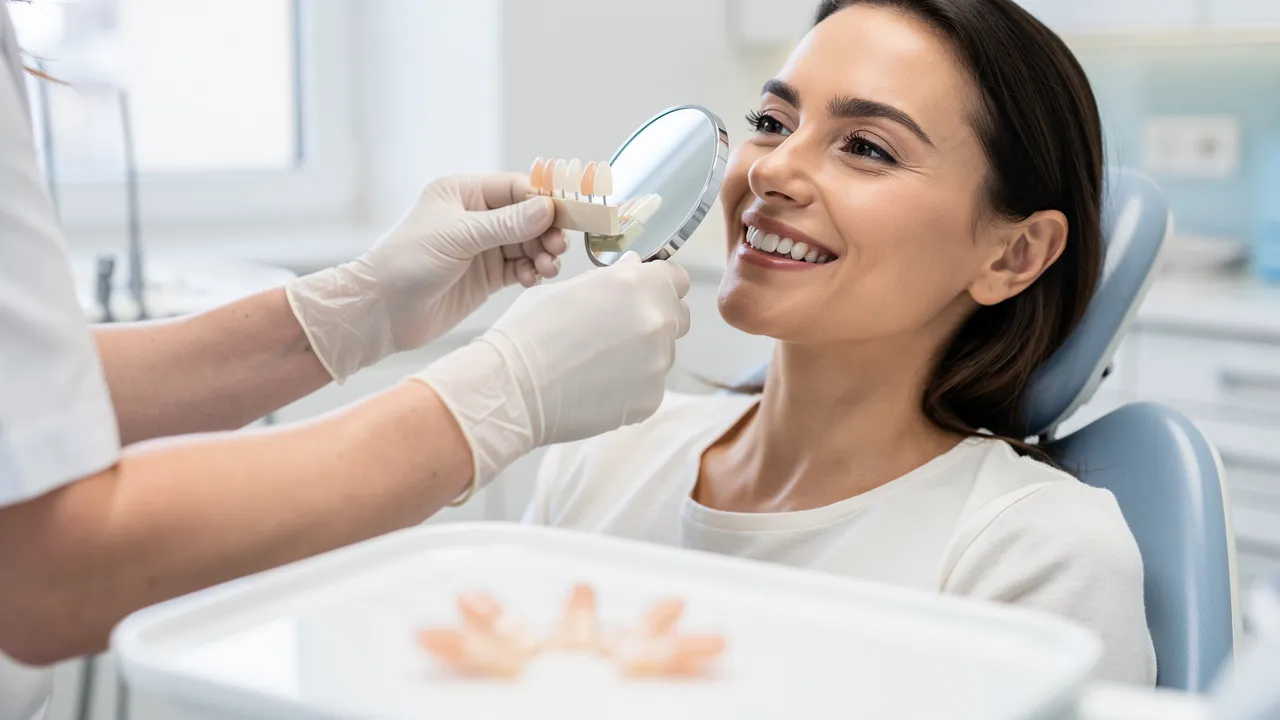
Start with what cosmetic teeth veneers can change
Dental veneers are custom-made shells that fit over the front surfaces of teeth and can conceal cracks, chips, stains, and other cosmetic imperfections. Veneers may help with tooth shape, color, gaps, and minor irregularities, but they do not correct every problem. They are designed to change appearance, not automatically to repair or strengthen the tooth underneath.
Veneers are a common cosmetic dentistry treatment. Adults are the group that most often considers them, although people of different ages may discuss them. Young adults in their late 20s may seek help with discoloration or minor misalignments, while adults in their 30s to 50s may consider treatment for age-related wear or a refreshed smile. Those patterns describe who commonly explores the option; they do not establish that veneers fit your teeth, bite, or goals.
The first useful question is not whether veneers look appealing. It is what you want changed. If the concern is surface staining, shape, one chipped tooth, crowding, or several issues together, the answer may point toward different treatments. A veneer can cover a visible concern while leaving decay, gum disease, bite problems, or weakness in the underlying tooth unresolved. Crowns are primarily used to restore teeth badly damaged by decay or trauma, whereas veneers are cosmetic treatments.
Long-term evidence also makes preservation part of the decision. A review reported survival above 90% beyond 10 years for the veneer group it evaluated, while preserved enamel was associated with survival and success and fracture was the primary reported failure mechanism, followed by debonding and color change. In one prospective cohort, 499 feldspathic porcelain veneers in 155 patients were followed for up to 21 years; patients with extensive tooth-structure loss through parafunction or an unfavorable periodontal prognosis were excluded, and only teeth with at least 80% enamel remaining were veneered. These findings describe selected treatment conditions, not a promised result for your teeth.
A review reported that veneers on surfaces with minimal dentin exposure were significantly less likely to require clinical interventions, with a risk difference of −0.16 and a 95% confidence interval from −0.31 to −0.01. That does not make minimal preparation suitable in every case. It gives you a reason to ask how much healthy structure would be preserved before you agree to treatment.
Match the smile concern to the least excessive option
Smile concerns call for different treatment questions, so start by identifying whether color, shape, position, damage, or several concerns are driving your decision. The comparison below keeps the options in their intended roles rather than treating veneers as a universal answer.
| Option | What it may address | Preservation and trade-off |
|---|---|---|
| Whitening | Surface stains and brighter natural teeth | It cannot change tooth shape or fix deep discoloration. Whitening does not involve enamel removal. |
| Composite bonding | A single chipped or cracked tooth and some minor cosmetic changes | Bonding is described as conservative. Composite can stain over time and may need repair sooner than porcelain. |
| Clear aligners | Crooked or crowded teeth and alignment concerns | Invisalign does not involve enamel removal. If significant crowding, rotation, or bite problems are present, orthodontic treatment may be needed before veneers. |
| Veneers | Color, shape, gaps, and minor misalignment at once | Porcelain veneers typically require some enamel removal, so the change is largely irreversible. They address appearance but do not necessarily repair or strengthen teeth. |
| Crowns | Teeth badly damaged by decay or trauma | Crowns can improve appearance, but their main purpose is restoration rather than a cosmetic-only change. |
Whitening is a sensible first discussion when color is the only concern. It brightens natural teeth but will not reshape them or remove deep discoloration. If you are considering veneers on only a few teeth, whitening the remaining natural teeth before treatment may help with shade matching because porcelain cannot be whitened later.
Bonding may fit a limited change when preserving natural structure matters to you. A veneer may fit a broader change in color, shape, gaps, or minor irregularity, but the broader visual change comes with preparation and future-care questions. Ask what each option can achieve for the specific tooth rather than choosing from a photograph or a package description.
Clear aligners address position rather than simply covering it. When alignment is the underlying concern, straightening first may reduce how much cosmetic work you need afterward. Veneers alone may not fully correct significant alignment problems. A treatment plan that combines alignment and cosmetic work should explain the order and the reason for each stage.
A veneer is not a substitute for a crown when a tooth needs restoration after substantial decay or trauma. Conversely, a crown is not automatically the right response to a cosmetic concern. Discuss composite bonding, professional whitening, or orthodontic treatment before committing to irreversible preparation.
Make enamel preservation central to the decision
Enamel preservation affects whether veneers remain a reasonable option for your teeth and how the restoration is bonded. Porcelain veneers typically require removal of a small amount of enamel, making the process largely irreversible because enamel does not grow back. One selected candidate-requirements source states that veneer preparation may involve removing 0.3 to 0.5 mm of enamel, but the amount for your teeth must come from the proposed plan rather than a general range.
A review of 63 studies reported higher survival with minimal-preparation veneer designs than with extensive preparation. The accepted descriptions of that review differ, so the practical point is narrower: preparation design, material, and the surface receiving the veneer all affect the evidence being discussed. Minimal preparation is not the same as no preparation, and a dentist must determine whether the design can provide the intended fit without compromising the tooth.
A systematic review and meta-analysis included 6 clinical studies from 973 screened articles and found that veneer survival and success varied by bonding substrate. The review reported survival of 99% for enamel-bonded veneers, with a range from 98% to 100%, and success of 99% for the same enamel-bonded group, also with a range from 98% to 100%. For veneers with severe dentin exposure, survival was 91% of the analyzed group, with a range from 84% to 98%, while success was 74% of that group, with a range from 64% to 85%.
The review found higher survival and success and fewer clinical complications and failures when ceramic veneers were bonded to enamel rather than dentin or existing composite resin restorations. For surfaces with minimal dentin exposure, the review reported survival of 95%, with a range from 91% to 100%, and success of 95%, with a range from 90% to 99%. For veneers bonded to composite resin, the review reported survival of 94%, with a range from 91% to 97%, and success of 70%, with a range from 60% to 80%.
Those percentages come from selected studies and conditions. They do not tell you how much enamel your teeth have, whether your bite applies damaging force, or whether another treatment would preserve more structure. Before treatment, ask for a plain explanation of the proposed preparation, how much enamel would remain, what surface would receive the veneer, and what would happen if the veneer later needed repair or replacement.

Compare porcelain and composite trade-offs
Porcelain and composite veneers differ in staining, repairability, appointment pattern, and published durability estimates. Material choice should follow the condition of your teeth, the amount of preparation proposed, your bite and habits, and the type of change you want - not longevity alone.
Porcelain veneers are generally more resistant to staining, while composite veneers may be easier to repair. Another source describes porcelain as highly resistant to staining and composite as more likely to stain, chip, and wear down over time. Composite veneers can often be placed in a single visit and are easier to repair; the same comparison describes porcelain veneers as typically requiring two to three visits. These are treatment-pattern differences, and appointment needs can vary with preparation, laboratory work, temporary restorations, and the treatment plan.
Published lifespan estimates vary. One comparison states that porcelain veneers last 10 to 15 years compared with 3 to 10 years for composite bonding. Another guide reports that porcelain veneers can last 10 to 20 years, sometimes longer, while composite veneers typically last around 5 to 7 years and may need repair or replacement sooner. A separate comparison gives composite bonding a typical range of around 5 to 7 years and says porcelain lasts longer. The estimates are not interchangeable because they concern different materials, sources, cases, and definitions of typical lifespan.
A systematic review of 499 porcelain laminate veneers reported cumulative survival of 98% at 5 years, 96% at 10 years, 91% at 15 years, and 91% at 20 years for the entire reviewed sample. Survival means the restorations remained in place under the study’s definitions; it does not mean that every veneer looked unchanged or required no maintenance during that period.
The sensible comparison is therefore wider than “Which material lasts longer?” Ask these questions:
- How much enamel would each option require you to remove?
- How would porcelain or composite respond to your bite, clenching, grinding, and daily habits?
- If a restoration chips, can it be repaired, or would it usually need replacement?
- How would the material behave beside your natural teeth as those teeth change color?
- What future treatment could be needed if the restoration reaches the end of its service life?
Replacement may involve further treatment to the tooth, so a lower initial commitment does not necessarily mean a smaller long-term decision.

Plan for maintenance, damage and replacement
Veneer maintenance continues after placement because veneers can chip, crack, loosen, or develop problems at their edges, and the underlying teeth may become sensitive. Veneers do not prevent decay. Excessive force, poor habits, or trauma may fracture or chip a veneer, so the treatment does not remove the need to protect the teeth supporting it.
A practical care routine includes:
- Brush twice daily with a soft-bristled brush and non-abrasive toothpaste.
- Floss daily and attend regular dental cleanings.
- If you grind or clench, ask whether a dentist-prescribed nightguard may help absorb clenching forces.
- Avoid using your teeth as tools for opening packages, holding objects, or tearing tape.
- Limit hard and sticky foods that can stress or loosen veneers or bonding materials.
Whitening needs planning before placement. Whitening does not affect veneer material in the same way it affects natural enamel. Whitening natural teeth after veneers may create a color mismatch, so dentists generally recommend completing whitening before veneers are placed. If you are treating only a few teeth, ask how the proposed shade will relate to the natural teeth that remain.
Call a dental office if a veneer feels loose, breaks, or changes the way your bite feels. Do not treat a damaged restoration as only an appearance issue. The tooth beneath it and the surrounding gum tissue may need assessment, and prompt attention can clarify whether repair, replacement, or another treatment is appropriate.
Use the examination to test the treatment plan
A veneer examination tests whether the proposed change fits the health of your teeth, gums, bite, and surrounding tissues. Active gum disease, significant decay, insufficient enamel, or severe grinding may make veneers inappropriate until the underlying issue is addressed. Decay, gum disease, or bite problems may need treatment before cosmetic work begins.
Our comprehensive exam evaluates your teeth, gums, bite, and soft tissue, with X-rays as needed. That evaluation gives the dentist a basis for discussing whether veneers or an alternative treatment should come first. A dentist may examine your teeth and gums, remove small amounts of enamel if you are a candidate, and take impressions; composite veneers do not require dental impressions.
The process may include:
- An examination of your teeth, gums, bite, and existing dental work.
- Treatment of decay, gum inflammation, or another problem that needs attention first.
- Discussion of your goals, the number of teeth involved, material, shade, shape, and preparation.
- Tooth preparation when needed, impressions or another method of planning, and a chance to try the proposed veneers before placement.
- Follow-up after placement to assess the restoration and address problems that appear.
Successful placement depends on prior assessment, preparation when needed, accurate bonding, and follow-up. A consultation should therefore produce more than a color discussion. It should connect your desired appearance with the condition of the teeth and the forces placed on them.
Practice-based data can show why the setting and conditions matter. One evaluation analyzed 1,459 veneer restorations in 341 patients: 1,043 restorations, or 71.5% of the 1,459, were direct composite, and 416 restorations, or 28.5% of the 1,459, were ceramic. Those results describe one practice-based evaluation, not a forecast for your proposed treatment.
A 2026 cost guide quotes CareCredit’s data as reporting an average price of $1,455 for one porcelain veneer and $751 for one composite veneer made in a dental office. Those averages are financial context, not a treatment plan or a price for your case.

Turn veneer cost into a written treatment question
Veneer cost depends on the material selected, the number of teeth treated, and the complexity of the case. Location and related care can change the total as well. A useful estimate separates the restorations from examinations, imaging, treatment needed first, temporary work, protective appliances, follow-up, repairs, and replacement questions.
One 2026 cost guide reports national ballpark prices of $1,000 - $2,500 per tooth for porcelain veneers and $250 - $1,500 per tooth for composite veneers. The same guide says the San Francisco Bay Area typically runs toward the higher end of its national ranges. Those figures are not our office’s prices, and they should not be used as a universal quote.
The definition of “full set” also changes the calculation. One guide says a full set usually means 8 to 10 upper front teeth, although some people choose 12 or more for a wider smile. That is a description of how the term is used in one cost guide, not a recommendation for how many teeth you should treat.
One national cost guide gives a ballpark of $8,000 - $25,000 for 8-10 porcelain veneers and $2,000 - $12,000 for the same number of composite veneers; these figures are not our office’s prices, and actual estimates depend on the case. Composite veneers generally cost between $250 and $1,500 for each tooth, while a full set typically costs between $3,000 and $12,000. The differing ranges show why a per-tooth figure cannot stand in for a case-specific plan.
Insurance requires the same care. One cost guide says most dental insurance does not cover veneers, while coverage varies by provider and plan. Some plans may cover part of the cost when veneers are considered medically necessary. Cosmetic treatment and treatment for disease or trauma may be handled differently, so ask what the plan says about the specific service and circumstance.
Request a written estimate that answers these questions:
- Which teeth are included, and why is each tooth part of the plan?
- Which material is proposed, and what preparation does it require?
- Are examination, X-rays, treatment of decay or gum disease, temporaries, and follow-up included?
- What happens financially if you choose bonding, whitening, aligners, a crown, or staged treatment instead?
- What repair or replacement costs could arise later?
- What does the estimate say about insurance, payment timing, and any separate services?
An in-person consultation is needed for an accurate case-specific quote. The written estimate should make the treatment sequence and the financial assumptions easy for you to understand before irreversible work begins.

Ask what happens before anything irreversible
Irreversible preparation deserves a focused conversation before you consent. Ask how much enamel would be removed, which material is proposed, how your bite or grinding may affect the result, what alternatives exist, how maintenance and repairs would work, how replacement would be handled, and how the shape and color would be chosen.
Take these questions with you:
- What concern is each veneer intended to change: color, shape, a chip, a gap, or alignment?
- How much enamel would be removed from each tooth, and how much healthy structure would remain?
- Could whitening, bonding, clear aligners, or a crown address part of the concern with a different level of preparation?
- What material is proposed, and why does it fit the tooth, bite, and cosmetic goal?
- Do clenching or grinding change the plan, and would a dentist-prescribed nightguard be appropriate?
- How will you choose the shade, length, contour, and relationship to neighboring teeth?
- Will you be able to review or try the proposed appearance before final placement?
- What sensitivity, chipping, loosening, edge problems, or bite changes should you report?
- How will the restorations be maintained, repaired, or replaced if a problem develops?
- What does the written estimate include, and what future care could fall outside it?
The two sets of percentages measure different outcomes, so they should not be blended into one prediction. Ask which outcome a dentist is discussing when someone describes durability, and ask how the evidence relates to the material, preparation, bonding surface, and conditions proposed for you.
Resolve preparation and care questions before treatment
Treatment sequence matters when alignment, shade, oral health, or daily habits could change the final plan. If alignment is the real problem, straightening first with Invisalign often reduces how much cosmetic work you need afterward. If you are veneering only a few teeth, whitening the remaining teeth first can help match the shade because porcelain veneers cannot be whitened later.
Resolve the order of care before preparation begins:
- Treat decay, gum disease, inflammation, or bite problems that need attention first.
- Decide whether alignment should precede cosmetic treatment.
- Complete any planned whitening before the shade of veneers is chosen.
- Discuss grinding, clenching, and whether a protective nightguard may be appropriate.
- Establish the daily cleaning routine and follow-up schedule.
- Ask what to do if a veneer chips, loosens, or changes your bite.
Long-term evidence should be read with the conditions attached. One prospective cohort followed 499 feldspathic porcelain veneers in 155 patients for up to 21 years; people with extensive tooth-structure loss through parafunction and an unfavorable periodontal prognosis were excluded. A selected clinical-survey passage reports a 7% failure rate for porcelain laminate veneers and says that failure had no direct impact on clinical success in terms of longevity or durability. Those findings came from defined samples and should not be treated as a personal forecast.
A systematic review reported survival of 91% for veneers with severe dentin exposure, with a range from 84% to 98%, and success of 74% for that group, with a range from 64% to 85%. The finding gives preparation and bonding surface a place in your discussion. It does not mean that dentin exposure will occur in your treatment or that a dentist can decide the outcome without examining your teeth.
Get qualified help when a dental concern is urgent
Pain, swelling, damage, or another urgent dental concern changes the order of care: contact qualified dental care promptly rather than treating the problem as a veneer-selection question. Cosmetic treatment should follow assessment of the teeth, gums, and bite, not replace it. If a restoration is loose or broken, avoid using that tooth as a tool and describe the change when you request care.
Evidence about material performance also has limits that matter when a concern is active. In one evaluation, composite veneers had a higher reported risk of failure than ceramic veneers; the hazard ratio was 4.00, with a range from 2.74 to 5.83, for survival, and 5.16, with a range from 2.65 to 10.04, for success. Those ratios compare the materials within that evaluation’s analysis. They do not identify the cause of your pain or establish which treatment you need.
Evidence on direct composite veneer survival beyond 3 years is limited; one study reported a 10-year survival rate of 52% for the studied direct composite group. The 52% figure concerns that study’s population and outcome definition, not every composite restoration.
Cost information also belongs after the dental concern is understood. That average is national context from the cited source, not an estimate for your teeth, location, material, or treatment sequence. Seek the examination first when symptoms or damage are present, then discuss whether cosmetic treatment belongs in the plan.
Request a consultation with your questions ready
Cosmetic veneers make more sense when your plan starts with the actual smile concern, preserves healthy structure where possible, explains material and maintenance trade-offs, and separates a case-specific estimate from national cost examples. Bring your questions about enamel removal, alternatives, bite and grinding, shade, repair, replacement, insurance, and future care.
A qualified dentist must decide individual suitability after examining your teeth, gums, bite, and relevant soft tissues. Ask for a written treatment and cost estimate that explains why each tooth is included and what happens if a more conservative option fits the concern. We accept new patients and allow appointment requests through online booking or by calling directly.
Questions to clarify before discussing cosmetic teeth veneers
Can veneers be whitened after they are placed?
Whitening does not change veneer material in the same way it changes natural enamel. Whitening natural teeth afterward may create a color mismatch, so dentists generally recommend completing planned whitening before veneers are placed and coordinating the shade with the remaining natural teeth.
What should a written veneer estimate include?
Ask the estimate to identify the teeth included, material, preparation, examination and imaging, treatment needed first, temporary work, follow-up, and possible repair or replacement costs. It should also explain alternatives and separate covered or uncovered services rather than presenting one unexplained total.
How should I interpret different estimates for veneer longevity?
Published estimates vary because studies and guides may involve different materials, preparation designs, bonding surfaces, patients, and definitions of success or survival.
Need help applying this?
Talk to a billing specialist who knows your payer mix.
Westborough Dental Care welcomes new patients in South San Francisco. Book a visit to meet Dr. Zoulas and the team.
Schedule a meeting