
does blue cross medical insurance cover dental implants
Does Blue Cross Blue Shield Medical Insurance Cover Dental Implants?

Begin with the medical circumstance behind the tooth loss
Dental implant coverage is not answered by the Blue Cross Blue Shield name alone. Some medical insurance plans may cover aspects of implant treatment, particularly when medical complications result from tooth loss, and coverage for an injury or accident that requires replacing one or more teeth may allow implants. That possibility does not establish coverage for your plan or for every part of treatment.
The useful question is not simply whether implants are covered. Your plan must answer whether it covers the specific service being proposed, under the specific medical circumstances involved, with the required documentation and authorization. A plan might address one aspect of treatment while leaving another aspect subject to dental benefits, exclusions, limits, or your personal responsibility.
Begin by identifying whether tooth loss followed an injury, accident, or medical complication that could bring the policy’s medical-necessity criteria into play. Implant benefits depend on the individual policy, so another person’s approval or denial does not establish your coverage. Coverage may also depend on whether the applicable policy considers the implant medically necessary.
Use that distinction to organize the rest of your questions. You need the plan documents, the medical circumstances behind the tooth loss, the treatment details, the records supporting the request, and a written explanation of any estimate or authorization decision. Until those pieces are matched, treat a general statement about implants as a starting point rather than a payment answer.
Separate medical benefits from dental benefits
Medical benefits and dental benefits can address different parts of the same implant question. Medical insurance may cover aspects of implants in limited circumstances, including some situations involving medical complications from tooth loss or an injury or accident. Dental insurance may have its own rules for implants, annual limits, exclusions, and related restorations; the crown attached to an implant abutment may be covered under some dental plans.
That distinction matters because a treatment plan can contain more than one billable component. Ask which benefit category applies to each proposed component and whether the plan applies a separate limit or exclusion.
Think of the treatment plan as a map, not a single insurance item. The implant, abutment, and final crown may appear as separate services, so the answer for one does not automatically resolve the others. For each line, record the benefit path the insurer identifies, the policy condition attached to it, and whether the response is only an estimate or a requirement that must be met before treatment. This makes a mixed response usable: one component can remain pending while another is subject to a dental limit or exclusion. It also gives the provider a precise list of services to describe and prevents the broad label “implant treatment” from hiding an unanswered component.
Your dental and medical coverage documents should be read separately, then compared with the written treatment plan. Medical-plan language must be handled with the same care: a general benefits description cannot replace the terms of your specific plan.
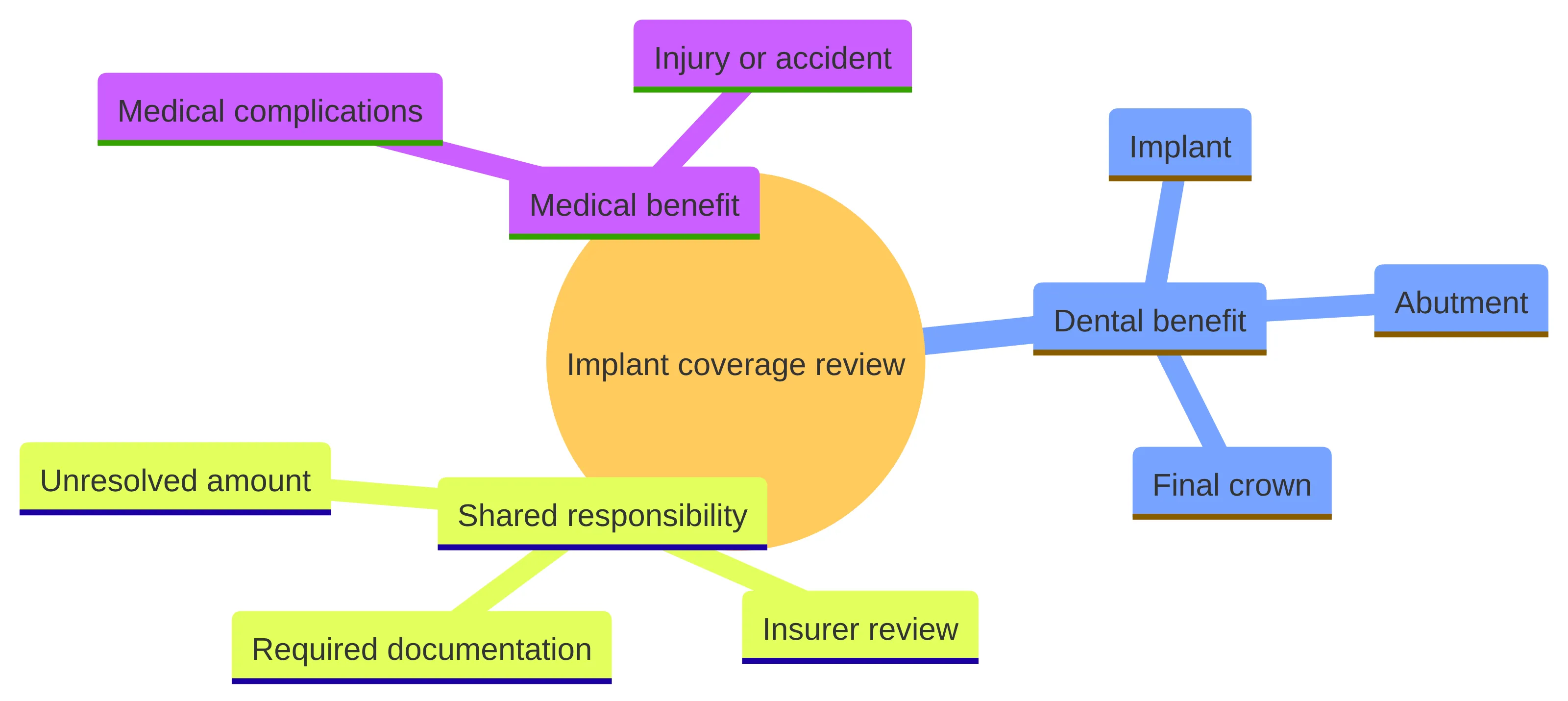
Use two columns in your notes:
- Medical benefit: Ask whether the tooth loss, complication, injury, or accident fits a covered circumstance and whether the proposed implant-related service is included.
- Dental benefit: Ask whether the implant, abutment, crown, or another listed service is covered, and record the applicable limitations or annual maximum.
- Shared responsibility: Record which insurer is reviewing which service, what documentation is required, and what amount remains unresolved.
Do not use a possible medical benefit to assume that the dental portion is covered. Likewise, a dental benefit for a crown does not establish payment for implant placement. Keep the two benefit paths separate until the plan identifies how each proposed service will be handled.
This separation prevents a possible medical benefit from being mistaken for complete payment of dental implant treatment.
Identify the circumstances that could change the answer
The reason for tooth loss can change how an insurer evaluates an implant request. Coverage for an injury or accident that requires replacing one or more teeth may allow dental implants. Some medical plans may also cover aspects of implant treatment when medical complications result from tooth loss. These are possible policy pathways, not a determination that your situation qualifies.
Medical necessity can be another condition in the plan’s review. Coverage may depend on whether the applicable policy considers the implant medically necessary. Your insurer may use its own criteria, so do not substitute a general description of medical necessity for the wording in your plan.
Describe the circumstances accurately rather than choosing the description that appears most likely to receive benefits. The insurer’s review concerns the circumstances and the proposed service together, so an incomplete or overly broad description can leave you without a usable answer.
Medical necessity and coverage are related but not interchangeable. A request can contain clinical records intended to support medical necessity, yet the plan may still apply a separate exclusion, limitation, benefit classification, or authorization rule. When you describe the circumstances, keep two statements separate: what happened to cause tooth loss and what service is being requested in response. Then ask which policy criterion connects those facts. This keeps an insurer’s review from being reduced to a yes-or-no description of the event. It also helps you identify whether an unanswered issue concerns the facts, the proposed service, or the plan’s benefit rules.
Your coverage review should identify the conditions that could change the result. Write down the following before you call:
- The stated reason for the missing tooth or teeth, including whether an injury, accident, or medical complication is involved.
- The exact implant-related service under review and whether the request includes a crown, abutment, imaging, or another listed component.
- The policy’s classification of the service, any exclusion, limitation, annual maximum, or other benefit condition.
- The records, X-rays, treatment plan, or other documentation the insurer requires.
- Whether the plan requires prior authorization, a referral, or an advance estimate before treatment.
A plan may require pre-authorization or a referral for certain services or providers, and an applicable plan must be checked to determine whether that requirement applies. Keep each condition attached to the service it affects instead of treating a single approval phrase as approval for the entire plan.
Read the plan before relying on a benefits call
Your plan documents should be the foundation of the coverage review. Look for the sections that define covered services, exclusions, limitations, benefit classifications, annual maximums, deductibles, and authorization requirements. The policy language may distinguish an implant from the crown attached to it, or it may place different services under different benefit rules.
A cost estimator or general online result cannot replace those documents. A dental cost-estimator notice explains that its information does not guarantee eligibility, coverage, or payment and that coverage documents control if there is a conflict. Estimates may vary by benefit plan and state, while claims are processed under the applicable plan provisions.
Use the plan’s wording to identify what must happen before treatment, what information the insurer needs, and what conditions apply when a claim is processed. A telephone explanation can help you find the right section, but it should not be treated as a replacement for the written terms.
Your plan-reading checklist should answer these questions:
- Is the implant-related service listed as covered, limited, excluded, or subject to a separate condition?
- Does the plan describe a medical circumstance, such as an injury, accident, or complication, that affects eligibility?
- Does the plan address medical necessity, and does it specify who reviews that question?
- What annual maximum, deductible, limitation, or exclusion could affect the benefit?
- Does the plan require prior authorization, a referral, or a pre-treatment estimate?
- Which written documents control if an estimator, phone explanation, and plan language differ?
Record the page or section for each answer. A benefits call can help you locate the relevant language, but the written terms should remain the reference point for the decision.
Because the brief may contain several layers of information, save the exact plan section that supports each conclusion rather than only the representative’s summary. Check that the document applies to the coverage period and benefit type you are using, and ask which document controls when medical and dental materials describe the same service differently. If the plan language is unclear, record the uncertainty as a question for the insurer instead of filling the gap with an online estimator or another person’s experience. This creates a record for later comparison with the written treatment plan and helps show which issues were verified and which still need confirmation.
Ask Blue Cross Blue Shield questions that produce a usable answer
Your insurer questions should describe the proposed service and the circumstances instead of asking only whether implants are covered. Coverage depends on the individual policy, so contact the insurer about specific implant terms and any riders that could affect coverage.
Use this call script:
- Does my specific plan provide a medical benefit for any part of the proposed implant treatment?
- Does the reason for tooth loss, including an injury, accident, or medical complication, affect the review?
- Does the plan require the service to meet a medical-necessity standard?
- Which components are being reviewed: the implant, abutment, final crown, or another stated service?
- Are any of those components handled under dental benefits rather than medical benefits?
- What exclusions, limitations, annual maximums, deductibles, or other conditions apply?
- Must my provider submit dental records, X-rays, a treatment plan, or another document?
- Is prior authorization required, and is a referral required for this plan or provider?
- Can I request a pre-treatment estimate or predetermination before treatment?
- What written response will identify the services reviewed and the conditions attached to the response?
Your call record should connect each answer to a service. Note the date of the call, the department that handled it, any reference number provided, the documents requested, and whether the representative described the answer as an estimate, an authorization decision, or a benefit explanation. Ask how to obtain the answer in writing when the insurer offers that option.
Do not let a general answer such as covered or not covered stand alone. Ask what the answer measures, which plan provision supports it, whether it applies to the complete treatment or one component, and what remains subject to review. Some plans and providers require pre-authorization or referrals, so your notes should show whether that requirement applies to your plan rather than assuming that every plan follows the same process.
If the representative uses a term you do not recognize, ask for its meaning and for the plan section that supports the answer. The goal is a response that identifies the service, the applicable benefit, the condition being applied, and the next document or authorization step.
To make the call useful, separate three outputs in your notes: the policy rule the representative cites, the service to which the rule applies, and the action still required. For example, a response may identify a possible benefit but still require records or authorization; those are different outcomes and should not be written as a final payment commitment. Ask whether the response addresses medical benefits, dental benefits, or both, and whether another proposed component needs a separate review. If the representative cannot answer a component, label it unanswered rather than inferring that the answer for a related service carries over.
Request records that support the coverage review
Your dental records can give the insurer the information it needs to evaluate the proposed request. Dental records, X-rays, and a dentist’s treatment plan may support a request involving the implant’s medical necessity. Ask your dental provider which records are available and which documents the insurer specifically requested.
Request a clean set of materials that identifies:
- The tooth or teeth involved in the proposed treatment.
- The stated reason for tooth loss or replacement.
- The implant-related services included in the treatment plan.
- The X-rays and other dental records relevant to the request.
- The written treatment plan and the provider’s estimated charges.
Keep copies of anything submitted. Match each document to the insurer’s request so you can tell whether the review concerns the implant, the attached restoration, or another part of the proposed care.
Your documentation package should support the exact question under review rather than make a broader promise about treatment. If prior authorization applies, the insurer may have a licensed dental professional review the proposed treatment and your dental records against the policy’s criteria. That review is different from simply receiving a cost estimate.
Ask the insurer whether it needs a particular form, a specific type of image, or a provider-submitted request. Ask the dental office which portion it will send and which portion you must provide.
Keep clinical records and financial documents together but distinguish their purposes. Records and X-rays address the service and circumstances under review; the treatment plan and charges identify what the provider proposes and what the insurer may need to evaluate.
Before the package is sent, compare the insurer’s request with the provider’s packet line by line. If the request names a treatment plan, X-rays, or records, note whether each item is included, who will submit it, and whether the insurer wants anything else. Keep a copy of the submitted version and the date it was sent. This does not by itself establish that the plan’s medical-necessity criteria are met or that payment will occur; it lets you distinguish a review waiting for information from one completed under the plan’s criteria. If the insurer later asks about a different component, add that request separately rather than assuming the first packet covered the entire treatment.
Distinguish an estimate from authorization
A pre-treatment estimate is an estimate, not a guarantee of payment. Dental plans may also call this advance review a predetermination of benefits. Without a predetermination, you may not know in advance how much insurance is likely to cover or what you may owe.
A pre-treatment estimate can still be useful because it gives you a written view of how the insurer expects the proposed service to process under the plan. Keep its limits beside the amount shown. The estimate may not account for every later claim detail, and it does not change the plan terms.
Prior authorization is a different review path. Some policies require prior authorization for specified services, while a pre-treatment estimate may be optional. Prior authorization may involve a licensed dental professional reviewing the proposed treatment and dental records against the policy’s criteria.
Ask which process your plan requires and what each response means. Your notes should distinguish:
- Pre-treatment estimate or predetermination: an advance estimate of likely benefit handling, not a guarantee of payment.
- Prior authorization: a policy-dependent review that may be required before specified services and may include professional review of the treatment and records.
- Final claim processing: the stage at which the submitted service is processed under the plan provisions.
Do not schedule solely because an estimate lists an amount, and do not assume that an authorization response answers every cost question. Ask how the insurer will handle each proposed component and what conditions remain.
Keep the estimate and authorization response with the treatment plan they address. If the proposed services change, ask whether the insurer must review the changed services rather than applying the earlier response automatically.
Build the provider-side cost file
Your provider-side cost file should show what treatment is proposed, what each part costs, and which amount is still dependent on insurance processing. A provider’s estimate may be inaccurate when the provider does not know all plan details, including your deductible and annual maximum. That is why the office estimate and the insurer’s benefit response should be kept as separate documents.
Ask for a written, itemized treatment plan that identifies:
- Each implant-related service included in the proposed care.
- The charge associated with each listed service.
- The expected sequence or stage for each service, if the plan describes one.
- The amount the office expects you to pay before insurance processing, if available.
- The information the office will submit to the insurer.
- Any part of the proposed care that is not included in the written estimate.
Use the file to compare the provider’s description with the insurer’s description. If the two documents use different service names, ask which line items correspond before relying on an estimated benefit.
Also label each figure by its source and status. A provider charge is not the same as an insurer’s estimated benefit, and an unresolved amount should not be entered as though it were a confirmed balance. If the office describes a fee as a published UCR fee, retain that wording and ask how it relates to the proposed line item; do not treat the label as proof that the plan will use or pay that amount. Note any service, stage, or charge that the written plan leaves out, then ask whether it is outside the proposal or simply awaiting clarification. This makes the cost file useful without turning it into an exact responsibility estimate.
Our published information gives you one practice-side fact to place in that file: we publish our UCR fees openly. We also file out-of-network claims for our patients. Those facts describe our published billing practices; they do not determine whether your Blue Cross Blue Shield plan treats the office or a particular service as in network, covered, or payable.
Ask the office for the written treatment information needed for your insurer’s review, then ask your insurer how that information will be processed under your plan. Keep the provider’s figures, the insurer’s estimate, and your own unresolved balance in separate columns. That format makes it easier to see where a cost is documented and where it still depends on plan provisions.
Do not combine the office’s published fee information with an insurer’s expected benefit as though they were the same figure. The provider identifies proposed charges; the plan applies its own provisions to the submitted services. Your file should preserve both sides of that distinction.
Use Westborough’s documented process without assuming coverage
Our implant process includes digital planning with an in-house cone-beam CT scanner. This information can help you describe the proposed care accurately when you ask an insurer which services it will review.
The process description is not a coverage determination. Digital planning, in-house treatment, and the division of services among placement, abutment, and crown do not by themselves establish a medical benefit, dental benefit, authorization, or final payment amount. Use the documented treatment details as inputs to the insurance conversation, then keep the insurer’s answer tied to the services it actually reviewed.
Your coverage questions should therefore name the actual proposed components rather than rely on the general word implant. Ask whether the plan is reviewing placement, the abutment, the final crown, or more than one of those services. Ask whether the medical circumstances and records support the policy’s stated criteria for each reviewed service.
This approach keeps the practice’s role and the insurer’s role distinct. We can provide treatment information and records for the proposed care. Your insurer decides how your plan provisions apply, including whether authorization or a separate benefit category is required.
Use the practice’s process details to make your insurance questions more precise, not to predict the answer. A description of how care is planned or delivered does not replace the plan’s coverage language.
Compare the insurer response with the written treatment plan
Your written comparison should match every insurer response to the corresponding line in the treatment plan. A possible benefit for one aspect of implant treatment does not show that every aspect is covered, and a pre-treatment estimate does not guarantee payment.
Create four columns:
- Treatment detail: Record the provider’s exact description of the proposed service.
- Insurer response: Record whether the insurer described the service as covered, excluded, limited, pending, or subject to another condition.
- Required next step: Record any requested record, prior authorization, referral, or pre-treatment estimate.
- Unresolved responsibility: Record the amount or condition that remains uncertain rather than converting it into a final personal cost.
Compare the implant, abutment, and final crown separately when they appear separately in the plan. Ask follow-up questions when the insurer’s wording covers only an aspect of the proposed care.
Read the comparison from both directions. Start with each treatment-plan line and locate its insurer response; then start with each insurer condition and locate the service or document it controls. Any condition without a matching service needs clarification, just as any service without a response remains unresolved. Mark whether the response concerns eligibility, likely benefit handling, a required review, or final claim processing, using the insurer’s own description rather than translating it into a promise. This two-way check can reveal when a response is broad, when a component was omitted, or when a requested document relates only to one part of treatment. Keep those findings separate from the provider’s clinical description and fee.
Your responsibility estimate should remain conditional until the applicable plan processes the claim. Dental estimates may vary by plan and state, and claims are processed under plan provisions. You may also be responsible for services your plan does not cover.
Use the comparison to decide what information is still missing, not to create an exact guarantee. If the treatment plan changes, ask whether the insurer must review the changed service again. If the insurer’s written response conflicts with an estimator, give priority to the applicable coverage documents and ask how the conflict should be resolved before you rely on the amount.
A complete comparison should leave you with a separate status for every proposed service: documented coverage, documented exclusion or limitation, pending review, or an unanswered question. That status is more useful than a single total that combines confirmed and unresolved amounts.
Know what still cannot be promised
A universal coverage promise cannot be made for dental implants. Implant benefits depend on your individual policy, and another person’s experience does not establish your coverage. A pre-treatment estimate is an estimate rather than a guarantee of payment.
That boundary applies even when several pieces appear favorable. A possible medical circumstance, a favorable phone explanation, an itemized provider estimate, or a listed amount in an estimator does not answer every question about exclusions, limits, documentation, authorization, and final claim processing.
Your remaining uncertainty should be stated plainly:
- The plan may cover some services and not others.
- The plan may require records, prior authorization, a referral, or an advance estimate.
- The provider may not know every detail of your plan, including the deductible and annual maximum.
- The amount shown in an estimate may differ from the amount processed under the plan provisions.
- You may owe for services the plan does not cover.
Treat each unresolved item as a question to answer before you commit to a payment assumption. Do not turn a possible benefit into a personal responsibility estimate until the service, plan condition, and written response are aligned.
Use the first visit to close the information gaps
Those materials can help organize the information for a focused insurance conversation.
Bring your insurance information, the plan documents you have, the insurer’s questions, and any prior written response. Use the visit to request the treatment description and cost information your plan requires. If the insurer has asked for specific records, identify that request clearly so the provider can address the relevant portion of the coverage review.
Your first-visit checklist should produce a usable file rather than a vague coverage impression:
- The proposed implant-related services are written down separately.
- Relevant digital X-rays and dental records are identified.
- The treatment plan explains the proposed care in terms your insurer can review.
- The provider’s charges are listed in writing.
- The insurer’s documentation, estimate, or authorization requirements are matched to the treatment plan.
- Any pending question is assigned to either the insurer or the dental provider.
A written treatment plan does not decide benefits, and an insurer’s review does not decide whether treatment is suitable for your oral condition. The two pieces answer different questions and should remain separate in your records.
Use the first visit to close information gaps, not to treat the appointment itself as proof of coverage. The useful result is a clear treatment description and a set of records that can be matched to the insurer’s specific request.
Take the next step only after verification
Your next step is to assemble the plan language, the reason for tooth loss, the written treatment plan, the provider’s itemized costs, and the insurer’s answers in one file. Ask whether medical or dental benefits apply to each component, whether records or prior authorization are required, and whether the response is an estimate or another type of review.
Proceed with a payment decision only after the proposed services, required documentation, authorization path, and unresolved responsibility are clearly identified. Then begin the coverage and treatment-information conversation.
What should you confirm before pursuing dental implant coverage?
What factors determine if Blue Cross Blue Shield medical insurance covers dental implants?
Coverage may depend on whether the implant is considered medically necessary, the specific circumstances surrounding tooth loss, and the details outlined in your individual policy.
How can I verify my Blue Cross Blue Shield coverage for dental implants?
Review your policy documents, contact your insurer to discuss specific terms, and ask about any required documentation or pre-authorization for the proposed treatment.
Is a pre-treatment estimate from my dentist a guarantee of insurance coverage?
No, a pre-treatment estimate is not a guarantee of payment; it is an estimate of how the insurer may process the claim.
What should I do if my dental provider's estimate differs from what my insurance covers?
Keep the provider’s estimate and the insurer’s response separate, and clarify any discrepancies by asking your insurer how they will process the claim.
What steps should I take during my first dental visit regarding insurance coverage for implants?
Bring your insurance information, ask for a detailed treatment plan, and ensure that the provider understands any specific documentation your insurer requires.
Can I expect my dental insurance to cover the crown associated with a dental implant?
Some dental plans may cover the crown attached to the implant, but this depends on the specific terms of your dental insurance policy.
Need help applying this?
Talk to a billing specialist who knows your payer mix.
Westborough Dental Care welcomes new patients in South San Francisco. Book a visit to meet Dr. Zoulas and the team.
Schedule a meeting