
full mouth teeth replacement cost
Full-Mouth Teeth Replacement Cost: How to Build a Realistic Estimate

Begin with the estimate, not a headline price
Full mouth teeth replacement cost cannot be reduced to one dependable number before the proposed treatment is defined. The total can vary with the treatment plan, the number of implants, and your location, so an exact price requires a personalized estimate. A useful estimate shows what is being replaced, which stages are included, what preparation may be needed, and how much you may be responsible for after insurance.
If you live in South San Francisco or Daly City, begin by treating any online range as planning context rather than as a quote for your care. The practical question is not simply whether a headline price looks low or high. The practical question is whether two estimates describe the same work.
Start your review with these three checks:
- Identify whether the plan covers one arch or both arches.
- Identify the proposed restoration, the number of implants, and the parts attached to them.
- Identify every included and excluded service, from examination and imaging through follow-up.
A lower total may describe a narrower stage of treatment. A higher total may include preparation, temporary teeth, sedation, or the final restoration. Without those details, the numbers are not comparable.
A written estimate also gives you a calmer way to discuss treatment. You can ask about each line instead of trying to remember a single total from a consultation. You can separate a clinical question, such as which restoration is being proposed, from a payment question, such as when each stage is due. That separation makes the financial conversation more useful without turning an online figure into a promise.
Think of the estimate as four connected records rather than one balance: the treatment scope, the component costs, the insurance calculation, and the payment schedule. If one record changes, the others may need to be read again. Keeping them together helps you see whether a quoted personal share reflects the complete plan or only the first stage.
Ask for a pre-treatment estimate before comparing implants with bridges or dentures. Then request the estimate in writing with the treatment stages and component costs shown separately. An area-based cost estimator can provide general context, but it is not a personalized quote. Use the document to identify what still needs an answer, not to assume that every listed service applies to you.
Before you compare totals, write the unit beside each number: per arch, both arches, per implant, per component, or complete treatment. Also mark whether the number is a quoted charge, an estimated insurance contribution, or an expected personal share. These labels prevent a component price from being mistaken for a complete treatment price.
Define what “full mouth” means in the proposed plan
Full-mouth replacement is a treatment description that still needs a precise scope. A plan may be priced by arch, and a source-reported guide separates one arch from treatment of both arches. The same guide also distinguishes removable snap-in dentures from fixed implant-supported bridges. Your estimate therefore needs to state exactly which arch or arches are included and which restoration is planned.
The number of implants is another part of the scope. Implant cost varies with the treatment plan and the number of implants needed, so the phrase full mouth does not establish an implant count or a final fee. Ask the dental team to write the proposed number of implants beside the restoration they support. If the number may change after imaging or another part of the evaluation, ask which condition would cause the estimate to change.
Use these questions to define the plan:
- Does full mouth refer to one arch, both arches, or a staged plan that addresses them at different times?
- Is the proposed replacement removable for cleaning or fixed in place?
- How many implants are proposed for each arch?
- What is the final restoration: a denture, bridge, or another named component in the plan?
- Are temporary teeth included, and are they part of the same stage or a separate charge?
- Which services are planned now, and which are conditional on examination or imaging?
The word replacement can also hide several separate cost lines. The implant body, connecting components, and final crown, bridge, or denture should not be treated as one unexplained item when the estimate can identify them separately. Preparation, imaging, sedation, and follow-up may also appear outside the main restoration price.
A clearly defined scope protects the comparison. If Estimate A describes both arches with a fixed restoration and Estimate B describes one arch with a removable restoration, the totals answer different questions. Resolve that difference before deciding that either option costs less.
Ask whether both arches are being planned at the same time or whether the plan separates them into stages. A two-arch total may combine two different restoration designs, or it may apply one design to each arch. The estimate should identify the arch, restoration, implant count, and timing for each part rather than leaving those details inside a general phrase such as full mouth.
Use source-reported ranges only as planning context
One 2026 cost guide reports $8,000–$13,500 per arch for snap-in dentures and $14,000–$36,000 per arch for fixed bridges. The same guide says treating both arches typically doubles the cost. These are source-reported figures, not a universal price and not a quote for treatment in South San Francisco or Daly City.
Use the ranges to prepare questions, not to predict your personal total. First determine whether the figure refers to one arch or both. Next determine whether it includes the implant placement, connecting components, temporary replacement, final restoration, preparation, imaging, sedation, and follow-up. A range that leaves out several stages can look less expensive than a complete plan without actually describing a lower total.
The ranges also should not be used as a midpoint calculation. A midpoint does not account for the treatment scope, the number of implants, the proposed restoration, or services that may be added after evaluation. A published range can show the scale of a discussion while still leaving the central financial question unanswered: what is included in your proposed plan?
When you encounter a number online, write down the source context beside it:
- Price basis: per arch or both arches.
- Restoration: removable snap-in denture or fixed implant-supported bridge.
- Included stages: examination, imaging, placement, restoration, and follow-up.
- Additional conditions: preparation, sedation, temporary replacement, or other services.
- Date and location: the source’s stated year and geographic context.
That note keeps a general range separate from a practice-specific estimate. It also gives you a reason to ask a focused question instead of asking only whether the office can match an online figure. If the proposed treatment differs from the published example, the relevant comparison is the complete scope, not the number printed in the headline.
A range can be useful even when it cannot answer your final budgeting question. For example, it can show why a one-arch removable plan should not be compared directly with a two-arch fixed plan. It can also prompt you to ask whether the published figure includes the final restoration or only implant-related stages. Record the limitations beside the range while the source context is still clear.
Compare removable and fixed restoration trade-offs
Removable snap-in dentures and fixed implant-supported bridges create different planning questions. Snap-in dentures are removable for cleaning, while fixed implant-supported bridges remain in place. A source-reported 2026 guide places the reported range for snap-in dentures below the reported range for fixed bridges on a per-arch basis, but the appropriate option and its cost depend on the individual treatment plan.
| Planning criterion | Removable snap-in denture | Fixed implant-supported bridge |
|---|---|---|
| Position during daily use | Removable | Remains in place |
| Cleaning question | Ask how and how often the denture should be removed for cleaning | Ask how cleaning around the fixed bridge should be handled |
| Source-reported 2026 range | $8,000–$13,500 per arch in one cost guide | $14,000–$36,000 per arch in one cost guide |
| Estimate detail to request | Implant count, denture components, temporary replacement, preparation, and follow-up | Implant count, connecting components, bridge, temporary replacement, preparation, and follow-up |
| Decision question | Ask why a removable restoration fits the proposed plan | Ask why a fixed restoration fits the proposed plan |
The table is a comparison framework, not a treatment recommendation. The reported ranges do not establish what your examination, imaging, preparation, or final restoration would cost. They also do not establish which option is suitable for you.
Use the comparison during an evaluation by asking the same questions about both paths. Ask which services are included, which stage each charge belongs to, and what would change the estimate. Ask whether a temporary replacement is included and how the final restoration is priced. If a plan presents only a combined total, request the underlying components before comparing it with another plan.
The practical differences extend beyond the headline fee. A removable restoration creates a cleaning and storage question that should appear in your discussion. A fixed restoration creates a cleaning-around-the-restoration question and may use different connecting components. The estimate should identify the restoration clearly enough for you to connect the financial lines with those daily-care questions.
The direct action is simple: ask the dental team to name the proposed restoration, explain its daily-care requirements, and show its component costs in writing. If the team is considering more than one approach, request a separate estimate or a clearly labeled alternative for each approach.
Build the estimate from its component costs
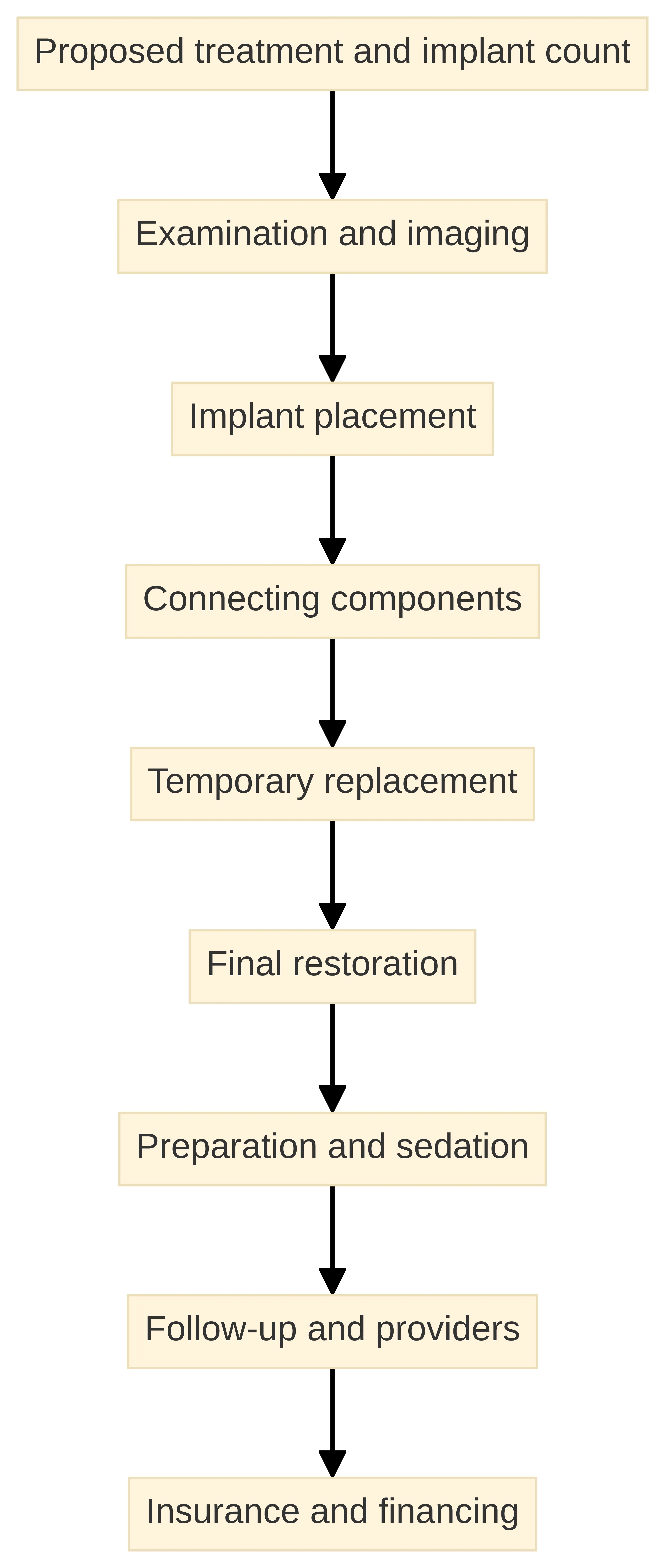
A full-mouth estimate becomes easier to compare when each major component has its own line. A written comparison can include the recommended treatment and number of implants, examination and imaging, implant placement, connecting components, the final restoration, temporary replacement, preparation, sedation, the provider for each stage, follow-up, exclusions, insurance responsibility, and financing terms.
Use the estimate as a map rather than a single balance. The following sequence gives you a practical way to read it:
- Proposed treatment and implant count: Record the restoration and the number of implants for each arch.
- Examination and imaging: Identify the examination, diagnostic images, and any other planning records listed.
- Implant placement: Check whether placement is priced separately from the implant body or included in a larger surgical line.
- Connecting components: Look for abutments or other connecting parts that join the implant to the restoration.
- Temporary replacement: Record whether temporary teeth are included, optional, or priced separately.
- Final restoration: Identify whether the final item is a crown, bridge, or denture and whether the charge covers one arch or both.
- Preparation and sedation: Mark any extraction, grafting, other preparation, or sedation line as included, conditional, or excluded.
- Follow-up and providers: Ask who handles each stage and what follow-up is included.
- Insurance and financing: Record the estimated plan contribution, your expected share, and the terms for any payment arrangement.
The component list also reveals where two estimates use different terminology. For example, one office may combine implant placement and connecting components while another lists them separately. The totals cannot be compared fairly until you know whether the same services are present in both documents.
Ask for a written explanation beside every blank or conditional line. A blank line may mean the service is not planned, the charge is not included, or the amount depends on a later decision. Those meanings have different financial consequences. Request the meaning in plain language and keep it with the estimate.
Add a status beside every line: included, separate, conditional, or unanswered. Then add the arch and stage. A line marked only as implant fee may still leave you unsure whether it covers the implant body, placement, connecting component, or another part of the process. A precise label lets you compare like with like and identify what still needs to be discussed.
Check whether preparation changes the total
Preparatory care can change the estimate before implant placement or restoration. One 2026 cost guide reports bone grafting at $300–$5,148 and sinus lifts at $1,500–$3,500. Those figures are source-reported planning context, not charges that apply automatically to your treatment.
A written comparison should identify extraction, grafting, or other preparation if the proposed plan includes them. Ask whether each item is already included, whether it is conditional on examination or imaging, and whether it belongs to the same stage as implant placement. Ask how the estimate changes if preparation is recommended for one arch but not the other.
Use a preparation section in your notes:
- Procedure or service being considered.
- Arch and site affected.
- Included price, separate price, or no price yet.
- Stage at which the service would occur.
- Temporary replacement or follow-up connected with that stage.
- Condition that would cause the estimate to change.
This distinction matters because a plan can have a lower initial stage and a higher complete treatment total once preparation is added. It also matters when you compare a staged plan with a plan that prices more work at the beginning. Ask for the complete expected sequence rather than assuming that the first scheduled service is the full financial commitment.
Preparation questions should stay separate from an eligibility decision. You can ask what the proposed plan includes and what could change the estimate without deciding in advance that you need or do not need a particular procedure.
Ask whether preparation is being discussed as part of the current estimate or as a possible later change. A conditional line should identify the event that would activate it, such as a finding from examination or imaging, and the stage where it would occur. If the amount is not yet known, record that plainly rather than entering zero. This keeps a conditional possibility visible without treating it as a confirmed charge.
Account for imaging, sedation, and care between stages
Imaging, sedation, temporary replacement, and follow-up can sit outside the main restoration line. The estimate-comparison guidance specifically includes examination and imaging, temporary replacement, preparation, sedation, follow-up, exclusions, and the provider for each stage. Ask about each item even when the main discussion focuses on implants or the final bridge.
A useful cost conversation separates three questions:
- What is needed for planning? Ask which examination or imaging is included and whether another image would create a separate charge.
- What is needed during treatment? Ask whether sedation, temporary replacement, and stage-specific services are included or separately priced.
- What is included after a stage? Ask which follow-up appointments are included and whether maintenance guidance is part of the written plan.
Do not treat the word included as self-explanatory. Ask which appointment, component, arch, and time period the inclusion covers. A temporary replacement may be included for one stage but not another. Follow-up may be listed without a number of appointments or without identifying the provider. The written estimate should make those boundaries visible.
The selected consultation guidance also recommends asking about treatment time, risks, a detailed cost breakdown, insurance coverage, and financing before scheduling surgery. Put those questions beside the line items so the financial document and the treatment conversation answer each other.
Your action is to mark every item as included, separate, conditional, or unanswered. Do not fill an unanswered line with an assumption. Ask for the amount or the condition that controls it, and keep the response with the estimate.
A stage-by-stage view also helps you separate immediate charges from later charges. Place examination and imaging in the evaluation stage, preparation in the applicable surgical stage, temporary teeth in the stage where they are provided, and the final restoration in its own line. This does not predict which services your plan will use; it gives each proposed service a place where its price and timing can be discussed.
Treat treatment time as part of financial planning
Implant treatment can involve multiple stages, and a selected 2026 consultation guide reports a span of 3–9 months from the first surgery to the final crown, depending on healing and whether bone grafting is needed. Treat that as a source-reported planning range, not as a personal timeline.
Treatment time affects how you read a financial estimate because the quoted total may be paid across separate stages. Ask when each stage is expected, which item is temporary, and when the final restoration is due. Ask whether the written total covers the full sequence or only the next appointment. If healing or preparation can change the schedule, ask whether that condition can also change the estimate.
Build a timing column beside your cost lines:
- Evaluation and records.
- Preparation, if included or later recommended.
- Implant placement.
- Temporary replacement, if planned.
- Final restoration.
- Follow-up after each stage.
The purpose of the column is not to predict the date of your final crown. The purpose is to connect each charge to the stage where it may arise. That makes it easier to see whether the estimate is complete and whether a payment arrangement matches the schedule.
Ask these questions before scheduling treatment:
- What are the planned stages from the first procedure to the final restoration?
- Which condition could lengthen the sequence?
- Which charges are due at each stage?
- Are follow-up visits included in the quoted total?
- What happens to the estimate if the plan changes after healing or preparation?
A timeline with no corresponding cost lines is incomplete for financial planning. A cost total with no stage labels is also difficult to use. Request both.
The reported 3–9-month span should not be converted into a promise that your care will follow that schedule. Use it to ask how the proposed sequence is organized and which changes could affect the timing. If a payment arrangement begins before the final restoration, compare the payment dates with the expected treatment stages so you understand what the arrangement covers at each point.
Separate general guidance from Westborough’s published fees
Our published fees are $209 for a new-patient exam, $274 for a full digital X-ray series, and $209 for an adult cleaning. Those are Westborough Dental Care fees for the listed services; they are not a universal full-mouth replacement price and do not by themselves form a full-mouth implant estimate.
Our published fees give you identifiable starting lines for an initial visit when those services are part of your appointment. A full-mouth plan still needs its own scope, implant count, restoration, preparation, and stage-by-stage charges. Do not add the three published fees together and treat that sum as the cost of replacing most or all teeth. The services answer different questions from the surgical and restorative components in a full-mouth plan.
We verify your insurance benefits before treatment. Your plan-specific benefits still need to be understood in relation to the proposed services, because coverage and personal responsibility can vary by plan.
Keep practice-specific information in a separate part of your worksheet:
- Westborough’s published fee for the new-patient exam.
- Westborough’s published fee for the full digital X-ray series.
- Westborough’s published fee for the adult cleaning.
- The fees in your personalized treatment estimate for implants, preparation, restoration, temporary replacement, sedation, and follow-up.
- The insurance information connected to each proposed service.
This separation prevents a general online range from being mistaken for our fee and prevents an examination or imaging fee from being mistaken for a complete restorative total. It also gives you a clear place to record which numbers are practice-specific and which numbers are only general planning context.
The published exam and imaging fees are starting points for the listed services, not a substitute for a treatment plan. Keep them in the evaluation portion of your worksheet, then record any proposed implant, restorative, preparation, temporary, sedation, and follow-up charges in their own sections. That organization lets you see which amount belongs to the first visit and which amount belongs to later care.
Read insurance as a plan-specific estimate
Dental insurance coverage for implants varies by plan. Some plans may cover part of implant-related costs, including crowns or diagnostic imaging. Other plans may exclude implants or prosthetics, limit benefits for pre-existing conditions, or impose annual coverage caps. Your final personal responsibility therefore cannot be established from the procedure name alone.
Read the benefit information by service rather than asking only whether implants are covered. Put these questions beside the treatment estimate:
- Does the plan address the implant body, the connecting components, the final crown, bridge, or denture, or only selected services?
- Does the plan include diagnostic imaging or examinations?
- Does the plan exclude implant-related prosthetics or limit benefits because of a pre-existing condition?
- What annual cap applies, and how much of that cap has already been used?
- Does the plan divide coverage across stages or years?
- Which amount is the plan’s estimated contribution for each line, and which amount remains yours?
A plan that contributes toward one component does not establish that it will contribute toward every component. An annual cap can also limit the amount available even when a service has some coverage. Keep exclusions and caps visible in the worksheet rather than placing them in a general notes section.
Use the practice’s benefits verification as one part of the planning conversation, and keep your own plan documents with the estimate. Westborough Dental Care verifies insurance benefits before treatment, but the treatment estimate still needs to show which proposed services were considered and what personal responsibility is expected for each one.
The direct action is to request a service-by-service insurance estimate and compare it with the same service-by-service treatment estimate.
Coverage can also be affected by timing. When a plan has an annual cap or divides benefits across stages, note the relevant treatment stage and benefit period beside the estimated contribution. A contribution toward an examination or image does not automatically determine the contribution toward a later restoration. Keep each amount tied to the service that generated it.
Insurance language deserves a separate check when a plan mentions an exclusion, annual maximum, or pre-existing-condition limitation. Ask how that term applies to the exact service in your proposed plan and ask for the expected personal share after the limitation. Keep that answer with the estimate so the total reflects the plan terms rather than a broad statement that insurance will or will not pay.
Calculate expected responsibility before scheduling
Expected personal responsibility should be calculated from the proposed treatment lines, the plan-specific contribution, and every excluded or capped service. Do not calculate it from a headline range or from the assumption that a percentage of the full total will be paid.
Create four columns for each stage:
- Quoted charge: The amount listed for the service or component.
- Plan estimate: The amount the dental plan is expected to contribute to that line.
- Your expected share: The amount left for you under the estimate.
- Open condition: Any exclusion, annual cap, timing issue, or unanswered question that could change the amount.
Then add a separate list for services that are not priced. Keep preparation, temporary replacement, sedation, follow-up, and the final restoration visible even if the initial estimate leaves them conditional. A missing amount is not the same as a zero amount.
Annual caps and exclusions can change the result. A plan may have some coverage for an implant-related service while leaving other components or later stages outside the benefit. The estimate should therefore show the service-level contribution and the remaining share, not only a combined insurance line.
Use the written treatment estimate as the decision document; keep any general area figure only to frame questions about the local financial discussion.
Before scheduling, review the worksheet for four boundaries:
- The treatment scope is the same across the quoted total and the insurance estimate.
- Each arch and each stage is labeled.
- Conditional and excluded services are identified.
- Payment responsibility is shown separately from the practice’s total charge.
If any boundary is unclear, ask for a revised written estimate or an explanation of the unresolved line. Do not replace an unanswered amount with an assumption.
Separate known amounts from planning allowances. A quoted charge is a stated amount for a listed service; a conditional line is a possible amount controlled by a later decision. Keep both visible, but do not add a conditional amount to the confirmed total without labeling the result as a planning scenario. You can then see the confirmed responsibility and the possible additional responsibility as different figures.
Compare payment arrangements by total obligation
Payment plans and third-party financing may spread treatment costs over time, but compare the interest, fees, payment schedule, and total repayment before agreeing.
Use a separate payment worksheet for each arrangement:
- Amount financed after any insurance contribution.
- Interest rate or other finance charge.
- Application, account, or other listed fees.
- Number and timing of payments.
- Total repayment over the full arrangement.
- What happens if treatment changes or a stage is delayed.
- Which treatment stages the arrangement covers.
A payment arrangement can also cover only the quoted stage rather than the complete sequence. Ask the practice or financing provider to identify the exact amount being financed and compare that amount with the complete treatment estimate.
A selected guide says HSA funds may be used for eligible medical costs including tooth replacements and estimates that this could reduce out-of-pocket costs by 20%–35%, depending on your tax bracket. Confirm whether the expense is eligible under your plan and discuss tax treatment with your tax adviser before counting an HSA amount in your budget.
Do not combine several possible funding sources into one confirmed total until each source is documented. Keep insurance benefits, HSA funds, savings, and financing separate. That makes it easier to see the amount that remains if one source contributes less than expected.
Your action is to compare the total repayment and the treatment stages covered by each arrangement. Choose the arrangement only after the complete treatment estimate, insurance contribution, and payment terms can be read together.
Compare arrangements using the same financed amount whenever possible. If one option covers only the first stage and another covers several stages, put that difference beside the monthly payment and total repayment. A monthly figure without the amount financed, term, fees, and covered stage cannot show the full obligation.
Use one written comparison for every estimate
A written comparison lets you compare estimates by scope instead of by the largest or smallest total. Use the same rows for every estimate and leave a clear note when a service is conditional or not included.
| Item to compare | Estimate A | Estimate B |
|---|---|---|
| Recommended treatment and number of implants | ||
| Consultation, examination, and indicated imaging | ||
| Implant placement and related fees | ||
| Abutments or connecting components | ||
| Final crown, bridge, or denture | ||
| Temporary replacement, if recommended | ||
| Extraction, grafting, or other preparation, if needed | ||
| Sedation or anesthesia costs, if applicable | ||
| Provider for each treatment stage | ||
| Follow-up appointments and maintenance guidance | ||
| Potential extra fees or services not included | ||
| Insurance estimate and expected personal share | ||
| Payment stages and financing terms, if used | ||
| Estimate validity and process for changes |
The comparison works only when the blanks are resolved. Ask whether an empty cell means the service is not planned, included elsewhere, not included, or awaiting a later decision. Mark each row with a short explanation instead of leaving a blank that could be mistaken for no charge.
Use the same unit of comparison throughout. Label one arch, both arches, and each treatment stage. Record whether a fee is a total, a per-arch amount, or a component amount. Record the date of the estimate and the condition that could change it, without treating the document as a permanent price guarantee.
Obtain a pre-treatment estimate for each option before placing implants, bridges, and dentures in the same worksheet. Then place each option in the same worksheet. The purpose is not to force different treatments into a false ranking. The purpose is to show what each option includes, what it leaves conditional, and what you would need to pay under the stated assumptions.
Use the comparison in three passes. First, check whether the proposed treatment and arch coverage match. Second, check whether preparation, temporary care, final restoration, and follow-up appear in both estimates. Third, compare insurance responsibility and payment terms only after the treatment rows describe comparable work. This order keeps a lower total from winning simply because it leaves more services outside the document.
Bring the completed comparison to the evaluation and ask the dental team to explain differences line by line. Focus first on scope, then on preparation and staging, then on insurance and payment terms. A complete comparison gives you a defined list of questions before you decide whether to schedule care.
If a row cannot be completed, label it as unanswered and write the question beside it. Do not leave a blank cell to represent a zero charge. This small distinction can change the total you think you are comparing.
Bring the information that makes the estimate usable
Your implant evaluation can address the estimate more directly when you bring the records and information that shape the treatment discussion. Implant-evaluation guidance recommends preparing medical history, medications, allergies, prior dental treatment, periodontal history, dental trauma, and relevant lifestyle information.
Have these points ready for the evaluation:
- Details for your current dental plan, including available insurance information.
- Medication names and directions, along with relevant medical history and allergies.
- Prior dental information and available X-rays.
- History of periodontal treatment, dental trauma, or prior dental surgery.
- A short description of the replacement concern and its timing.
- Your written comparison of estimates or the questions you want answered.
Have the details available even if you do not know which parts will affect the proposed estimate. The purpose is to give the dental team an accurate starting point and to help you understand why a stage, component, or preparation item appears in the plan. Do not omit a medication or prior treatment because it seems unrelated to the cost conversation.
Ask the following questions during the evaluation:
- What treatment scope is being proposed, and which arch or arches does it cover?
- What information from the examination or imaging changes the estimate?
- Which stages are included in the written total?
- Which items are conditional or excluded?
- What treatment time and follow-up should be included in the planning discussion?
- What insurance and financing information is needed before scheduling?
Your documents do not create a treatment recommendation by themselves. They make the conversation more specific and give you a better basis for requesting the written, multi-stage estimate described in the earlier sections.
Keep a copy of your comparison and questions with the records you bring. During the visit, write the answer beside the relevant line rather than relying on memory later. If an estimate changes after examination or imaging, keep the earlier version and note what changed so you can distinguish a revised scope from a different price for the same scope.
Ask why the proposed full-arch system fits the plan
A proposed full-arch system should be explained in relation to the treatment plan, not presented only as a name. Consultation guidance recommends asking which system is proposed, why it is appropriate, and how it differs from the alternatives being considered. Alternatives may include single implants, implant-supported bridges, or other full-arch systems.
Ask for answers to these questions:
- Which full-arch system is being proposed?
- Why does the dental team recommend that system for the plan under discussion?
- How does it differ from the other full-arch or restoration options being considered?
- How many implants does the proposed system use for each arch?
- Which connecting components and final restoration are included?
- Does the system require a temporary replacement or a later final restoration?
- Which preparation, imaging, sedation, and follow-up lines belong to the system estimate?
The number of implants and the treatment plan affect cost, and the written comparison should identify those details. A system name alone does not tell you whether the estimate covers one arch or both, whether the restoration is temporary or final, or whether preparation is included. Ask the team to connect the explanation to the same component list used for every other estimate.
You do not need to decide between unfamiliar labels before you understand the practical differences. Request a plain-language explanation, a complete cost breakdown, and the reason each alternative is included or excluded. Then record the answer beside the corresponding estimate line.
Compare systems by the same questions rather than by the label alone. Note the arch coverage, implant count, temporary and final restoration, preparation, stage timing, follow-up, insurance treatment, and payment terms for each proposed path. A system comparison becomes financially useful only when those shared criteria are visible.
The supported action is to ask for the proposed system, its reason, its alternatives, and its complete stage-by-stage cost in writing. Keep that explanation with the comparison instead of judging the plan from the system name alone.
Request a personalized estimate from Westborough Dental Care
A realistic full-mouth replacement budget begins with a defined scope, a line-by-line estimate, a plan-specific insurance review, and a payment comparison that includes every treatment stage. Use source-reported ranges only to frame questions. Bring your records, medication list, insurance card, and prior X-rays so the evaluation can address the proposed plan with the information available.
Before you commit to a treatment schedule, ask for the recommended restoration, implant count, preparation, imaging, temporary and final components, follow-up, insurance contribution, expected personal share, and financing terms in writing. A qualified dental professional must decide whether a proposed option is suitable for your individual situation.
If your questions are ready, the next step is to use the practice’s evaluation process to turn the planning worksheet into a personalized discussion and written estimate.
What should you confirm before comparing full-mouth replacement estimates?
What factors influence the cost of full-mouth teeth replacement?
The cost of full-mouth teeth replacement can vary based on the treatment plan, the number of implants needed, the type of restoration (removable or fixed), preparatory procedures like bone grafting, imaging, sedation, and follow-up care.
How can I prepare for a dental evaluation regarding full-mouth implants?
Bring your insurance card, a list of current medications, prior dental records or X-rays, and a summary of your medical history, including any allergies or previous treatments.
What should I ask during my dental consultation for full-mouth implants?
Inquire about the proposed treatment plan, the number of implants, the type of restoration, the expected treatment timeline, risks, and a detailed cost breakdown including insurance coverage.
How do insurance benefits affect the cost of full-mouth dental implants?
Insurance coverage for implants varies by plan; some may cover parts of the costs, while others might exclude implants or impose annual caps. It’s important to verify your specific benefits before treatment.
What documents should I bring to my first visit for a dental implant evaluation?
You should bring your insurance card, a list of current medications, any prior dental records or X-rays, and a written list of questions or concerns regarding your treatment.
What are the differences between removable snap-in dentures and fixed implant-supported bridges?
Removable snap-in dentures are designed to be taken out for cleaning, while fixed implant-supported bridges remain permanently in place. The choice between them affects both cost and daily care requirements.
Need help applying this?
Talk to a billing specialist who knows your payer mix.
Westborough Dental Care welcomes new patients in South San Francisco. Book a visit to meet Dr. Zoulas and the team.
Schedule a meeting