cosmetic dentist near me
How to Choose a Cosmetic Dentist Near You in South San Francisco
Start with provider questions for a cosmetic consultation
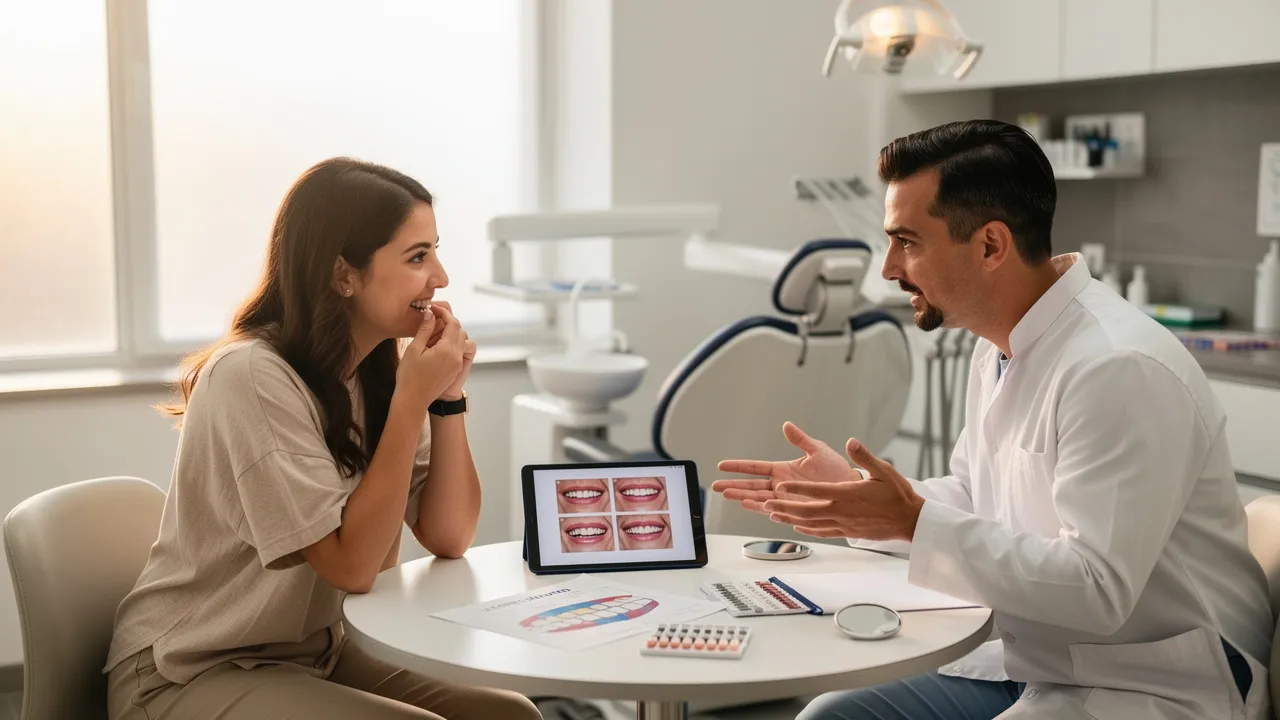
To evaluate a cosmetic dentist near South San Francisco, start with questions about training, relevant experience, communication, and planning. The label is not a protected credential, and the American Dental Association does not recognize cosmetic dentistry as a formal specialty. Ask about additional training, experience with the procedure you are considering, and how the dentist evaluates outcomes over time.
General dentistry focuses on preventive care and essential treatments, while cosmetic dentistry focuses on improving the appearance of teeth, including symmetry and color. Appearance and oral health should be considered together during planning. That makes the provider’s explanation of alternatives, restorative considerations, and what an evaluation will establish relevant to your choice.
Cosmetic dentistry can address concerns about smile color, shape, spacing, or completeness with options such as whitening, veneers, crowns, and bonding. Those concerns can look similar from the outside while raising different planning questions. A change in color is not the same decision as a concern involving a chipped, irregular, damaged, or missing part of a tooth.
You do not need to choose a treatment before an evaluation. Instead, use your search to identify a practice that will help you sort the concern, compare reasonable categories, and understand what still needs to be established before treatment is considered.
A practical way to compare a local practice with your priorities is to ask three questions:
- Does the practice offer the type of care you may need?
- What will the first visit establish?
- How will insurance or payment be planned before treatment?
The sections below turn those questions into a more detailed method for comparing cosmetic options and deciding whether to request an evaluation.
Translate your concern into a treatment category
Your smile concern gives the evaluation a starting point, but it does not select the treatment for you. Cosmetic dentistry can address color, shape, spacing, or completeness through options such as whitening, veneers, crowns, and bonding. Use those categories to describe what you want to discuss rather than treating a category as a recommendation.
For example, you might describe your concern as:
- A color change you want to understand in relation to whitening or bleaching.
- A chip, gap, or irregularity you want a dentist to evaluate.
- A shape or spacing concern that may lead to a conversation about veneers, bonding, or clear aligners.
- Damaged or missing tooth structure that may require the discussion to include restorative care.
These descriptions are useful because they tell the practice what you want to clarify. They do not establish which option fits your teeth.
Some cosmetic procedures are primarily aesthetic, while options such as crowns can also have a restorative function. Restorative dentistry may involve crowns, bridges, inlays or onlays, and dental implants to replace or rebuild damaged and missing teeth. That distinction becomes relevant when an appearance concern is connected to tooth structure that has been damaged or is no longer present.
Ask the practice to explain whether your concern is being considered as an appearance question, a restorative question, or both. You can then compare the alternatives by purpose instead of choosing the option with the most familiar name.
We offer porcelain crowns, dentures, Invisalign clear aligners, and bleaching as cosmetic dentistry treatments.
That scope gives you a specific question to ask in a South San Francisco evaluation: can the same discussion address the appearance goal and any restorative concern you may have, or should the plan separate them? The answer depends on what an examination establishes.
Use a provider-fit screen before discussing treatment
Choosing a cosmetic dentist can start with the way a practice explains care. Instead of selecting a service from a list, use the questions below to examine the provider’s preparation, relevant experience, planning process, and communication. These questions are suitable for a consultation in or near South San Francisco.
| Decision area | Question to ask | What the answer should clarify |
|---|---|---|
| Additional training | What additional training has the dentist completed in cosmetic dentistry? | The preparation the dentist brings to the discussion of cosmetic care. |
| Procedure-specific experience | How frequently does the dentist perform the procedure being considered? | Whether the conversation includes experience relevant to the care under discussion. |
| Evaluation over time | How does the dentist evaluate outcomes over time? | How the practice thinks about follow-up rather than discussing only the initial plan. |
| Oral-health context | How will the appearance goal be considered alongside oral health? | Whether appearance and oral health are addressed together during planning. |
| Alternatives | What alternatives should be explained before a plan is considered? | Which other approaches belong in the discussion and what remains to be established. |
| Restorative questions | Could restorative needs affect the purpose or sequence of the proposed care? | Whether the discussion accounts for damaged or missing tooth structure when relevant. |
| Technology | How would intraoral scans, imaging, or milling be used for planning or execution? | The role of a tool in the proposed process, without treating technology as a conclusion about care. |
| Fees and insurance | Which fees are published, how are benefits verified, and how are claims handled? | What the practice can explain about its financial processes before treatment. |
| First visit | What will the first visit establish, and will it produce a written treatment plan? | What information the initial appointment is intended to organize for further discussion. |
The value of these questions is that they test the provider’s explanation. They give you a way to compare practices by the information they provide about training, experience, planning, follow-up, technology, and costs. They also leave room for the examination to establish details that cannot be determined from a service description alone.
A provider-selection decision is different from a procedure comparison. The central question is not which name sounds most appealing. It is whether the practice can explain how it would approach your goals, what information it needs, which alternatives belong in the discussion, and how financial and follow-up questions will be handled. That makes the quality and completeness of the consultation part of the decision.
Begin with preparation and relevant experience. Ask what additional training the dentist has completed and how frequently the dentist performs the procedure you are considering. The question should be specific to the care under discussion rather than based on a general service list. You can also ask how the dentist evaluates outcomes over time. Together, these questions help you understand the background and process that the practice brings to the consultation without assuming that a particular option is appropriate before an evaluation.
Next, listen for how the practice connects appearance with oral health. Cosmetic dentistry addresses appearance, but appearance and oral health should be considered together during planning. Ask what the proposed care is intended to address, what alternatives should be explained, and whether restorative concerns could affect the purpose or sequence of the discussion. This keeps the conversation broad enough to include both cosmetic and restorative questions when the information supports doing so.
Westborough Dental Care’s published service information gives a local reader several concrete subjects to ask about. We offer porcelain crowns, dentures, Invisalign clear aligners, and bleaching as cosmetic dentistry treatments. We also use crowns, bridges, inlays/onlays, and dental implants to replace or rebuild damaged and missing teeth through restorative dentistry. Those facts describe the practice’s stated scope; they do not by themselves establish which service relates to an individual goal. Ask the practice to explain which part of its scope is relevant to the conversation and what the evaluation must establish.
Technology is another area where a clear explanation matters more than a list of equipment. We use intraoral scans, CEREC milling, and cone-beam CT to plan and execute dental procedures. Our digital dentistry also uses in-office scanning, 3D imaging, and same-day milling instead of traditional impressions, film X-rays, and lab-fabricated restorations. A useful question is how a particular tool would be used in planning or execution for the care being discussed. This keeps technology in its proper role: a subject for clarification rather than a conclusion about eligibility or results.
Cost communication belongs in the same conversation. Before choosing a practice, ask whether it offers the care you may need, what the first visit will establish, and how insurance or payment will be planned before treatment. We publish our UCR fees openly, provide verification of benefits before treatment, accept 14 in-network PPO carriers, and file out-of-network claims for our patients. Ask which of these published processes applies to the financial questions you have and which details depend on the care discussed during the evaluation.
The first visit can organize the information needed for those questions. Our first visit lasts about 60 to 90 minutes and includes a comprehensive exam, a full series of digital X-rays, a professional cleaning if gum health allows, and a written treatment plan. Before scheduling, ask what you want the visit to clarify: the scope of care, alternatives, restorative considerations, planning steps, or financial questions. During the visit, the written plan can give you a concrete basis for asking what has been established and what still needs explanation.
For a local provider decision, use the same sequence each time. First, ask about additional training and experience with the relevant procedure. Then ask how the practice evaluates outcomes over time and how it brings oral-health and restorative questions into planning. After that, ask how technology, fees, benefits, claims, and the first visit fit into the process. The answers will not replace an evaluation, but they can show whether the practice is addressing the questions that matter to your decision.
This approach also helps separate a practice’s stated capabilities from assumptions about your care. A list of cosmetic and restorative services tells you what to ask about. A description of digital tools tells you what planning processes to clarify. Published fee and insurance information tells you which financial questions to raise. A written treatment plan gives the first visit a defined subject for follow-up. Keeping those roles separate makes the consultation easier to assess without turning general information into an individualized treatment conclusion.
Before you compare fees or timelines, write down the concern you want addressed and ask for the purpose of each proposed option. If the explanation does not connect the option to your concern and preservation questions, keep the evaluation in the information-gathering stage.
Do not treat the cosmetic dentist label as proof of fit
The label can describe the kind of care you want to discuss, but it does not answer whether a particular practice has the experience or planning approach relevant to your concern.
That makes the evaluation process more useful than the title alone. Look for clear answers about the procedures you are considering, the reasoning behind the proposed plan, and the way appearance and oral health are considered together.
Ask questions that make the provider’s experience specific to your decision:
- What additional training has the dentist completed?
- How frequently does the dentist perform the procedure you are considering?
- How does the dentist evaluate outcomes over time?
- Which alternatives would be discussed if the first option does not match your priorities?
You are not looking for a credential word by itself. You are asking for information that helps you understand the provider’s approach to the procedure and the follow-up questions that come with it.
A practice that answers these questions plainly gives you more to compare than a broad cosmetic description. Keep the decision open until you understand the relevant experience, the alternatives, and how the proposed result would be assessed over time. Use the answers to assess consultation quality, not to score a practice based on a single credential or service description. A useful answer should connect relevant experience to the procedure under consideration, explain what the examination still needs to establish, and make room for alternatives. It should also address what happens after the initial decision: ask what follow-up information the practice would provide and how it evaluates outcomes over time.
A simple comparison is to record four kinds of answers for each practice: what the dentist says they have prepared to do, how they would examine or plan the care, which alternatives they would explain, and how they would discuss review or maintenance after treatment. The point is not to predict a result from the conversation. It is to see whether the practice can explain the full decision rather than only the visible change.
Use that comparison for each option you mention. For whitening or bleaching, ask what future care or reassessment questions belong in the discussion. For veneers or bonding, ask how the practice would discuss preservation, follow-up, and any repair or replacement considerations that depend on the evaluation. For crowns, ask how restorative purpose affects the plan and what should be reviewed over time. For clear aligners, ask what follow-up questions belong after the initial planning conversation. The dentist’s answers may depend on examination findings; that dependence is itself information to record, not a reason to fill gaps with assumptions.

Apply the conservative-planning test
A preservation-focused conversation should address questions such as:
- What part of the smile concern is being addressed?
- Which alternatives were considered before this option?
- How does the plan preserve healthy tooth structure?
- Does a damaged or missing tooth change the purpose of the proposed care?
- What would you need to understand before deciding whether to proceed?
These questions do not determine suitability. They help you see whether the plan is being built around your stated goal and the dental circumstances identified during evaluation.
If the discussion presents a cosmetic option without explaining preservation, alternatives, or restorative considerations, ask for that explanation before moving to fees or scheduling treatment. A clear plan should give you a reason to compare options, not pressure you to select one immediately.
Check whether Westborough covers the decision you need to make
This matters if your smile goal includes a tooth that is damaged, incomplete, or missing. The planning conversation may need to address appearance and rebuilding together rather than treating them as separate topics.
Ask whether the evaluation can cover both parts of your concern. Do not assume that a cosmetic service list alone answers a restorative question.
For a local comparison, look for a scope that matches the decision you need to make:
- If your concern is discoloration, chips, gaps, or irregularities, ask which cosmetic categories will be considered.
- If your concern involves damaged or missing tooth structure, ask how restorative options will be included.
- If you are considering clear aligners, bleaching, crowns, or another listed service, ask what the first evaluation must establish before treatment is discussed.
A match between your question and the practice’s stated scope is a reason to request information. It is not a promise that a particular treatment will be offered for your case.
Use technology as a planning question, not a promise
Technology matters when you understand what it contributes to planning or execution. We use intraoral scans, CEREC milling, and cone-beam CT to plan and execute dental procedures. Our digital dentistry uses in-office scanning, 3D imaging, and same-day milling instead of traditional impressions, film X-rays, and lab-fabricated restorations.
Those are process details. They do not by themselves establish whether a cosmetic option fits your teeth, what the final plan will cost, or what result you should expect.
Ask how each tool relates to your decision:
- What information will an intraoral scan add to the discussion?
- When would cone-beam CT or 3D imaging be relevant to planning?
- How does in-office scanning affect the way the proposed care is explained?
- What does CEREC or same-day milling change in the workflow, and what remains dependent on examination and planning?
A useful answer connects the tool to a question you already have. It should not use equipment names as a substitute for explaining the treatment categories, alternatives, preservation considerations, or costs.
Add one technology question to your appointment notes, then ask what the tool can and cannot establish for your situation. Keep the decision focused on the plan rather than assuming that a digital workflow makes a treatment appropriate.
Make cost communication part of the evaluation
Cost should be discussed beside the proposed purpose, alternatives, sequence, and insurance or payment process. Before choosing a practice, ask what care you may need, what the first visit will establish, and how insurance or payment will be planned before treatment.
We publish our UCR fees openly. We provide verification of benefits before treatment. These details give you information to use in the financial conversation, but they do not replace a case-specific explanation of which services are being considered or what your final responsibility would be.
As of November 3, 2026, we accept 14 in-network PPO carriers, and we file out-of-network claims for our patients. Insurance participation and claims handling are useful questions to raise before treatment, especially when you are comparing a cosmetic option with a restorative option.
Ask which part of the proposed care is being discussed, how benefits will be checked, whether the practice is treating the service as cosmetic or restorative for planning purposes, and which payment information you will receive before deciding. Treat benefit verification as part of planning rather than as a guarantee of coverage.
Before you leave a financial conversation, try to have these points explained:
- Which treatment categories are being considered?
- Which alternatives affect the proposed fee or sequence?
- Which published fee information applies to the services under discussion?
- How will benefits be verified before treatment?
- If your plan is out of network, how will claims be filed?
- Which costs remain dependent on what the examination establishes?
This approach keeps a published fee, an insurance process, and a personalized treatment discussion in their proper places. It also gives you questions to resolve before you commit to care.
Know what the first visit can establish
Our first visit lasts about 60 to 90 minutes and includes a comprehensive exam, a full series of digital X-rays, a professional cleaning if gum health allows, and a written treatment plan. Those components give the visit a broader purpose than selecting a cosmetic service from a menu.
The written plan can organize the questions that matter to your decision: which concern is being addressed, whether restorative considerations are involved, what alternatives should be compared, how preservation is handled, and which fee or insurance questions need clarification.
Use the first visit to establish information, not to force a treatment choice. Ask what the examination and images show about the concern you described, what the proposed categories are intended to address, and what remains open until the plan is explained.
You can also ask what the written plan will include, how alternatives will be presented, and how payment or insurance questions will be handled before treatment. A first visit is more useful when you leave knowing which questions have been answered and which need another discussion.
Bring your questions in writing and ask for the proposed sequence to be explained in plain language. If a service appears on a website but the first-visit discussion identifies a different concern, use the written plan to understand that change rather than assuming the listed service remains the next step. Add a longer-term column to those notes. For every option mentioned—whitening or bleaching, veneers, bonding, crowns, and clear aligners—record:
- What the practice says the option is intended to address.
- What alternatives will be explained.
- How healthy tooth structure and restorative concerns will be considered.
- What follow-up or maintenance questions should be answered.
- How the practice will evaluate the outcome over time.
- Which costs or financial steps depend on the final plan.
This is not a way to estimate durability or choose a treatment in advance. It is a way to prevent an initial appearance discussion from omitting the period after treatment is planned. Ask the practice to distinguish information it can explain generally from details that require examination. If the answer about follow-up differs across options, note the difference and ask what causes it. If the practice cannot yet answer a question, record it as an item for the written plan or a later discussion rather than treating the absence of an answer as evidence for or against a service.
When reviewing the written plan, look for enough detail to revisit these questions: the stated goal, the alternatives discussed, preservation and restorative considerations, the role of any technology, the expected follow-up conversation, and the fee information associated with the options. You are comparing the clarity of the planning process, not trying to calculate a lifespan or predict a result from general information. A practice that explains what is known, what remains open, and how outcomes will be reviewed gives you a more usable basis for deciding whether to proceed with further discussion.
Prepare questions before contacting the practice
Start with the concern you want to describe:
- Is my main concern color, shape, spacing, a chip, a gap, an irregularity, or missing tooth structure?
- Which treatment categories could address that concern?
- Is the question primarily cosmetic, restorative, or a combination of both?
- What information will the evaluation need before alternatives can be compared?
Cosmetic dentistry can address concerns involving color, shape, spacing, or completeness, and we offer cosmetic procedures for discoloration, chips, gaps, or irregularities. Use those terms to explain your goal without treating them as a diagnosis or a treatment selection.
Then ask about preservation and alternatives:
- How will healthy tooth structure be considered in the plan?
- Which alternatives should I compare before deciding?
- If a crown or another restorative option is discussed, what function is it intended to restore or rebuild?
- Does the proposed plan address appearance and oral health together?
Ask how that principle applies to the options being discussed instead of assuming that a broad statement answers your specific question.
Make the provider’s experience specific:
- What additional training has the dentist completed?
- How frequently does the dentist perform the procedure I am considering?
- How are outcomes evaluated over time?
- What would make another option more suitable for the concern being discussed?
These questions focus on the procedure and planning approach rather than the cosmetic label alone.
Clarify the planning process:
- Would intraoral scans, cone-beam CT, 3D imaging, or CEREC milling be relevant to the discussion?
- What will the first visit establish?
- What will the written treatment plan explain?
- Which questions cannot be answered until the examination and imaging are complete?
We use intraoral scans, CEREC milling, cone-beam CT, in-office scanning, and 3D imaging in dental procedures. Our first visit includes a comprehensive exam, digital X-rays, a cleaning if gum health allows, and a written treatment plan. Ask what those components mean for your decision rather than treating the technology itself as a reason to proceed.
Finish with financial questions:
- Which proposed options have published fee information?
- How will benefits be verified before treatment?
- Does the practice accept my plan, and how are out-of-network claims handled?
- Which costs depend on the examination, alternatives, or final sequence?
- What payment information will I receive before deciding?
We publish our UCR fees openly, provide verification of benefits before treatment, accept 14 in-network PPO carriers as of November 3, 2026, and file out-of-network claims for patients. Those processes help frame the conversation; they do not determine your final treatment plan or financial responsibility.
Bring information that makes the evaluation more useful
Bring the information the practice requests for your first visit:
- Your insurance card.
- A list of current medications.
- Any prior dental records or X-rays.
- Your written questions about appearance, preservation, alternatives, restorative needs, technology, and cost.
We ask patients to bring an insurance card, a current medication list, and prior dental records or X-rays to the first visit. Your written questions are a practical addition because they keep the discussion connected to the decision you are trying to make.
Bring the information as background for the evaluation, not as a way to determine treatment on your own. Use the visit to connect your records and concerns with the examination, images, written plan, and financial questions that still need an explanation.
Decide whether to request an evaluation
We accept new patients, and you can request an appointment through online booking or by calling us directly.
That makes an evaluation the appropriate next decision when you want to discuss your goals without selecting a cosmetic treatment in advance. Bring your questions and records, then use the written plan and financial discussion to decide whether the proposed options fit your priorities.
If your priorities do not match the services, preservation approach, planning detail, or cost communication you need, keep comparing practices before arranging treatment. A service list can identify a possible starting point, but your decision should rest on how clearly the practice addresses the questions behind your smile goal.
Take the next step with realistic expectations
Choosing a cosmetic dentist near South San Francisco is a decision about planning, not just appearance. Start with your concern, ask how cosmetic and restorative needs will be considered together, and look for an explanation of preservation, alternatives, technology, first-visit findings, and costs.
Bring your insurance card, medication list, prior records or X-rays, and the questions you want answered so the conversation can begin with your actual smile goals.
What should you ask a cosmetic dentist before choosing care?
What should I look for in a cosmetic dentist near me?
Look for a practice that connects your smile goal with oral-health and restorative considerations, explains alternatives, discusses preservation of healthy tooth structure, and makes fees and insurance processes understandable before treatment. Ask about experience with the procedure you are considering rather than relying on the “cosmetic dentist” label alone.
Can a cosmetic dentist tell me which treatment I need before an examination?
Not reliably. Whitening, veneers, bonding, crowns, and clear aligners address different concerns, and damaged or missing tooth structure may add restorative questions. An evaluation is needed to establish which categories and alternatives are relevant to your situation.
What happens during a cosmetic dentistry evaluation at Westborough Dental Care?
The practice states that its first visit lasts about 60 to 90 minutes and includes a comprehensive exam, a full series of digital X-rays, a professional cleaning if gum health allows, and a written treatment plan. Use the visit to discuss your goal, preservation, alternatives, restorative needs, and the questions that remain before treatment is considered.
What questions should I ask before choosing veneers, bonding, crowns, or aligners?
Ask what concern the proposed option is intended to address, which alternatives were considered, how healthy tooth structure will be preserved, whether restorative needs change the plan, and what the examination must establish before proceeding. You can also ask about relevant experience, expected follow-up discussions, technology used in planning, and the fee information that applies to each option.
Need help applying this?
Talk to a billing specialist who knows your payer mix.
Westborough Dental Care welcomes new patients in South San Francisco. Book a visit to meet Dr. Zoulas and the team.
Schedule a meeting