
is it safe to get dental implants in mexico
Is It Safe to Get Dental Implants in Mexico? Use a Clinic-Specific Safety Gate

Answer the safety question at the clinic level
There is no Mexico-wide yes-or-no answer to whether dental implants are safe. Your decision depends on the specific clinician, facility, treatment plan, implant components, infection-control practices, emergency arrangements, records, and follow-up plan. Medical-tourism risks vary, and the CDC says quality-of-care and infection-control practices can differ significantly outside the United States.
That means a low advertised price or a destination name cannot answer the safety question for you. A specific clinic has to provide enough information for you to assess how care will be planned, delivered, documented, and supported after you return home. Before you schedule or travel, treat the clinic as a set of questions to answer rather than as a promise to accept.
Dental implant care abroad can create several separate points of uncertainty. You may have difficulty confirming the provider’s credentials or whether the implant components meet applicable regulatory standards. Language barriers or different communication styles can create confusion before or after surgery. If a problem develops after you return home, coordinating follow-up care may be difficult or impossible. Inconsistent care standards can contribute to infection, implant failure, or corrective surgery after you return home.
The practical answer is a clinic-specific safety gate: do not move from an advertisement to a booking until you can document the answers that matter. If important answers remain vague, pause and seek another evaluation.
Use a documented safety gate before considering treatment abroad
A documented safety gate is a short set of questions and records you use before committing money, travel time, or treatment. It does not approve a clinic by itself. It gives you a consistent way to separate what the provider has documented from what the advertisement suggests.
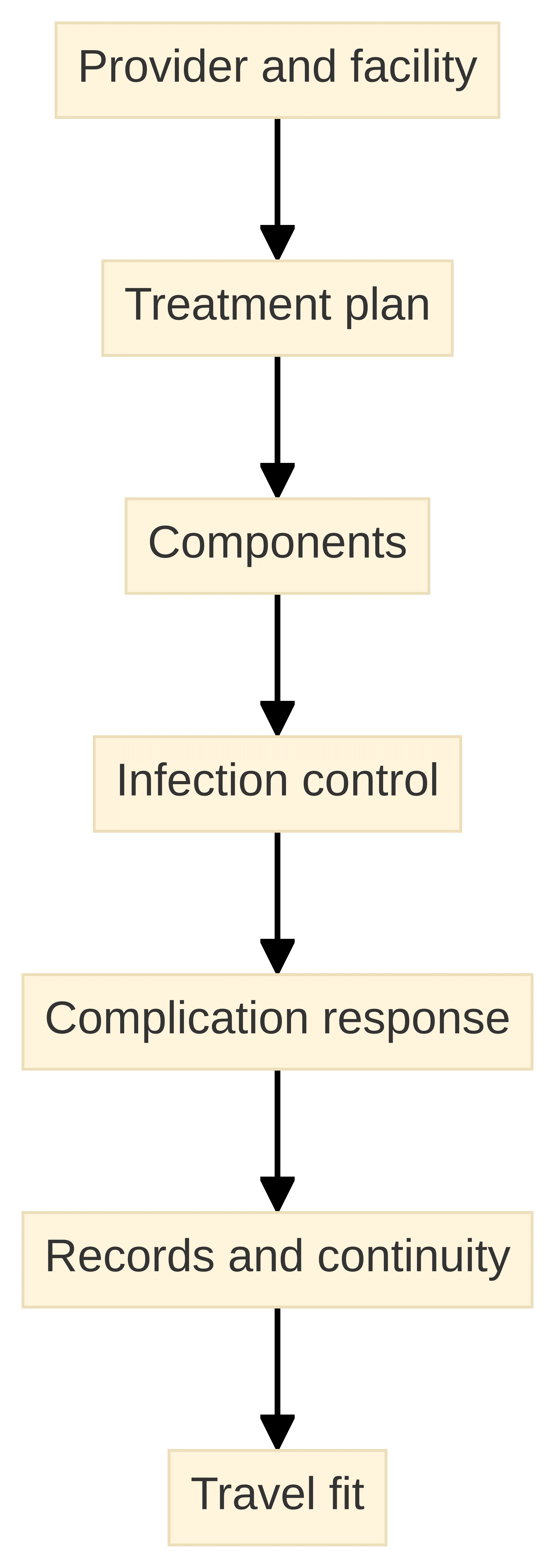
Use the gate in this order:
- Provider and facility: Can you identify the treating clinician, the facility where care will occur, and the qualifications or licensing information relevant to the planned procedure?
- Treatment plan: Do you have a written description of the proposed treatment, its stages, the teeth or spaces involved, and the circumstances that could change the plan?
- Components: Will the provider identify the implant system, abutment, restorative materials, and final crown or other restoration in your records?
- Infection control: Can the facility explain its hand hygiene, protective equipment, sterile instruments, safe injections, sharps safety, and cleaning practices?
- Complication response: Who will assess you if a problem occurs during the trip, and what happens after you return home?
- Records and continuity: Will you leave with the imaging, treatment details, component information, medications or instructions provided to you, and a contact for follow-up?
- Travel fit: Have you considered the timing of appointments, recovery between stages, travel-related health advice, and the possibility that care may take longer than planned?
Keep the answers in writing. A verbal assurance may be difficult to use when you are in another country or trying to arrange care at home.
The CDC describes Standard Precautions as the minimum infection-prevention practices for every patient, regardless of infection status or care setting. The CDC lists hand hygiene, appropriate protective equipment, respiratory hygiene, sharps safety, safe injections, sterile instruments and devices, and clean, disinfected surfaces among those precautions. Use those categories when you ask the clinic how it prevents contamination rather than accepting a general statement that the facility is clean.
The CDC also advises discussing medical travel with your U.S. primary healthcare professional well in advance and says a travel-medicine specialist could be consulted 4–6 weeks before travel. Put that conversation on your safety-gate checklist before you buy tickets or schedule a procedure.
Create one folder for the answers, estimates, treatment plan, clinician information, and travel advice. Mark each item as documented, unclear, or not provided. That simple record lets you see which decision points are still open instead of allowing several unanswered questions to disappear into a sales conversation.
Verify the clinician, facility, and infection-control practices
The clinician and facility are separate parts of the decision. Ask for the treating clinician’s full name, professional qualification, relevant implant training, license or registration information, and the facility’s name and address. Ask who will place the implant, who will provide the restoration, and whether different clinicians will handle different stages. Ask how the facility supports the planned procedure and who is responsible if the treatment moves from one clinician or location to another.
Before traveling, ask the facility to explain its infection-control process in concrete terms:
- How are hand hygiene and protective equipment handled during patient care?
- How are instruments sterilized, stored, and brought into the treatment area?
- How are injections prepared and administered safely?
- How are sharps handled?
- How are treatment surfaces cleaned and disinfected between patients?
- What training do dental personnel receive for these procedures?
These questions follow the CDC’s description of Standard Precautions, which includes hand hygiene, personal protective equipment, safe injections, sterile instruments, sharps safety, and clean, disinfected surfaces. Education and training are also identified as important to applying those precautions consistently.
Do not treat a polished website, testimonials, or a fast reply as proof of clinical standards. Ask for documents you can understand and retain. If the provider will not identify the clinician, facility, components, or infection-control process, you cannot complete the safety gate.
Older CDC dental infection-control guidance describes personnel health, exposure management, and medical follow-up as components of an infection-control program. You can therefore ask what happens if a patient or staff member has an exposure concern and who coordinates the response. The question is not whether you can predict every complication. It is whether the facility has a defined response rather than leaving you to find help after an unexpected event.
Separate the person answering your questions from the person responsible for care. A coordinator may arrange appointments, but you still need the treating clinician’s identity and the facility’s direct process for clinical questions. Ask for written answers from the provider rather than relying only on promotional descriptions or translated summaries.
Require a complete treatment and component plan
A treatment plan should tell you what the clinic intends to do, what must happen before each stage, and what information will be recorded afterward. Ask for a written plan that identifies the affected tooth or space, the proposed implant placement, the restoration, the expected sequence of appointments, and the conditions that could change the sequence. Ask which clinician is responsible for each stage and whether any part will be completed by a separate facility.
Request the component details before treatment, not only after a problem occurs. Ask for the implant manufacturer and model, the abutment information, the restorative material, and the final crown or other restoration planned for you. Ask how those details will be supplied in your records. If you are considering dental implants abroad, you may find it difficult to confirm whether implant components meet applicable regulatory standards, so component identity and documentation belong in the decision before you travel.
Do not approve a plan that gives you only a single procedure label or a package price. You need to understand what is included, what remains undecided, and what may require another appointment.
Planning information should also cover communication. Ask the clinic to explain the treatment and aftercare in a language you understand, and ask how you can reach the treating team if a question arises after surgery. Language barriers and different communication styles can create confusion before or after surgery abroad. Have the provider write down the instructions, restrictions, warning signs, contact details, and planned review appointments.
Use a simple document check before committing:
- The proposed treatment and its stages are written in plain language.
- The implant and restorative components are identified.
- The responsible clinician is named for each stage.
- The plan states what happens if the proposed treatment changes.
- The aftercare instructions and contact route are written down.
- The provider explains which records you will receive and when.
If the plan cannot answer those questions, stop comparing prices and request clarification or another opinion. A clear plan should also distinguish what has already been decided from what depends on an examination, imaging, healing, or another clinical finding.
Plan for complications and follow-up before traveling
Follow-up is part of the treatment decision, not an administrative detail to solve later. Ask who will examine you if an unexpected problem develops during the trip. Ask where that assessment will occur, how quickly the provider can respond, and what information will be sent to a clinician who sees you after you return home.
Before you leave, obtain the provider’s written aftercare instructions and an emergency contact that works outside normal appointment hours. Ask whether the plan includes a scheduled review before departure and what happens if you cannot attend it. Ask who pays for an additional visit, a change in travel, or care arranged after you return. Do not assume that a package price includes every later assessment.
If the clinic has no clear answer for complications, the risk is not limited to the procedure itself. A problem may become a records, communication, scheduling, and access problem at the same time.
The need for a local follow-up plan matters because coordinating care after you return home may be difficult or impossible. Inconsistent international care standards can contribute to infection, implant failure, or corrective surgery after you return home. Those possibilities do not show that every overseas procedure will have a complication; they show why you need a plan for what happens if care does not proceed as expected.
Ask the clinic to provide a complete handoff package for another dental professional. It should include the treatment performed, dates and stages, imaging, implant and abutment details, restorative details, medications or instructions provided, and the contact information for the treating team. If the provider will not supply those records, do not rely on memory or photographs of paperwork as your only continuity plan.
Write down the follow-up pathway in order: who you contact first, where you go during the trip, what information is sent to a professional at home, and who is responsible for communicating with you after departure. Ask the provider to explain what happens if a planned review must be postponed. If the answer depends on an informal promise, treat the arrangement as unresolved.
Compare the full practical picture, not the advertised price
A price comparison is incomplete if it counts only the advertised procedure. Build the comparison around the full path from evaluation through follow-up. Include consultations, imaging, treatment stages, restoration, medications or aftercare supplies, additional appointments, travel, lodging, time away from work, changes to transportation, and care arranged if a problem develops. Do not assume that a lower quoted price remains lower after those items are included.
Use this table to organize the practical difference between treatment abroad and a local evaluation. It does not rank either option or predict your clinical result.
| Criterion | Treatment abroad | Local evaluation and follow-up |
|---|---|---|
| Initial planning | Requires remote communication, travel scheduling, and confirmation of the treating facility before departure. | Lets you discuss the proposed plan in the area where evaluation and later communication may occur. |
| Records and components | You need to obtain the full treatment and component record before leaving the provider or country. | You can ask for records during local visits and use them in later referrals. |
| Complication response | A problem after returning home may make follow-up difficult or impossible. | Follow-up does not require an international return trip, although the appropriate provider still has to be identified. |
| Travel burden | Adds transport, lodging, timing, and travel-health decisions to the care plan. | Removes the international travel portion of the decision, while appointments still require time and planning. |
| Cost comparison | Requires a total that includes care, travel, and possible additional arrangements. | Requires a total that includes the proposed care and its follow-up, not just an initial consultation. |
The right choice still depends on the specific plan and your circumstances. Use the table to identify questions, not to treat location alone as proof of safety.
Ask each provider the same questions about what is included and what is excluded. Request a written estimate that separates evaluation, imaging, surgery, components, restoration, follow-up, and possible additional services. Ask when the price could change and whether a complication or an altered treatment plan creates a new charge.
A useful comparison has at least three separate totals:
- The amount paid directly for the planned dental care.
- The travel and time costs required to receive that care.
- The possible costs of additional appointments, changed travel, or care after you return home.
Keep those categories separate even if a provider presents them as one package. A single total can hide which part of the plan changes when the treatment sequence changes. Do not let a cost comparison replace the safety gate. A clinic that cannot document the treating clinician, components, infection-control practices, or follow-up plan has left material questions unanswered, regardless of its quoted price.
Prepare for travel as part of the care decision
Build a travel contingency plan before you depart:
A CDC report recommends seeking a pretravel medical consultation 4–6 weeks before international travel.
- Leave enough time for the planned appointments and any review the clinic requires.
- Keep the facility’s address, clinician’s name, emergency contact, and appointment schedule accessible.
- Carry copies of your treatment plan, medication information, and relevant dental records.
- Ask what happens if travel is delayed or you need an extra appointment.
- Decide how you will communicate with the clinic after returning home.
- Keep enough flexibility to respond if the planned sequence changes.
Travel does not make a procedure unsafe by itself, but it can make an unresolved problem harder to manage. If the clinic cannot explain how travel timing and follow-up fit together, pause before booking. Your travel plan should match the treatment stages rather than assume that every visit will fit into a fixed itinerary.
Recognize warning signs that justify a pause or second opinion
A warning sign is an unanswered question that affects safety, continuity, or your ability to make an informed choice. Pause and request clarification when:
- The provider will not identify the treating clinician or facility.
- Qualifications, licensing information, or the responsible clinician for each stage are not provided.
- The clinic gives a package label instead of a written treatment sequence.
- The implant, abutment, or restorative components are not identified in advance.
- Infection-control answers stay general and do not address hand hygiene, protective equipment, sterile instruments, safe injections, sharps safety, or surface disinfection.
- The clinic cannot explain who will respond to a complication during the trip.
- No written plan exists for records and follow-up after you return home.
- Communication is unclear enough that you cannot repeat the treatment and aftercare instructions in your own words.
- The quoted price cannot be separated into included care, excluded care, and possible changes.
These are decision boundaries, not predictions about what will happen. The CDC identifies the listed infection-prevention practices as Standard Precautions, and international dental-tourism guidance describes credential checks, component standards, communication, and follow-up as practical concerns. Unanswered material questions justify waiting.
Ask for a second opinion when the proposed treatment changes without a clear explanation, when the provider cannot give you the records you need, or when the care plan depends on you accepting uncertainty about who will manage a problem later. A second opinion can focus on the plan and documentation rather than on choosing a destination.
Do not allow urgency, a limited-time price, or a promise of a fast appointment to replace the questions above. If you cannot document the answer, you are not ready to commit. You can also pause when the provider gives conflicting answers about the clinician, treatment stages, components, price, or follow-up route. Write down the conflict and ask for one consistent written explanation before making a decision.
Compare continuity abroad with a local evaluation
The relevant comparison is not “foreign care versus American care” as a broad category. Compare the actual continuity available through the specific provider with the continuity available through a local evaluation. Treatment abroad may involve a distant clinician, international travel, different communication arrangements, and a possible gap between the team that performed the procedure and the professional you contact after returning home. The CDC says medical-tourism risks vary by factors that include quality of care and infection-control practices, and those practices can differ significantly outside the United States.
A local evaluation does not guarantee a particular result or remove the need to ask questions. It can give you a nearby setting in which to discuss your concerns, organize records, understand the proposed stages, and plan how referrals or follow-up would be handled. Choose based on the documented plan and continuity you can actually access, not on a country label.
At Westborough Dental Care in South San Francisco, we handle implant placement, abutment placement, and the final crown in-house using digital surgical guides. We use intraoral scans, CEREC milling, and cone-beam CT to plan and execute dental procedures. We offer a first visit of about 60–90 minutes with a comprehensive exam, full-series digital X-rays, a cleaning when gum health allows, and a written treatment plan.
Those are details about our local process, not a claim that local care is automatically right for you or that we can assess a Mexico-based provider from a distance. We can also transfer digital records if you need a specialist referral.
Use a local evaluation as a way to clarify your questions before committing to care abroad if you need help understanding the proposed treatment, the records you have received, or the stages you should expect.
Your comparison should end with a documented choice. Either the Mexico-based provider answers the safety gate and gives you a workable continuity plan, or you pause and pursue an evaluation closer to home. If you choose the local route, bring the foreign provider’s written plan and component information so the discussion can address specific questions rather than an advertised package.
Leave with a complete care record and aftercare plan
Before leaving the provider or the country, collect the information another dental professional would need to understand what was done and what comes next. Ask for both digital and printed copies when practical, and keep them somewhere you can access during travel.
Your record checklist should include:
- The clinician’s name and the facility’s contact information.
- The examination findings and imaging used for planning.
- The written treatment plan and the stages completed.
- The date and location of each procedure.
- The implant manufacturer, model, and identifying information.
- The abutment and restorative component details.
- The final crown or other restoration information.
- Medication instructions and written aftercare directions.
- The scheduled review date and the contact for questions or complications.
- Instructions for the professional who may provide care after you return.
Ask the clinic to explain every record in a language you understand. If any item is unavailable, ask when and how it will be supplied. Do not leave with only a receipt or a generic treatment name.
Your aftercare plan should answer what to do during the trip, what review is expected before departure, and whom to contact after returning home. It should also explain how records will be shared if another clinician needs to assess you. Follow-up may be difficult or impossible to coordinate after a problem develops at home, so make the handoff concrete before you travel.
Older CDC dental infection-control guidance includes exposure management and medical follow-up within an infection-control program. Ask how the provider documents and communicates an exposure concern or other event that requires care. A complete handoff does not promise that complications will not occur. It gives you the information needed to explain the treatment and seek appropriate attention if the plan changes.
Before you leave, compare the documents against the treatment you actually received. Check that the completed stages, implant details, restorative information, instructions, and follow-up contact are present. Keep the final record with your other health information and make sure you can share it with a professional at home if necessary.
Choose the next step after the safety questions are answered
Dental implants in Mexico may be worth investigating only after you can document the specific clinician, facility, treatment and component plan, infection-control practices, complication response, travel preparation, records, and follow-up. If a material answer remains unclear, pause rather than allowing location or price to make the decision for you. A qualified dental professional must assess your individual oral and medical circumstances, and travel-medicine advice should be tailored to your destination and needs.
If you prefer to begin with a local evaluation, we provide restorative-dentistry care in South San Francisco. Our first visit includes a comprehensive exam, full-series digital X-rays, a cleaning if gum health allows, and a written treatment plan; bring your medication list and prior dental records or X-rays so the conversation can address your questions directly.
What should you confirm before committing to dental implants in Mexico?
What should I consider before getting dental implants in Mexico?
Evaluate the specific clinician, facility, treatment plan, infection-control practices, and follow-up arrangements. Ensure you have documented answers to key questions before committing to treatment.
How can I verify the qualifications of a dental provider in Mexico?
Request the clinician’s full name, professional qualifications, relevant training, and the facility’s licensing information. Ensure you can confirm these details before proceeding.
What are the potential risks of dental tourism for implants?
Risks include varying safety and quality standards, difficulty in confirming provider credentials, language barriers, and challenges in coordinating follow-up care if complications arise.
What steps should I take for follow-up care after dental treatment abroad?
Obtain a complete record of your treatment, including details about the procedure, implant components, and aftercare instructions. Ensure you have a clear plan for follow-up with a local provider.
How can I assess the infection control practices of a dental clinic in Mexico?
Ask the clinic about their hand hygiene, sterilization procedures, use of personal protective equipment, and how they handle injections and surface disinfection.
What should I include in my travel contingency plan for dental treatment abroad?
Ensure you have the clinic’s contact information, a copy of your treatment plan, and a plan for communication after returning home. Consider potential delays and how they might affect your care.
What warning signs should prompt me to reconsider dental treatment in Mexico?
Be cautious if the provider cannot identify the treating clinician, does not provide clear treatment plans, or if infection-control practices are not adequately explained.
Need help applying this?
Talk to a billing specialist who knows your payer mix.
Westborough Dental Care welcomes new patients in South San Francisco. Book a visit to meet Dr. Zoulas and the team.
Schedule a meeting