
preparing a tooth for a crown
Preparing a Tooth for a Crown: What to Expect
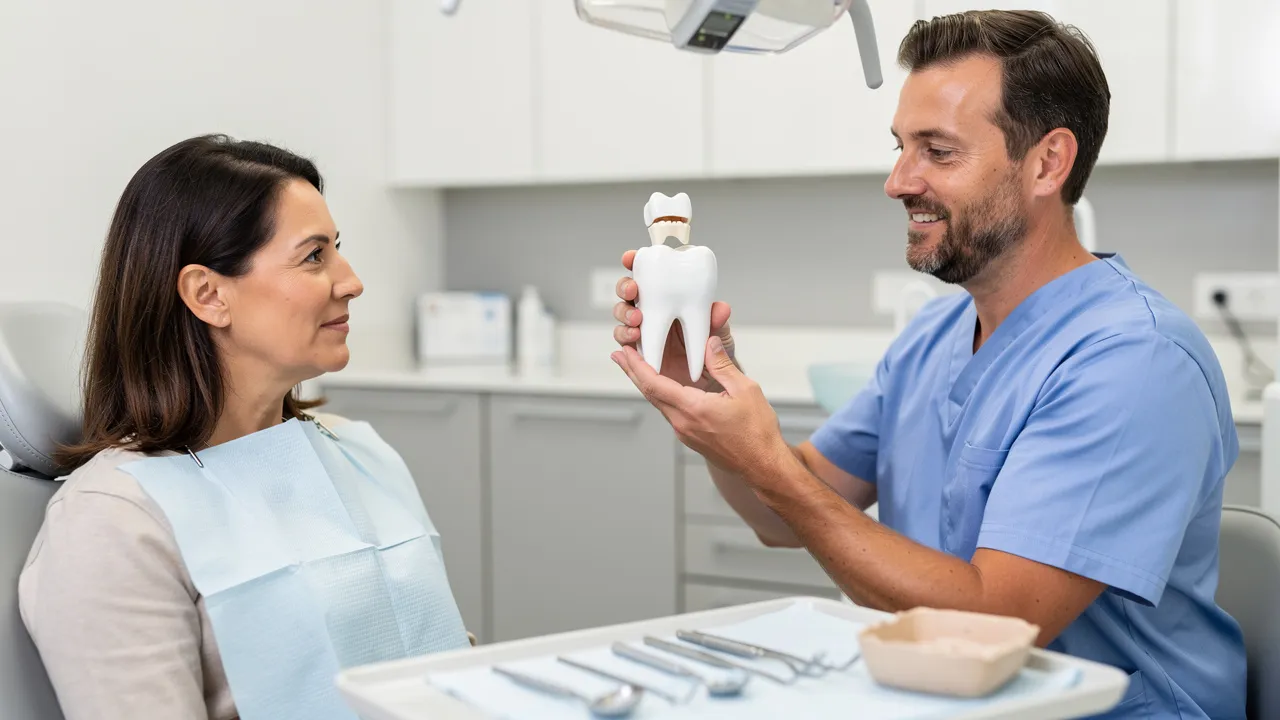
Why evaluation comes before crown preparation
A dental crown is a tooth-shaped cover placed over a damaged tooth; the tooth is reduced to make room, while its root remains for support. A crown may be considered when damage is too extensive for a filling, but suitability depends on the individual tooth and treatment plan.
The condition of your tooth guides the restorative choice. A filling, inlay, onlay, crown, or root canal treatment may be considered for different conditions, depending on how much sound tooth remains. The choice between a filling and a crown is driven by the remaining tooth structure around the cavity, not by whether the tooth hurts. An inlay sits inside the chewing surface, an onlay replaces one or more cusps, and a crown covers the whole visible tooth; the most conservative option that is strong enough is usually preferred.
Crown preparation is also a long-term treatment decision. Crowns typically last around 5 to 15 years, and decay can still form where the crown meets the tooth. Ask what problem the proposed crown is meant to address, how much sound structure remains, and which alternatives might preserve more of your natural tooth. Those questions give you a clearer basis for deciding whether to proceed with an evaluation.
Assess the tooth before it is shaped
The dental examination comes before the tooth is shaped. Your dentist examines the tooth and may review or take X-rays as part of the evaluation. The assessment can help identify how much sound structure remains and whether decay, a crack, gum concerns, or a problem inside the tooth changes the proposed plan. The examination and treatment plan determine which details apply to your tooth.
Additional treatment may come before a crown. A root canal may be needed when the pulp chamber has been penetrated or decay or infection reaches the pulp. Some teeth require a core buildup or root canal when decay is extensive or nerve damage is present. Periodontal surgery may be required for decay below the gumline, a crown fracture, or inadequate crown length; crown lengthening can create room for preparation and reestablish biologic width. These possibilities do not diagnose your tooth. They explain why the plan may involve more than shaping and covering it.
A 2023 review combining 37 studies found that about 5 in 100 crowned teeth developed pulp death. The evidence was low certainty, so the figure is an estimate rather than a precise prediction for your tooth. The tooth’s history matters, especially when decay, large fillings, cracks, or symptoms were present before treatment. Ask how your symptoms and examination findings affect the proposed sequence before the irreversible preparation begins.
The same evaluation applies if you are considering a same-day crown. Ask why the crown is needed and whether a same-day approach is appropriate. Candidacy depends on the tooth, bite, gum health, and remaining tooth structure, so a shorter schedule is not automatically suitable for every tooth.
What tooth preparation changes
Tooth preparation removes decay, old filling material, and some healthy enamel, then shapes the tooth for the crown. The dentist controls the amount of tooth structure removed because over-reduction can compromise the tooth’s integrity. Crown preparation is irreversible because the tooth structure removed will not grow back. That is why the examination, restoration choice, and preparation design need to fit the individual tooth.
The amount of reduction is not identical for every tooth or crown. Dentists may aim for about 3 millimeters for front teeth and premolars and about 4 millimeters for molars, with the crown material also affecting the design. A traditional crown may involve removing about 1 to 2 millimeters of tooth structure. These figures may reflect different measurement conventions, tooth surfaces, materials, or preparation designs. Ask your dentist to explain the planned reduction for your tooth rather than applying either figure as a personal rule.
A traditional crown procedure takes two visits: roughly 60 to 90 minutes for preparation and 20 to 45 minutes for fitting, separated by 1 to 3 weeks of laboratory fabrication. A same-day workflow can differ. For a same-day crown, the dentist scans the prepared tooth, designs the crown digitally, mills it from a solid ceramic block in about 15 to 30 minutes, and cements it during the same appointment. The treatment plan and available equipment determine which schedule applies.
The tooth’s history remains relevant after preparation. Tell the dentist about pain, sensitivity, prior treatment, or a crack before the tooth is shaped.
What the preparation visit may feel like
Local anesthesia changes what preparation may feel like. With effective local anesthesia, preparation may feel like pressure or vibration rather than sharp pain. You may notice the sound and movement of the instruments, but tell the dental team if you feel a sharp sensation or need a pause. Comfort during the procedure and sensations after the appointment are separate parts of the experience.
Sensitivity after preparation may come from dentin exposure, nerve irritation, the temporary crown’s level of protection, the crown material, or your mouth’s adjustment to the restoration. After the anesthetic wears off, slight soreness for a day or two and temporary temperature sensitivity may occur and are usually mild. Sensitivity may be more noticeable during an adjustment period and usually diminishes as your mouth adapts.
A full crown preparation may expose approximately 1 to 2 million dentin tubules. That exposure can increase dentin permeability and lead to pulpal irritation. Clinical experiments found that preparing vital teeth for full-coverage crowns can cause sharp, transient pain from dentin hypersensitivity in the majority of cases. Those findings describe possible sensitivity around or after preparation, while effective local anesthesia addresses sensation during the procedure. The risk of pulpal damage may depend on heat from bur attrition, remaining dentin, dentin permeability, provisional-crown construction, cement quality, and marginal infiltration. Those factors can help explain why recovery expectations may differ between teeth. A dentist can discuss which factors are relevant during the examination.
Scan the tooth and protect it temporarily
An impression or digital scan records the prepared tooth, adjacent teeth, and bite so the laboratory can fabricate the permanent crown. A physical impression uses a material that sets around the teeth, while some dental offices use a tool to create a virtual 3D model instead. Both approaches are intended to capture the information needed for the planned restoration.
A temporary crown covers and protects the prepared tooth while the permanent crown is made. It can help maintain tooth position, gum contours, spacing, appearance, and chewing comfort during the interim stage. A temporary crown is usually acrylic and held with temporary cement. It is a provisional restoration, so it may protect or fit differently from the final crown.
The first traditional crown appointment includes preparation, impressions, and temporary crown placement and lasts 60 to 90 minutes. Among cracked teeth with inflamed but not irreversibly damaged pulps, about 1 in 5 needed root canal treatment within about 6 months after being crowned without a root canal first. That finding applies to a specific group of cracked teeth, not to every prepared tooth, so report existing symptoms and cracks during the evaluation.
Plan around the usual visits and timing
Traditional crown treatment usually involves two appointments. The first appointment covers preparation, an impression or scan, and temporary protection. The second appointment includes permanent-crown try-in, fit and bite checks, adjustment, and cementation. The traditional procedure takes two appointments spread over roughly 2 to 3 weeks, while the laboratory builds the permanent crown over 1 to 2 weeks. The exact calendar depends on the tooth, laboratory, treatment plan, and practice.
A same-day crown system can complete the process in one longer appointment lasting 2 to 3 hours. These ranges describe workflows, not a promise for your appointment.
Schedule questions are worth asking before treatment. Ask whether your plan uses a laboratory-made crown or an in-office workflow, whether you will wear a temporary crown, how many visits are expected, and which steps could change the timing. A reported U.S. fee range places $2,000 within the normal range for a crown; a quote far above or below the local norm may justify a second opinion. This is general context, not an individualized price assessment.
Prepare for the appointment and bring focused questions
Appointment preparation starts with information you can bring. Before the appointment, prepare a written medication list and your questions, tell the dental team about every medication and supplement, and eat a normal or light meal unless the dentist gives different instructions. If sedation is planned, ask the dental office what transportation or eating instructions apply rather than assuming the general guidance fits your appointment.
Our first visit at Westborough Dental Care lasts about 60 to 90 minutes. We ask you to bring your insurance card, a list of current medications, and any prior dental records or X-rays; our first-visit information also asks you to bring comfortable clothes. We accept new patients and allow appointment requests through online booking or by calling us directly.
Focused questions can make the evaluation more useful. Ask your dentist:
- Why is a crown being considered for this tooth?
- How much sound tooth remains, and are a filling, inlay, or onlay reasonable alternatives?
- Does the tooth show signs that could require a root canal, core buildup, or gum treatment first?
- Is a same-day approach appropriate for this tooth, bite, gums, and remaining structure?
- What will happen if the tooth becomes sensitive after preparation?
- Which steps, visits, temporary restoration, and costs are included in the plan?
In one study recalling patients 10 to 19 years after treatment, about 16 in 100 vital single crowns and about 33 in 100 bridge retainers had needed endodontic treatment. Insurance records covering 88,409 crown placements found that about 3.5 in 100 needed root canal treatment and roughly 9 in 10 had no complication after 9 years. These figures describe different populations and time periods, so use them as context for questions rather than as a forecast for your tooth.
Expect mild early sensitivity and monitor recovery
Early recovery can include mild soreness, gum tenderness, or sensitivity to temperature and pressure. Some mild soreness or temperature sensitivity is common for 1 to 3 days after the first visit, while another source describes sensitivity as often peaking within the first 48 hours and fading over 1 to 2 weeks. Brief cold sensitivity and mild gum tenderness may occur after treatment. Most people can resume normal activities immediately after each appointment, although the tooth may remain sensitive while your mouth adjusts.
Your response should guide the next step. Contact a dentist for pain when biting, a loose crown, lingering or throbbing pain, swelling, fever, or a bad taste. Brief sensitivity may improve as the restoration settles, but severe, worsening, or persistent symptoms need dental assessment. Do not treat a continuing problem as ordinary recovery simply because some sensitivity after preparation can be expected.

Handle the temporary crown safely between visits
A temporary crown may not fit as well as the final crown, may come loose with gum or sticky foods, and may cause sensitivity to heat or cold. It protects the prepared tooth, maintains spacing, and allows normal function until the permanent crown arrives. Follow the dental office’s specific care instructions, and use caution with foods or habits that could dislodge the temporary restoration.
If your temporary crown falls out, keep the piece, avoid chewing on that side, and contact the dentist promptly. Do not glue or force the temporary back into place; household glue is not appropriate for your mouth. The dental office can decide how to manage the exposed tooth and temporary restoration.
The second appointment involves permanent crown try-in and cementation and lasts 30 to 60 minutes. During that visit, the dentist checks the fit and bite before the permanent crown is cemented. Tell the dental team about sensitivity, pressure, looseness, or chewing changes from the temporary so those details are part of the follow-up discussion.
Use cost ranges as planning context, not a quote
The reported national average cost for a dental crown ranges from $500 to $2,000. That is a reported U.S. range for crown treatment, not a preparation-only fee or an individualized quote. The final price can vary with case complexity and whether the crown is cosmetic or restorative. Treat the range as an early planning figure rather than the amount you will necessarily owe.
Crown price can vary with several parts of the plan:
- The crown material
- The tooth’s location
- Preparatory work such as a root canal, core buildup, or gum treatment
- Case complexity
- Geographic location
- Insurance coverage
For the crown categories described here, average prices are around $450 for temporary or provisional crowns, around $1,100 for porcelain-fused-to-metal crowns, and around $1,200 to $1,800 for all-ceramic and zirconia crowns. These are averages for described crown categories, not a preparation fee for your specific tooth.
Insurance changes the amount you may pay, but the policy controls the result. Most plans cover part of a restorative crown, while coverage typically does not apply to a purely cosmetic crown. Ask your insurer or benefits coordinator about the plan’s deductible, waiting period, annual limit, replacement rules, exclusions, and estimated share before treatment.
Our published practice information states that we provide written treatment plans with cost estimates for free and publish UCR fees. Our same-day porcelain or ceramic crowns cost $2,334. That practice-specific price is not directly comparable with the reported national average because it describes a particular material and same-day workflow. Your written plan should make clear which examination, preparation, temporary or permanent restoration, laboratory work, and related treatment the quoted amount includes.
Use these questions to make estimates easier to compare:
- Is the amount for preparation, the crown, or the full treatment sequence?
- Is a temporary crown included?
- Are X-rays, scans, impressions, laboratory work, cementation, or adjustments separate charges?
- Could a root canal, core buildup, gum treatment, or another restoration change the total?
- Which part might insurance cover, and what remains your responsibility?
A clear estimate connects the price to the tooth and treatment plan instead of presenting a single number without context. A reader comparing two dental estimates should match the unit of comparison: a complete crown sequence, the crown alone, or a single preparatory service. A lower headline price may reflect fewer included services rather than a lower total for the same treatment plan. The reported U.S. range of $500 to $2,000 describes crown treatment and does not establish a separate fee for tooth preparation alone. A reader should ask whether examination, X-rays, preparation, temporary protection, laboratory work, cementation, and follow-up adjustments are included or billed separately. A reader should also ask whether a root canal, core buildup, or gum treatment is included, excluded, or contingent on examination findings. Same-day and traditional workflows also should be compared by included services and temporary-crown care, not only by number of visits. An insurer’s estimate should be checked against the policy’s benefit rules rather than treated as a guaranteed payment. A written estimate can show whether a price difference reflects different care, different materials, or different coverage assumptions.
Know when dental or emergency help is needed
Certain symptoms need prompt qualified care. Seek urgent dental care for sharp pain, visible missing tooth pieces, swollen gums, or bleeding that will not stop. Facial swelling or fever with toothache, or difficulty swallowing after dental treatment, are red flags requiring same-day care. Contact a dental office promptly for lingering or throbbing pain, a loose temporary or crown, a bad taste, or pain when biting.
Rapidly spreading facial swelling or trouble breathing requires emergency help. Go to an emergency room immediately if facial swelling spreads quickly or you have trouble breathing. Do not wait for a routine crown appointment when breathing is affected.
If a tooth breaks and pieces are missing, save what you can and seek urgent dental care rather than trying to repair the tooth yourself.
A Singapore study of 199 teeth found that 29% developed irreversible inflammation or pulp death within 3 years. That figure concerns a specific study population and cannot determine what your symptoms mean. Use the symptom-based actions above and arrange qualified care when your condition is severe, worsening, or outside the mild early sensitivity pattern.
Use your questions to choose the next appointment step
Preparing a tooth for a crown usually moves from evaluation and possible X-ray review to numbing, controlled shaping, an impression or scan, temporary protection, and permanent-crown fitting. Your tooth’s remaining structure, pulp and gum condition, bite, symptoms, treatment design, schedule, and cost determine which parts apply. Bring your medication list, records, insurance information, and focused questions so a qualified dentist can explain the appropriate next step for your tooth.
Practical questions before preparing a tooth for a crown
Does preparing a tooth for a crown hurt?
With effective local anesthesia, preparation may feel like pressure or vibration rather than sharp pain. Afterward, mild soreness or temperature sensitivity can occur and often improves within a few days, although some sensitivity may last longer as the tooth adjusts. Severe, worsening, lingering, or throbbing pain should be assessed by a dentist.
How long does the first crown appointment take?
The first traditional visit commonly takes about 60 to 120 minutes, depending on the tooth, treatment plan, and case complexity. It may include examination or X-ray review, numbing, shaping, an impression or scan, and temporary-crown placement. Ask the dental office for an appointment-specific estimate.
What does preparing a tooth for a crown typically cost?
A reported U.S. range for complete crown treatment is about $500 to $2,000, but that is not a quote and may not include every related service. Material, tooth location, case complexity, laboratory work, preparatory treatment, geography, and insurance can change the total, so request a written estimate showing what is included.
Need help applying this?
Talk to a billing specialist who knows your payer mix.
Westborough Dental Care welcomes new patients in South San Francisco. Book a visit to meet Dr. Zoulas and the team.
Schedule a meeting