types of cosmetic dentistry
Types of Cosmetic Dentistry: Compare Whitening, Bonding, Veneers, Crowns, and Clear Aligners
A practical way to compare cosmetic dentistry
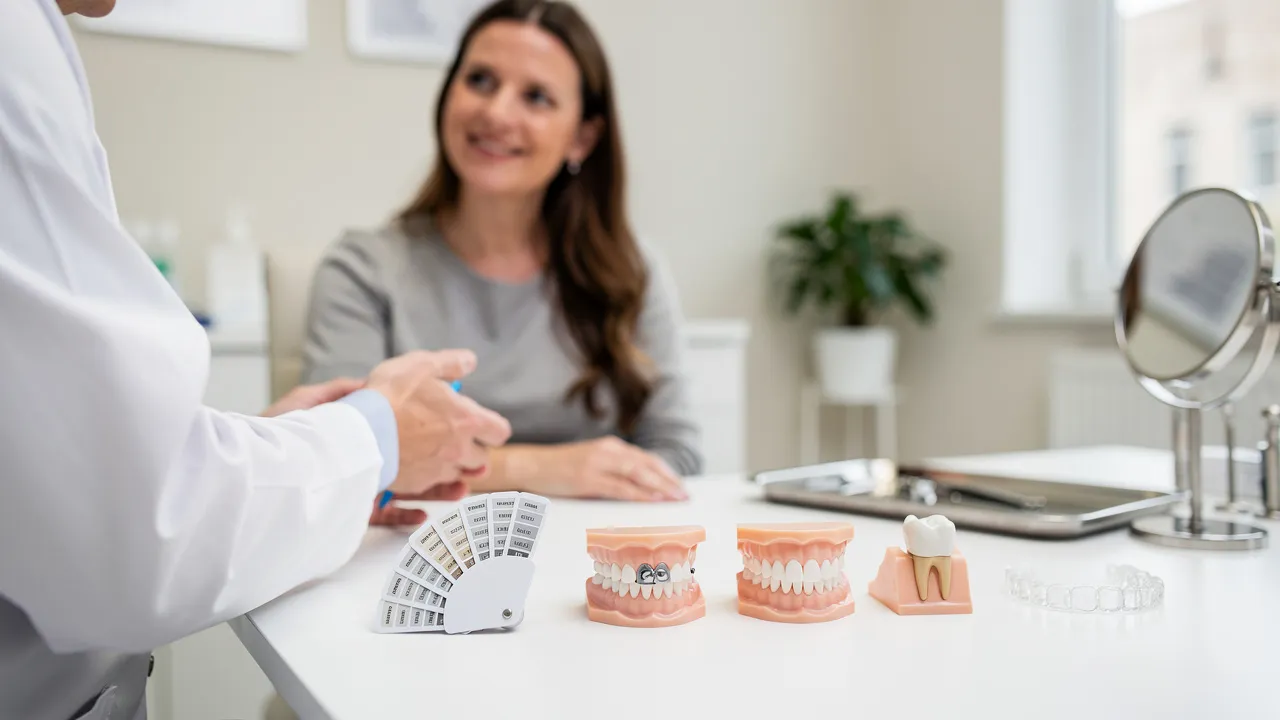
Cosmetic dentistry commonly includes teeth whitening, dental bonding, veneers, crowns, and clear aligners. These options do not all solve the same kind of concern. Whitening changes color, bonding can repair or reshape a small area, veneers change the visible front surface of selected teeth, crowns cover an entire tooth when strength matters, and clear aligners move teeth gradually.
A useful comparison asks four questions: what you want to change, how much natural tooth structure the option preserves, what trade-offs come with it, and whether the treatment is primarily cosmetic or also restorative. Preservation is only one part of the decision. A less invasive option may still require maintenance, while a more extensive restoration may be discussed because a tooth needs structural support. That approach keeps a procedure name from deciding the conversation before your teeth have been examined.
Your first step is to describe the appearance issue and the scope of change you want to discuss without choosing a procedure in advance. You might be concerned about color, a chipped edge, spacing, crowding, tooth shape, or several issues at once. Your budget and preferred timeline also belong in the discussion, but they do not replace an examination.
Use this guide to organize that conversation. A dental examination is needed to determine which treatment suits your teeth. Bring a clear description of the change you want rather than assuming the most visible concern identifies the right procedure.
Whitening: change color without changing shape
Teeth whitening focuses on tooth color rather than tooth shape and does not require a change to natural tooth structure. It may help with surface stains associated with coffee, tea, wine, tobacco, or normal enamel changes. Whitening can brighten natural teeth, but it does not change their shape or fix deep discoloration.
That makes whitening a narrow option when color is your main concern. It is not a way to close a gap, repair a chip, or alter a crooked tooth. If the concern involves shape, position, or a deeper change in color, ask what alternatives should be considered rather than extending whitening on your own.
Dentist-supervised whitening includes at-home and in-office options, while over-the-counter whiteners are another category. Custom-tray whitening uses gel placed in dentist-made trays at home. The trays are designed to fit comfortably and minimize gel contact with the gingiva.
At-home systems typically use 10% to 38% carbamide peroxide, with treatment time primarily determined by concentration. A cited systematic review found daily treatment times ranging from 2 to 10 hours over periods of 6 to 28 days. Those figures describe the reviewed systems, not a schedule you should choose without professional instructions. Ask which type of whitening is being discussed and how its directions apply to your teeth.
Whitening affects natural teeth, not tooth-colored restorations such as crowns, veneers, or bonding. If your smile includes both natural teeth and restorations, shade matching and treatment order are questions for the dental consultation.
The most common adverse effects of vital tooth whitening are temporary tooth sensitivity and gingival inflammation. One described whitening appointment lasts about an hour and can make teeth about 5 to 10 shades brighter; results are generally noticed 24 hours after application. That example is a reported treatment description, not a promised result or timeline for you. Ask what sensitivity or gum irritation would mean for your proposed approach.

Bonding: repair or reshape while preserving more tooth structure
Dental bonding uses tooth-colored composite resin applied directly to the tooth, shaped by hand, and hardened with a curing light. Bonding can address small gaps, minor chips, localized discoloration, or the shape of a single tooth. Because little or no enamel needs to be removed, bonding is considered one of the few reversible cosmetic procedures.
Composite bonding typically takes 30 to 60 minutes per tooth and is usually completed in a single office visit. The practical advantage is a limited change to a small area; the trade-off is that the material can stain more easily than porcelain and can chip more easily under heavy bite forces. Ask whether the location of the bonding and your bite could affect maintenance.
Oral health problems can change the order of treatment. If you have an issue such as tooth decay, you may need other treatment before bonding.
Bonding is therefore best discussed as part of the condition of the tooth, not only its visible shape. Ask whether the proposed work repairs an appearance issue, addresses a weakened area, or needs to wait until another problem has been treated.
One Massachusetts cost guide lists cosmetic bonding at $200 to $800 per tooth, in-office whitening at $300 to $1,000, take-home whitening trays at $150 to $600, porcelain veneers at $1,400 to $2,600 per tooth, composite veneers at $630 to $1,510 per tooth, and Invisalign at $3,500 to $8,000. These are listed figures from a Massachusetts guide, not fees for every practice or a quote for your treatment.
Use the bonding range as a prompt to ask what the fee includes, how many teeth are involved, and what future repair or maintenance could cost. A lower initial price does not by itself describe the amount of tooth change, the expected service life, or the scope of follow-up.
Veneers: broader visible change with a lasting commitment
Porcelain veneers are thin shells placed on the front of selected teeth to change their shape, length, color, or minor spacing. They may be discussed when several visible concerns occur together, including discoloration, chips, gaps, or minor misalignment. Veneers address the front appearance of a tooth; they do not serve the same structural role as a crown.
Veneers require some preparation of the natural tooth and are a more permanent commitment than whitening or bonding. One cited comparison lists removal of 0.5 to 0.7 mm of enamel and describes that change as irreversible.
Ask which teeth would be included, how much preparation each tooth requires, and what alternatives could address the same concern with less alteration.
No-prep veneers are thin translucent porcelain shells requiring minimal to no removal of natural tooth enamel. That description does not make them suitable for every situation. Because they are typically thinner, no-prep veneers may not effectively cover more significant dental imperfections. Ask what preparation a proposed veneer requires for each tooth rather than assuming that every veneer follows the same process.
The useful comparison is not simply traditional versus no-prep. Ask what each option can change, what it cannot cover, how it would affect the tooth, and whether the proposed result depends on treating several teeth together.
One provider source reports dental veneer prices between $350 and $3,000 per tooth, depending partly on material and clinic location. A separate comparison lists porcelain veneers as lasting 10 to 15 years, while another source states that front-teeth veneers may require restoration every 10 to 20 years. The different ranges show why material, tooth condition, habits, maintenance, and the source of the estimate should be discussed before you compare a total price.
Ask whether the estimate covers one tooth or a group of teeth, what future restoration could involve, and how the proposed material affects the maintenance discussion. A service-life range is a planning consideration, not a promise that a veneer will remain unchanged for a particular number of years.
Crowns: when appearance and tooth strength meet
Dental crowns cap an entire tooth and are typically used when that tooth needs structural support, not only a cosmetic change. Crowns may be considered for teeth with large fillings, cracks, significant wear, or root canal treatment, where durability matters as much as appearance. They cover the whole tooth rather than only its front surface.
One cited comparison lists removal of 1 to 2 mm from all sides of the tooth and describes that change as irreversible. That preparation is materially different from bonding and more extensive than the preparation described for veneers, so ask why full coverage is being considered for a particular tooth. The answer should connect the proposed coverage to the tooth’s condition, not only to the appearance you want.
Crowns require more preparation than veneers and are not reversible. They may also cause tooth sensitivity that is usually temporary but can be uncomfortable in the short term. Crowns are often recommended when a tooth cannot be restored with veneers or bonding, including teeth that are severely damaged or decayed.
The central comparison is therefore not simply crown versus veneer for appearance. Ask whether the tooth needs rebuilding or replacement, what alternatives exist, and how much coverage is necessary for its condition. If the proposed crown is primarily being discussed for appearance, ask how the structural question was evaluated.
One comparison lists dental crowns as lasting 5 to 15 years, while another source says crowns can last up to 15 years with proper care. These figures describe reported service-life ranges, not a fixed expiration date.
Include repair or replacement in the planning conversation. The relevant question is not only what a crown costs at the start, but also what preparation, follow-up, and future care the proposed restoration may involve.
Clear aligners: move teeth before changing their surfaces
Clear aligners can improve a smile by correcting mild to moderate crowding, spacing, and rotations with removable trays that gradually guide teeth into better positions. They address alignment rather than changing the color or covering the surface of a tooth.
Clear aligners may be used alone or before veneers, bonding, or reshaping. Aligning teeth first may reduce later tooth alteration, but that possibility depends on the treatment plan and your dental condition. Clear aligners may also be discussed alongside whitening, bonding, veneers, crowns, or another restoration when several concerns overlap.
Describe whether position, spacing, or crowding is the change you want to discuss. That gives the dentist a starting point for comparing movement with surface treatment.
At Westborough Dental Care, our aligners come out for meals and oral hygiene, with no food restrictions like traditional braces. That is a practice-specific feature of the aligners we offer, not a general promise about every clear-aligner system.
Ask how long your proposed alignment plan is expected to take, what retention involves afterward, and whether alignment should come before any cosmetic restoration. Include the retainer and follow-up questions when you compare the overall treatment plan.
Compare cost and longevity as estimates, not promises
Cosmetic dentistry costs should be compared by treatment, number of teeth, location, material, included visits, maintenance, and possible repair or replacement. The following figures come from two different comparisons: one Massachusetts cost table and one national-average comparison for the United States.
A price range is meaningful only when you know what it measures. Before comparing two estimates, ask whether each figure covers one tooth or several, a single appointment or a full course of care, and the restoration alone or related examinations and follow-up.
| Option | Listed cost example | Scope of the figure |
|---|---|---|
| In-office whitening | $300 to $1,000 | One Massachusetts cost table |
| Take-home whitening trays | $150 to $600 | One Massachusetts cost table |
| Composite bonding | $200 to $800 per tooth; $200 to $600 per tooth in a national-average comparison | Two separate comparisons |
| Porcelain veneers | $1,400 to $2,600 per tooth in Massachusetts; $1,000 to $2,500 per tooth nationally | Two separate comparisons |
| Crowns | $1,200 to $2,500 per tooth | One national-average comparison |
| Invisalign | $3,500 to $8,000 | One Massachusetts cost table |
The table measures listed price ranges, not a prediction of your total. A consultation should separate the procedure fee from examinations, preparatory care, retainers, night guards, replacement, and follow-up when those items apply. Geographic scope also matters: a Massachusetts table and a national-average comparison do not establish a fee for every United States practice.
One comparison lists composite bonding as lasting 3 to 10 years, porcelain veneers as lasting 10 to 15 years, and dental crowns as lasting 5 to 15 years. Those service-life figures vary by treatment and do not promise that a restoration will last for a particular period in your mouth. Maintenance, bite forces, tooth condition, habits, and repair needs belong in the cost discussion.
Our cosmetic dentistry focuses on preserving healthy tooth structure rather than aggressively reshaping teeth. Our flat member rates for clear aligners are $6,500 for more than 6 months and $5,250 for less than 6 months; retainers cost $650 and night guards cost $775. Our same-day porcelain or ceramic crowns cost $2,334. These are Westborough Dental Care rates and should be kept separate from the outside comparisons above.
Preservation, longevity, and cost can point in different directions. Use all three as discussion points instead of treating any single figure as the deciding factor.
We publish UCR fees and provide written treatment plans with cost estimates for free. Ask for the proposed treatment, number of teeth, alternatives, expected maintenance, insurance terms, and repair or replacement assumptions in writing so the estimate can be compared with the priorities you identified.
A written estimate also gives you a way to distinguish the initial procedure fee from related care. Keep the proposed scope, timeline, and future-care assumptions together when comparing options.
Compare cost, longevity, and scope before the consultation
Your consultation questions should connect appearance with condition, preservation, cost, and upkeep. Ask:
- What did the examination show about my teeth, gums, bite, and existing restorations?
- Which options address the appearance concern, and what alternatives should I compare?
- Would the proposed treatment rebuild, cover, move, or replace any part of a tooth?
- How much natural tooth structure would change, and is any part of that change irreversible?
- What risks, limitations, sensitivity, maintenance, and repair or replacement issues should I expect?
- What is the expected timeline, including preparation, active treatment, and follow-up?
- What is the total fee, what does insurance cover, and which future costs are separate?
- Can I receive the proposed treatment, alternatives, fees, and estimated maintenance in writing?
Before consenting to an elective procedure, review the answers rather than comparing only the initial price. The useful outcome of the appointment is a clear explanation of why an option fits the examination findings and what trade-offs accompany it.

Know when to pause cosmetic planning and seek qualified care
Cosmetic planning should begin with a professional dental assessment, not with a procedure selected from a general comparison. Describe the problem you want to address and let the clinical discussion cover tooth structure, alternatives, rebuilding or replacement, and any irreversible change.
Pause elective cosmetic planning until the urgent concern has been assessed.
Do not self-treat a suspected dental problem or proceed with cosmetic treatment based only on general information. A cosmetic goal can wait while a painful, swollen, injured, infected, or rapidly changing dental problem receives appropriate attention.
Choose the next conversation, not a procedure name
Your next conversation should center on the change you want, the amount of natural tooth structure you want to preserve, your timeline, budget questions, maintenance, and possible repair or replacement. Bring the comparison points that matter to you, along with any concern about color, shape, chips, gaps, alignment, or tooth strength. A qualified dentist must decide individual suitability after examining your teeth and oral health.
Need help applying this?
Talk to a billing specialist who knows your payer mix.
Westborough Dental Care welcomes new patients in South San Francisco. Book a visit to meet Dr. Zoulas and the team.
Schedule a meeting