
4 front teeth implants cost
4 Front Teeth Implants Cost: How to Compare a Complete Treatment Estimate
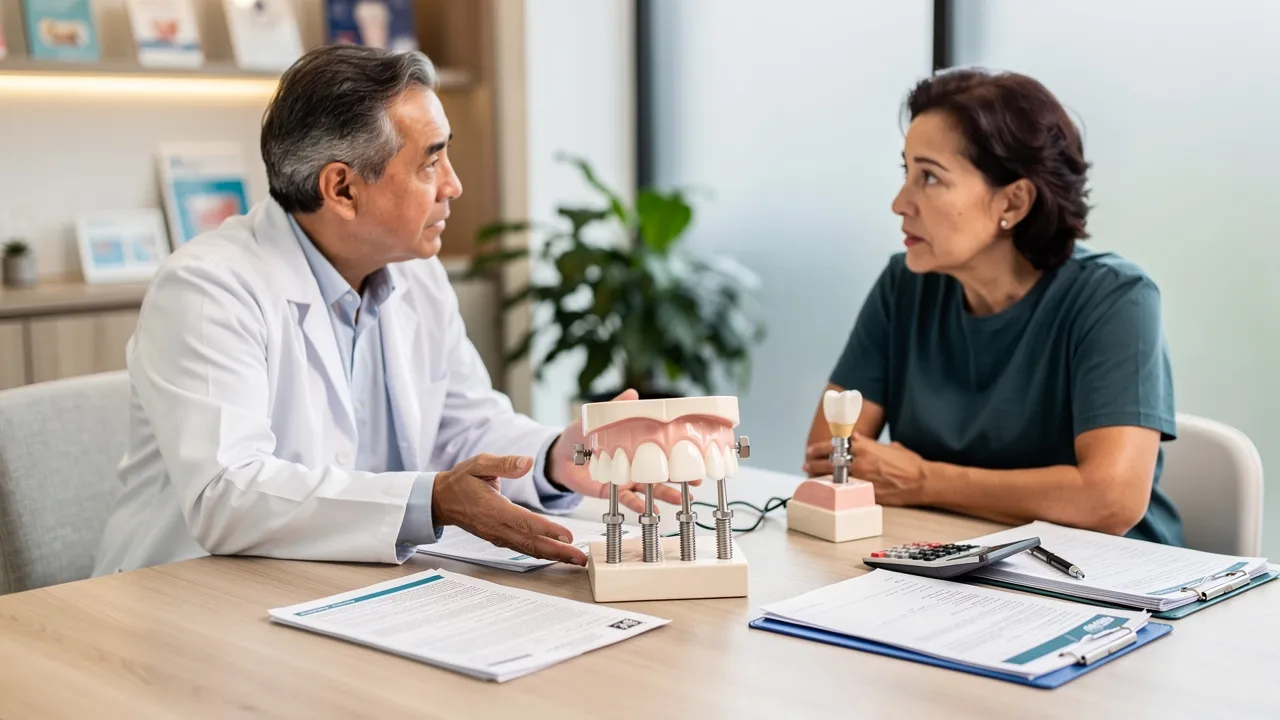
Start by identifying what “four front teeth implants” means
The phrase “four front teeth implants” does not describe one fixed treatment design. You may be asking about four separate implants, each replacing one tooth, or about an implant-supported bridge that replaces several adjacent teeth with a shared restoration. Those designs can have different components, fees, and treatment questions.
An implant-supported bridge is commonly considered when several adjacent teeth are missing. Dental implant guidance explains that two implants can, in many cases, support a bridge replacing three to four missing teeth, while the number of implants depends on the number and location of the missing teeth. That does not establish which design is appropriate for you.
Start with the treatment design, not a price copied from a search result. Before comparing estimates, ask each practice to write down:
- Whether the proposed plan uses individual replacement teeth or a shared bridge.
- How many implants are proposed and where they would be placed.
- What final restoration would sit on the implants.
- Which preparation, temporary replacement, imaging, and follow-up items are included.
The number of missing teeth alone cannot tell you the number of implants or the complete treatment cost. An evaluation is needed to connect the design to your circumstances.
The cost question becomes more useful when you turn it into an estimate-audit question: What treatment is being proposed, which parts are separately charged, and what would you personally pay? That framework lets you compare written plans without treating a generic figure as your own price.
Make the restoration design the first line on the estimate
The restoration design should be the first line on an implant estimate because the design determines what the rest of the estimate is describing. An individual-tooth plan and an implant-supported bridge are not interchangeable labels.
An individual replacement may be described tooth by tooth, with an implant body, connecting component, and final crown associated with each planned replacement. A bridge plan may use fewer implants to support several prosthetic teeth as one restoration. Dental implant guidance says that the dentist determines the implant count from the number and location of the missing teeth, and that two implants can in some cases support a bridge replacing three to four teeth.
Ask for plain-language answers to these questions:
- Is the plan for four individual implant restorations, an implant-supported bridge, or another restoration design?
- How many implants are included in the proposed plan?
- How many replacement teeth will the final restoration contain?
- Which teeth are being replaced, and which teeth will support or sit beside the restoration?
- Is a temporary replacement included while the final restoration is being prepared?
The fourth question is a useful way to bring neighboring teeth into the conversation without assuming that their condition has already been assessed. Ask how the condition of nearby teeth affects the proposed design, rather than deciding from the number of missing teeth that one plan must apply.
The written answer should identify the proposed design before it lists a total. If two estimates describe different designs, their totals are not meaningful comparisons until you understand what each plan includes.
An estimate checklist recommends asking each practice to specify the recommended treatment and the number of implants. Put those two items at the top of every estimate you collect. If either item is missing, request clarification before comparing the totals.
Build the total from each treatment component
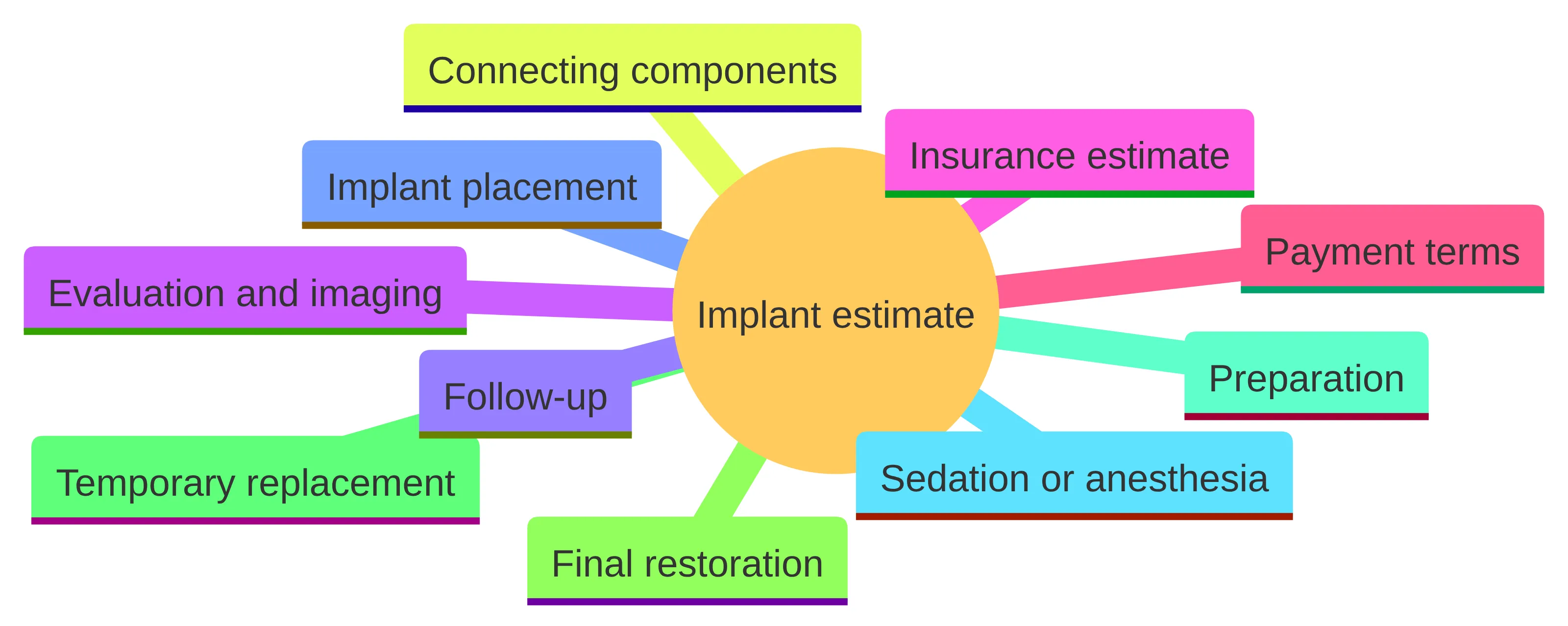
A complete implant estimate may contain several separate treatment components rather than one all-inclusive procedure fee. Use the estimate to trace the proposed care from evaluation through the finished restoration.
A written estimate may list these items separately:
- Consultation, examination, and indicated imaging.
- Implant body placement and related surgical fees.
- Abutments or other connecting components.
- The final crown, bridge, or other restoration.
- A temporary replacement, if one is recommended.
- Extraction, grafting, or other preparation, if needed.
- Sedation or anesthesia, if applicable.
- Follow-up appointments and maintenance guidance.
- The insurance estimate and expected personal share.
- Payment stages and financing terms, if used.
These line items answer different questions. Diagnostics describe how the proposed plan is evaluated and designed. Implant placement concerns the foundation for the restoration. Abutments or connecting components link that foundation to the final replacement. The crown or bridge is the visible replacement, but its fee does not automatically represent every earlier or later stage.
A temporary replacement also deserves its own line. Ask whether it is recommended, whether it is included, and whether an additional fee applies. Do not assume that a temporary item is part of the final restoration charge.
Preparation needs the same treatment. Extraction, grafting, sedation, and anesthesia may belong in an estimate only when they are recommended or applicable. Their inclusion on a checklist does not establish that you need them. Ask whether each item is recommended, who provides it, and whether the quoted amount includes it.
Follow-up should appear in the financial discussion even when no separate fee is listed. Ask which appointments are included, whether another provider handles any stage, and whether later services are outside the quoted plan. The purpose is not to predict every future charge. It is to make the boundaries of the proposed estimate visible.
Ask when each charge becomes due as well as what it covers. Payment stages can be listed separately from the clinical total, so you can distinguish the cost of treatment from the timing and terms of payment.
A staged estimate is easier to understand when every line has one of three labels: included, separately priced, or not part of the proposed plan. Ask the practice to use those distinctions in writing.
The treatment components should add up to a plan you can describe in ordinary language: evaluation and imaging, implant placement, connecting parts, final restoration, possible preparation, and the financial terms. If the estimate gives only one total, ask which of those stages that total covers and which stages remain outside it.
Separate evaluation variables from assumptions about your treatment
The treatment variables in an implant plan should be separated from assumptions about what you personally need. The number and location of missing teeth influence the proposed implant count, but an online phrase cannot establish your plan.
Several questions can change which line items appear or how they are priced:
- Does the proposed design use individual restorations or a shared bridge?
- How many implants are proposed for that design?
- What imaging is indicated for planning?
- Are extraction, grafting, or other preparation services recommended?
- Is sedation or anesthesia applicable to the proposed care?
- Is a temporary replacement part of the plan?
- How does the condition of neighboring teeth affect the restoration design?
- Which provider handles each stage?
Bone and gum questions belong in the evaluation rather than in a generic cost assumption. An estimate checklist identifies grafting as a possible preparation item when needed, and Westborough Dental Care’s first-visit information says a professional cleaning is provided if gum health allows. Those details support asking what preparation or gum-related care is recommended for you; they do not show that you need grafting, a cleaning, or any particular implant design.
Ask whether any bone or gum preparation is recommended, whether it is included in the estimate, and whether another provider handles it. Ask separately how nearby teeth are considered in the restoration plan. These questions keep possible treatment factors separate from conclusions about your mouth.
Imaging is another treatment-specific variable. An estimate may include consultation, examination, and indicated imaging, but the type and role of imaging should be identified rather than assumed from a general implant price. Ask what imaging is included, whether it is already completed, and whether another imaging charge could apply at a later stage.
The same discipline applies to the restoration. A bridge, individual crowns, a temporary replacement, and other restoration choices can describe different plans. Ask what the proposed restoration is intended to replace and how its fee is separated from the implant placement fee.
These questions do not diagnose you or determine candidacy. They create a clean boundary between what the estimate proposes and what still requires an individual evaluation.
The practical action is simple: ask the practice to mark every variable as recommended, optional, not applicable, or not yet determined. That notation makes it easier to see why two estimates differ without treating either estimate as a universal template.
Do not mistake one published procedure fee for the treatment total
A published procedure fee is not automatically the total cost of replacing four front teeth with implants. A procedure fee may cover one crown, one stage, or one type of restoration while leaving diagnostics, implant placement, connecting components, preparation, temporary teeth, or follow-up outside the quoted amount.
Our October 20, 2026 article reports average same-day crown costs of $2,334 for a porcelain or ceramic crown and $3,130 for an implant-supported crown. Those figures describe crown costs reported in that article; they are not a personalized implant estimate and do not establish the total cost of treatment.
The distinction matters because an implant-supported crown is only one part of a complete plan. An estimate checklist also identifies consultation, examination, imaging, implant placement, abutments or connecting components, the final restoration, possible preparation, sedation or anesthesia, follow-up, insurance responsibility, and payment terms as items that may need separate attention.
The unit of a fee matters too. Ask whether an amount applies to one crown, one implant, one connecting component, one stage, or the complete proposed restoration. Then ask whether the other stages are listed elsewhere or excluded.
Use a published fee as a question prompt, not as your expected bill. Ask what the fee covers, how many teeth or restorations it applies to, whether implant placement is included, and which charges would be added for your proposed design. Then request the complete staged estimate in writing.
The reported crown figures may help you recognize why a crown line and a complete implant-treatment total are different financial questions. They should not be multiplied by four or treated as a forecast of your personal responsibility.
Translate insurance information into expected personal responsibility
Insurance information becomes useful only when it is translated into an expected personal share for the specific proposed plan. A February 27, 2021 cost guide says dental implants are more expensive than dentures and bridges and are not usually covered by dental insurance; actual benefits and patient responsibility depend on the individual plan.
Do not subtract an assumed insurance percentage from a published implant fee. Ask for these figures in writing:
- The estimated charge for each treatment stage.
- The amount the plan is expected to cover for each applicable stage.
- The expected personal share for each stage.
- Any treatment component for which a coverage estimate was not available.
- Whether the insurance information is an estimate rather than a final determination.
A complete financial picture should connect coverage to the actual treatment design. If one estimate describes four individual crowns and another describes a bridge, the insurance questions may not refer to the same services. Compare the proposed treatment, the included components, and the expected personal share together.
We provide verification of benefits before treatment. Benefit verification can help organize the financial conversation, but it does not turn a general price into a final patient responsibility. Request the treatment estimate and the expected insurance share as separate lines so you can see how the figures relate.
The direct action is to ask for an insurance estimate and expected personal share in writing, then compare those figures with the complete staged treatment estimate. If a coverage or responsibility line is unclear, ask which treatment component it refers to before using the total for your decision.
Compare written estimates by inclusions, exclusions, and responsibility
Written implant estimates are easiest to compare when the same questions appear in the same order. Use the following two-column worksheet for Estimate A and Estimate B; the labels keep differences in treatment design, inclusions, exclusions, and personal responsibility visible.
| Item to compare | Estimate A | Estimate B |
|---|---|---|
| Recommended treatment design | ||
| Number of implants | ||
| Consultation, examination, and indicated imaging | ||
| Implant placement and related fees | ||
| Abutments or connecting components | ||
| Final crown, bridge, or other restoration | ||
| Temporary replacement, if recommended | ||
| Extraction, grafting, or other preparation | ||
| Sedation or anesthesia, if applicable | ||
| Provider responsible for each stage | ||
| Follow-up appointments and maintenance guidance | ||
| Fees or services excluded from the quote | ||
| Insurance estimate | ||
| Expected personal share | ||
| Payment stages and financing terms, if used | ||
| Estimate validity and changes that could affect it |
Estimate comparison should begin with scope, not the lowest displayed total. A lower number may describe fewer stages, a different restoration design, or more exclusions. A higher number may include services that the other estimate lists separately. The table gives you a way to ask whether the difference comes from treatment design, included care, insurance assumptions, or payment terms.
Use these comparison rules:
- Compare the recommended treatment and implant count before comparing dollars.
- Match each included component with its counterpart in the other estimate.
- Mark every excluded or not-yet-determined item.
- Compare expected personal responsibility rather than an unqualified insurance deduction.
- Ask which provider handles each stage and whether that provider’s fee is included.
- Keep payment terms separate from the clinical treatment total.
- Note the estimate date and validity period so you know which version you are comparing.
- Ask what change would require the estimate to be revised.
A written estimate is ready for comparison when you can identify what each total includes and what it leaves open. If you cannot make that distinction, request a revised explanation rather than choosing from the totals alone.
Use the Westborough evaluation to resolve the remaining cost questions
Our evaluation is the point where general cost questions can be connected to an individualized written plan.
Please bring your insurance card, a list of current medications, and any prior dental records or X-rays to your first visit. Those materials give us information to include in the evaluation conversation, while the written treatment plan identifies the proposed care that the financial estimate should describe.
Use the appointment to ask for direct answers to the questions that remain open:
- What restoration design is being proposed for the four missing or threatened front teeth?
- How many implants does that design use?
- Which diagnostics and imaging are included in the estimate?
- Are extraction, grafting, gum-related care, sedation, or anesthesia recommended?
- What temporary replacement, final restoration, and follow-up services are included?
- Which provider handles each stage?
- What is excluded from the quoted amount?
- What insurance estimate and expected personal share apply to each stage?
We plan dental implants digitally using an in-house Cone Beam CT scanner and place them with a surgical guide for higher precision. Treat that as part of the planning conversation, not as a promise of a particular treatment design, price, or result. Ask how the proposed planning process relates to the written estimate you receive.
Bring a short list of what you already know about the missing or damaged teeth, along with the questions you want answered. Separate those known details from findings made during the evaluation so the estimate reflects the proposed plan rather than an assumption made in advance.
The evaluation should leave you with a treatment description you can understand and a financial document you can compare. If a line remains uncertain, ask whether it is included, separately priced, not applicable, or dependent on a later decision.
Your next step is to bring your records and insurance information, request the written staged estimate, and ask how benefits and expected personal responsibility apply to that specific plan. We provide verification of benefits before treatment.
Request the written estimate before deciding
The cost of replacing four front teeth with implants is best assessed by examining the complete proposed plan, not by choosing one universal number. Start by identifying whether the plan uses individual restorations or a shared bridge, then record the implant count and restoration design. Next, separate diagnostics, implant placement, connecting components, the final restoration, preparation, temporary teeth, follow-up, insurance, and payment terms.
Before deciding, make sure you can answer five questions:
- What treatment design is being proposed?
- How many implants and replacement teeth are included?
- Which services are included, separately priced, or excluded?
- What insurance amount and personal share are expected for each stage?
- What questions still require an individual evaluation?
If you cannot answer those questions from the written plan, pause the price comparison and request clarification. A complete estimate should let you describe both the proposed care and the financial boundaries without filling gaps with assumptions.
Only a qualified dental professional can determine whether a particular design is suitable for you. Request the written estimate after that evaluation, compare complete plans by scope, and decide only after the clinical and financial details are clear.
A clear next step is to prepare your insurance information and dental records, request an evaluation with Westborough Dental Care, and ask for a written staged estimate that identifies the proposed treatment and expected personal responsibility.
What should you confirm before comparing four-front-teeth implant estimates?
What does the term 'four front teeth implants' refer to?
The term can refer to either four individual implants, each replacing one tooth, or an implant-supported bridge that replaces several adjacent teeth with a shared restoration. The specific treatment design will determine the number of implants needed.
What components should be included in a complete dental implant estimate?
A complete estimate may include separate charges for consultation, examination, imaging, implant placement, abutments, the final crown or bridge, temporary replacements, extraction or grafting if needed, sedation, follow-up appointments, and insurance estimates.
How can I compare different dental implant estimates effectively?
To compare estimates, ask each practice to specify the recommended treatment design and the number of implants. Use a checklist to ensure you are comparing similar components, including inclusions, exclusions, and expected personal responsibility.
What factors can influence the cost of replacing four front teeth with implants?
Factors include the number and location of missing teeth, the type of restoration (individual implants vs. a bridge), any necessary preparatory procedures like grafting, and the specific components included in the treatment plan.
What should I ask during my dental implant evaluation?
During your evaluation, ask about the proposed restoration design, the number of implants, any necessary imaging, whether extraction or grafting is recommended, and how insurance will apply to your treatment.
How does insurance coverage typically work for dental implants?
Insurance coverage for dental implants can vary widely. Many plans do not cover implants, while some may cover part of the costs for dentures or bridges. It’s important to request a written estimate that includes expected personal responsibility for each treatment stage.
What is the next step after receiving a dental implant estimate?
After receiving an estimate, review it carefully to ensure it includes all necessary components and ask for clarification on any unclear items. Schedule a consultation with the dental practice to discuss the estimate and your specific treatment needs.
Need help applying this?
Talk to a billing specialist who knows your payer mix.
Westborough Dental Care welcomes new patients in South San Francisco. Book a visit to meet Dr. Zoulas and the team.
Schedule a meeting