dental insurance that covers implants immediately
Does Dental Insurance Cover Implants Immediately? A Day-One Coverage Decision Guide

Immediate availability is not the same as immediate implant coverage
“Immediate” is not a single coverage status. In a dental plan, it may describe when the policy becomes active, when a service category becomes eligible, or when the plan’s waiting-period rule no longer blocks that category. A policy can therefore be active on day one without making an implant eligible on day one. The phrase “no waiting period” for some services does not establish that implants or every related service are covered immediately.
The cited Guardian comparison shows why the service category matters: the plans shown list a 12-month waiting period for major care, while some other services have different waiting periods or are available on day one. That comparison applies only to the plans shown. It is not a rule for every United States dental plan and does not show that a newly purchased plan covers an implant.
Read “immediate coverage” as a question about the plan’s wording, not as a promise about the result. The relevant answer remains subject to the plan’s terms and the insurer’s determination. Even when a service is eligible, the patient may still face the plan’s cost-sharing rules or other limits, and a preliminary response does not establish final payment or final responsibility.
Insurance timing should not be the sole reason to postpone a dental assessment. Severe pain, swelling with an abscess or infection, or a painful tooth fracture warrants prompt dental assessment rather than waiting only for an insurance decision.
Use the plan’s major-care rules as the first timing check
Major-care timing is the first insurance check for an implant because the plan may place the proposed services in a category with its own waiting period. Do not assume that a general day-one benefit applies to implant placement, the restoration, or every related service. Ask the insurer how each proposed procedure is classified under your plan and whether its waiting period has been satisfied.
The cited Guardian comparison shows why the category matters: the plans shown list a 12-month waiting period for major care, while other listed services have different waiting periods or are available on day one. The comparison is not a universal rule. Your plan may use different terms, classifications, or conditions, and the terms in effect for your coverage control the response.
Use this timing check before you focus on percentages:
- Confirm the policy effective date and your current eligibility. Ask whether coverage is active for the date on which the dental office would submit the claim.
- Ask whether implant placement is classified as major care, a separate implant benefit, or an excluded procedure.
- Ask whether a waiting period applies to implant placement, the implant-supported crown, abutment, grafting, extraction, or any other proposed component.
- Ask when the waiting period begins and what event makes the service eligible: enrollment, the effective date, or another plan-defined condition.
- Ask whether an exception or waiver exists under your plan and what documentation the insurer requires before applying it.
- Ask whether a waiting period applies even when the tooth is painful, broken, or missing. Do not assume urgency changes the insurance rule.
Write down the representative’s name or reference number if the insurer provides one, the date of the conversation, and the exact wording used for eligibility. Then compare that response with your plan documents. A verbal answer can help you identify the right issue, but you still need the office and insurer to match the response to the proposed services and claim requirements. If the plan makes the implant eligible only after a waiting period, decide whether to wait, consider another treatment discussion, or examine a payment approach without treating any option as automatically covered.
Check the restrictions that can change your expected responsibility
Plan restrictions can change your expected responsibility even when the insurer describes implants as a covered service. Implant coverage depends on the plan and may be limited by cost sharing, waiting periods, annual or lifetime maximums, frequency limits, exclusions, and other terms. A coverage label is only the beginning of the calculation.
Check these restrictions one at a time:
- Cost sharing: Ask what percentage the plan may pay and what remains after the deductible and coinsurance. A percentage does not tell you the final dollar amount without the allowed charge and the rest of the plan terms.
- Annual maximum: Ask how much of the yearly benefit remains before treatment begins and which proposed services draw from it. If several services use the same annual maximum, the amount available for later services may be different from the amount available at the start of treatment.
- Lifetime maximum or procedure limit: Ask whether a lifetime cap, frequency limit, or replacement rule applies to the implant or related restoration. Ask how the plan treats a prior procedure for the same tooth or site.
- Missing-tooth clause: Ask whether the plan excludes a tooth that was missing before coverage began or limits replacement of that tooth. A missing-tooth clause may exclude treatment, so identify it before treatment rather than after a claim is submitted.
- Eligibility and exclusions: Ask whether the plan has other restrictions affecting the tooth, the treatment sequence, the provider, or the timing. Request the exact section of the plan document that supports the answer.
- Remaining benefits: Ask whether benefits already used during the current plan year reduce what is available for the proposed care.
Insurance verification before treatment can include eligibility, payable benefits, exclusions such as a missing-tooth clause, yearly and remaining benefits, and other plan restrictions. That information gives you a more useful starting point than a general statement that implants are covered. It still does not guarantee that a claim will be paid, because the claim must match the plan terms and the submitted treatment details.
Use a written worksheet with one row for each service and columns for eligibility, waiting period, exclusion, deductible, coinsurance, annual maximum, estimated plan payment, and estimated personal responsibility. The worksheet is a planning aid. It is not a promise of coverage, and you should update it when the treatment plan or insurer response changes.
Treat the implant as a set of separately evaluated services
An implant treatment plan may include separately identified services, so ask about each component instead of asking only whether the implant is covered. The coding guidance identifies services such as implant placement, second-stage surgery, bone grafting, membranes, surgical guides, and prosthetic work. A dental consultation and oral X-rays may be needed before treatment, and some patients may need bone grafting before an implant can be placed.
Your proposed plan may also mention an extraction, an abutment, a final crown, or a bridge. Keep each item visible in the estimate and ask the insurer how it is handled. Do not let a response about implant placement stand in for a response about the restoration or another service.
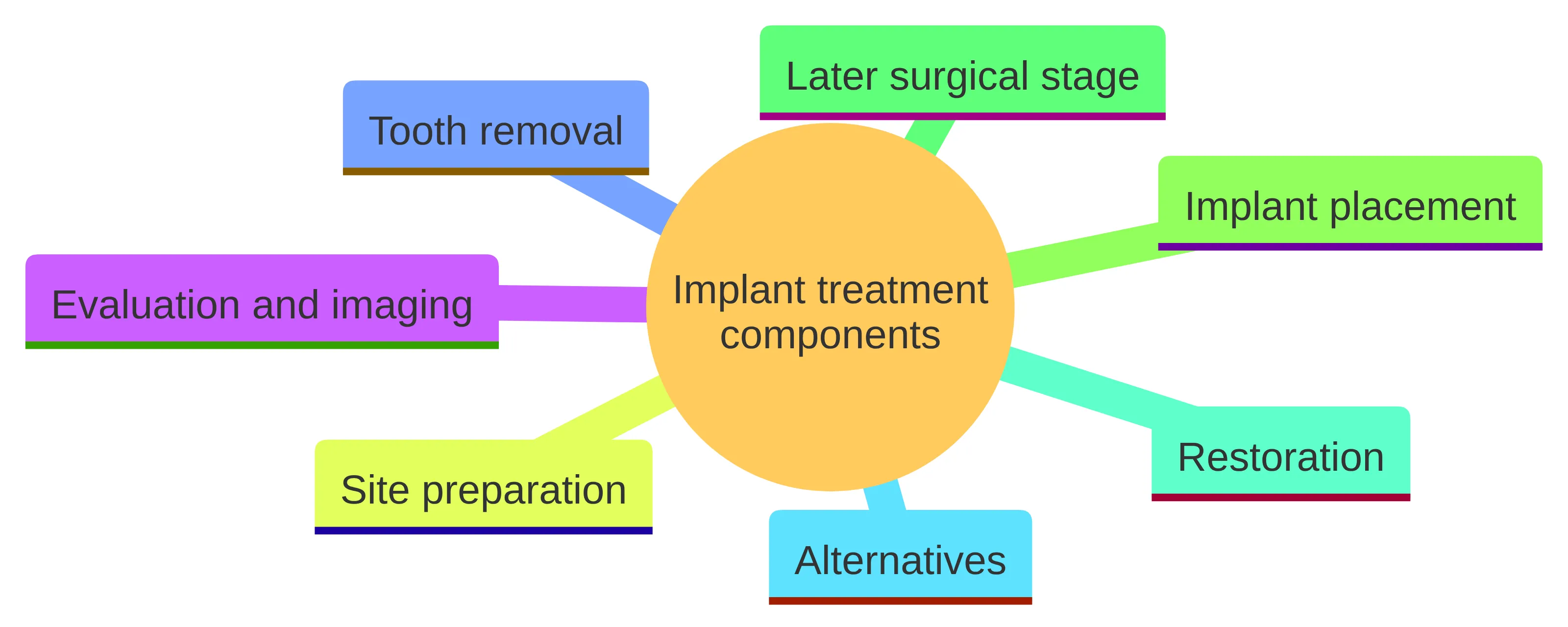
Use a component map like this:
- Evaluation and imaging: Ask whether the examination, oral X-rays, or other proposed imaging has its own benefit, deductible, or frequency rule.
- Tooth removal: If extraction is proposed, ask whether it is covered separately and whether timing affects eligibility.
- Site preparation: Ask about bone grafting, a membrane, or a surgical guide if the dental plan includes one. These services may be identified separately from implant placement.
- Implant placement: Ask how the plan names and classifies the surgical placement procedure, including any waiting period or preauthorization requirement.
- Later surgical stage: Ask whether second-stage surgery is a separate covered service and whether it is subject to another limit.
- Restoration: Ask about the abutment, crown, bridge, or other prosthetic work as its own line. Confirm whether the plan treats it as major care, a prosthetic benefit, an alternative treatment, or an exclusion.
- Alternatives: If you are comparing an implant with a bridge or denture, request the same type of estimate for each option. A pre-treatment estimate can help you compare the listed costs for each option.
The point of this map is not to predict which treatment is suitable for you. It is to prevent one broad insurance question from hiding several separate benefit decisions. Give the insurer the exact service descriptions or procedure codes supplied by the dental office, and keep the office estimate organized in the same order.
Ask the insurer for a component-by-component benefits answer
The insurer should receive a clear list of proposed services rather than a single question about dental implants. Before treatment, verify your coverage and eligibility. Use the following questions to make the call specific:
- Is my coverage active for the proposed treatment date? Ask the insurer to confirm eligibility and the effective date that applies to the claim.
- How does my plan classify each service? Name the evaluation, imaging, extraction, grafting, implant placement, second-stage surgery, abutment, crown, bridge, or other item listed by the dental office.
- Does a waiting period apply to each service? Ask for the waiting-period length, the date it ends, and whether the service can be submitted before that date.
- Does a missing-tooth clause or another exclusion apply? Ask the insurer to explain whether the tooth’s prior condition changes eligibility and to identify the relevant plan language.
- What deductible, coinsurance, and plan payment apply? Ask whether the response is based on the plan’s allowed charge and whether network status changes the calculation.
- What annual or lifetime maximum remains? Ask which proposed services use the remaining amount and whether benefits already used this plan year are included.
- Are there frequency, replacement, or site-specific limits? Ask whether the plan restricts how often the service is covered or how it handles a prior restoration or missing tooth.
- Is predetermination available for this proposed treatment? If it is available, request it before treatment.
- What would make the claim payable or not payable? Ask for the conditions that control the decision, rather than accepting only a percentage or the word covered.
- Can you provide the response in writing? Keep the benefit language, reference number, and date with your treatment estimate.
Eligibility verification before treatment can help identify coverage problems and reduce the risk of unexpected out-of-pocket expenses, but it cannot guarantee claim payment. If the insurer gives a broad answer, return to the component list and ask the representative to address each item. If the answer changes when you provide a procedure code or tooth number, record the changed answer and request clarification before authorizing treatment.
Ask the dental office to match the proposed plan to the benefit inquiry
The dental office should match the proposed treatment plan to the benefit inquiry so the insurer is answering the same question you are using to plan care. Ask for a written list of the proposed services, the order in which they are expected to occur, the estimated office charges, and any procedure codes the office uses for the inquiry. Then compare that list with the insurer’s response line by line.
Ask the office these questions:
- Which services are included in the proposed implant plan, and which services would be added only if the evaluation identifies a need?
- Which items are being submitted for benefit information or predetermination?
- Does the estimate separate the evaluation, imaging, extraction, site preparation, implant placement, later surgery, and prosthetic work?
- Are the abutment and final crown listed separately from implant placement?
- If you are considering a bridge or another alternative, can the office provide a separate pre-treatment estimate for comparison?
- Which amount is the office charge, which amount is the insurer’s estimated benefit, and which amount remains estimated for you?
- What must happen before treatment is authorized, and what could change the estimate after the clinical evaluation?
The written service list helps keep the office discussion focused on the proposed next steps.
A dental office can help organize the proposed services, but an office estimate is not the insurer’s final claim decision. Keep the office estimate and the insurer’s response together, and ask about any mismatch before you approve treatment. If the insurer discusses one code while the office estimate uses another description, ask both sides to explain whether they refer to the same service.
Use predetermination to reduce uncertainty, not to promise payment
Predetermination can clarify expected coverage before significant implant treatment, especially when alternative treatments may have different coverage levels. The cited dental education guidance recommends requesting predetermination for major restorative work such as implants and for treatment with multiple options. Ask whether your plan offers this process and whether it is called predetermination, preauthorization, or another term.
A useful predetermination request should connect the proposed care to the benefit question. Ask the dental office and insurer to identify:
- The tooth or site being treated.
- Each proposed service and its procedure code or description.
- The clinical reason for the proposed treatment, if the plan requires supporting documentation.
- The estimated charge for each service.
- The plan’s waiting period, exclusion, deductible, coinsurance, and remaining maximum as they apply to each item.
- Any documents or images needed for the insurer’s review.
Use the response to compare what the plan may pay with what you may need to pay. Do not treat the response as a payment guarantee. Predetermination can show how coverage may differ before treatment, but final responsibility can still depend on eligibility, the submitted claim, the plan terms, and the services actually provided.
If the response denies one component, ask whether another component is handled differently and whether an alternative treatment has a separate benefit rule. If the response is unclear, ask the insurer to identify the exact condition that prevents a definitive answer. Then ask the dental office whether the proposed plan can be revised, delayed, or compared with another option without assuming that the alternative is covered.
Build a fallback plan before authorizing treatment
A fallback plan gives you a way to respond if coverage is denied, delayed, limited, or reduced by an annual maximum. Build that plan before authorizing treatment, while you can still compare timing, treatment components, and payment terms without assuming that insurance will pay a particular amount.
Start with a three-part comparison:
- Coverage path: Record the insurer’s response for each component, the applicable waiting period, the remaining annual maximum, and the estimated amount left to you. Mark every unanswered item instead of filling it with an assumption.
- Treatment comparison: Ask the dental office for a pre-treatment estimate when comparing an implant, bridge, or denture. Compare what each estimate includes, which services are separate, and how the insurance response applies to each option. A cost comparison does not decide which treatment is suitable for you.
- Payment path: Ask about the timing of each charge and what happens if the insurer pays less than estimated. Financing may spread dental payments over time rather than requiring the full amount upfront.
At Westborough Dental Care, we can discuss financing options, including CareCredit, for larger treatment plans. We also offer a membership plan for patients without dental insurance. Ask what each available arrangement includes, what it does not include, when payments are due, and how it relates to the written treatment estimate. Neither option should be treated as a prediction of insurance eligibility or as a substitute for reading the actual terms.
If your plan has an annual maximum, ask whether delaying one component changes the amount available in a later plan year and whether the dental office can explain the consequences of that timing. Do not delay care solely to preserve a benefit when you have severe pain, infection, swelling, or a painful fracture; clinical urgency needs its own assessment. If the treatment is not urgent, a written comparison can help you decide whether to proceed with the proposed sequence, ask about another option, or revisit the timing after the waiting period.
Keep a record of the estimate, benefit response, predetermination, payment terms, and any change to the proposed plan. A fallback plan is a set of documented choices, not an assumption that one funding source will cover the entire treatment.
Do not let an insurance question delay urgent dental assessment
Severe dental symptoms need prompt dental assessment even when insurance coverage is uncertain. The ADA guidance lists severe dental pain, an abscess or localized bacterial infection with pain and swelling, and a painful tooth fracture or a fracture causing soft-tissue trauma among acute dental emergencies.
If you have severe pain, swelling with an abscess or infection, or a painful tooth fracture, seek prompt dental assessment instead of waiting only for an insurance decision. Tell the practice what you are experiencing and explain that coverage is still being checked. The insurance question can continue separately from the clinical assessment.
At Westborough Dental Care, we hold time in our daily schedule for urgent visits. That availability does not determine the treatment you need or what your plan will pay, but it gives you a reason to contact the practice promptly when symptoms are acute. Bring your insurance information if you have it, while keeping the immediate focus on describing the pain, swelling, fracture, or other urgent symptom clearly.
Start with an evaluation and documented verification plan
A sensible implant coverage plan starts with two parallel tracks: understand the proposed dental care and verify how your plan treats every component. Confirm eligibility and waiting periods, check the missing-tooth clause and other restrictions, record your annual and remaining benefits, request predetermination when available, and prepare a fallback payment plan before authorizing treatment.
At Westborough Dental Care, our first visit includes a comprehensive exam, full-series digital X-rays, a cleaning if gum health allows, and a written treatment plan, and the visit lasts about 60 to 90 minutes. Bring your insurance card, current medication list, and prior dental records or X-rays. We can discuss financing options, including CareCredit, for larger treatment plans. We offer a membership plan for patients without dental insurance.
A qualified dental professional decides whether a particular treatment is suitable for you, while your insurer applies the terms of your plan to the submitted services. Use the evaluation, written estimate, insurer response, and predetermination together so you can identify what is known, what remains conditional, and what you would be responsible for if coverage changes. Bring those questions and documents to the practice so the conversation can be based on your proposed care and plan terms.
What should you confirm before pursuing immediate implant coverage?
What does immediate coverage mean for dental implants?
Immediate coverage does not guarantee that dental implants are covered right away, even if a plan has no waiting period. Coverage may depend on specific conditions, exclusions, or waiting periods for certain services.
How can I verify my dental insurance benefits for implants?
To verify your dental insurance benefits for implants, contact your insurer and ask about eligibility, coverage classifications, waiting periods, exclusions, and any remaining benefits before treatment.
What should I ask my dental office regarding my treatment plan?
Inquire about the specific services included in your treatment plan, the order of procedures, estimated costs, and whether any services require preauthorization or have separate coverage.
What are common restrictions that affect dental implant coverage?
Common restrictions include cost sharing percentages, annual or lifetime maximums, waiting periods, missing-tooth clauses, and frequency limits that may apply to implant procedures.
What steps should I take if my insurance claim for an implant is denied?
If your insurance claim for an implant is denied, review the denial reasons, consider appealing the decision, and discuss alternative payment options with your dental office.
Need help applying this?
Talk to a billing specialist who knows your payer mix.
Westborough Dental Care welcomes new patients in South San Francisco. Book a visit to meet Dr. Zoulas and the team.
Schedule a meeting