
cosmetic dentistry what is it
What Is Cosmetic Dentistry? Options, Costs, Longevity, and Questions to Ask

Start with the appearance question, not the procedure name
Cosmetic dentistry focuses on improving the appearance of your mouth, teeth, and smile. Dentistry also supports oral health and function, so an appearance concern may need to be considered alongside the condition of your teeth, gums, restorations, and bite.
That distinction gives you a more useful starting point than choosing a procedure from a menu. A darker shade, chipped edge, small gap, or irregular tooth position can lead to different conversations. The visible concern is only the first question. The discussion can then consider whether the proposed treatment also addresses a structural or functional need.
You may want a subtle shade change, a more even edge, a different tooth shape, or improved alignment. Those goals do not automatically point to the same treatment.
Write down the concern in ordinary language before you search for a procedure. For example, you might describe a tooth as darker than its neighbors, a front edge as chipped, or several teeth as crowded. Bring that description to an evaluation. It gives the dentist a starting point for discussing options, preparation, maintenance, cost, and alternatives without assuming that a particular procedure is already appropriate.
Cosmetic and restorative dentistry can meet different goals
Cosmetic dentistry emphasizes the appearance of your mouth, teeth, and smile. Restorative dentistry includes treatments such as implants, crowns, bridges, dentures, and root canal therapy. The two areas can overlap because a treatment may affect both how a tooth looks and how it functions.
A crown illustrates that overlap. A crown can be part of restorative care, while a porcelain crown may also be discussed in a cosmetic plan when the appearance of a damaged or altered tooth matters. Dentures can likewise have an appearance concern as well as a tooth-replacement context. The category alone does not tell you whether a treatment fits your situation.
At Westborough Dental Care, our cosmetic dentistry treatments include porcelain crowns, dentures, Invisalign clear aligners, and bleaching. We also offer cosmetic procedures for concerns such as discoloration, chips, gaps, or irregularities.
That service list describes what we offer; it does not determine what you need. An evaluation should connect your appearance goal with oral-health findings, existing dental work, and any functional concern. Ask whether the proposed treatment is primarily changing appearance, restoring a tooth, or doing both. Then ask what alternatives would address the same concern with a different level of preparation or maintenance.
Map the concern to the relevant treatment category
Your stated concern should guide the first treatment conversation. At Westborough Dental Care, we offer cosmetic procedures for concerns such as discoloration, chips, gaps, and irregularities.
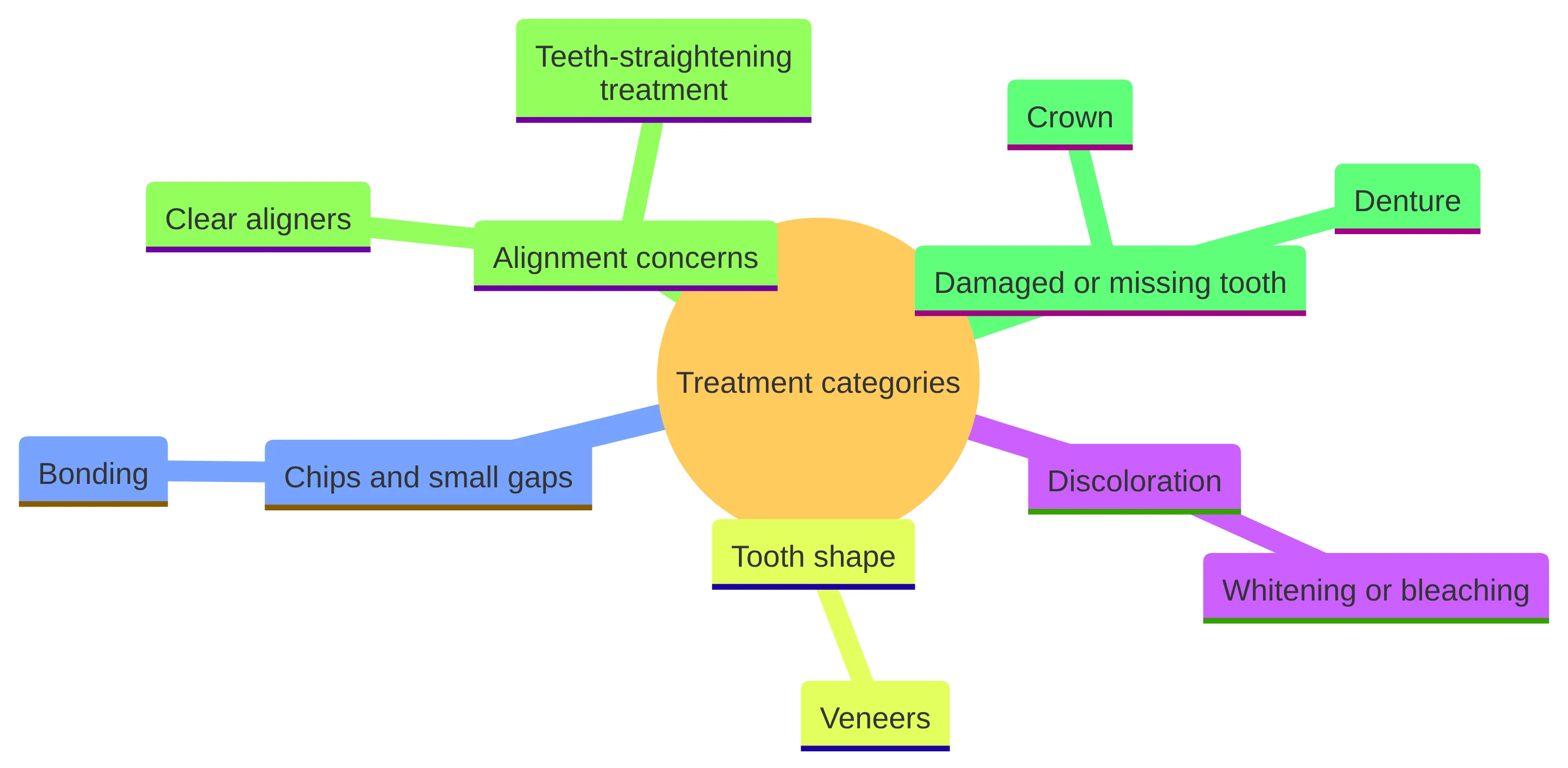
Use the categories below as prompts for discussion, not as a self-diagnosis:
- Discoloration: Ask whether whitening or bleaching is relevant to the type and location of the color change.
- Chips, small gaps, or uneven edges: Ask whether bonding or another restorative approach could address the visible change.
- Tooth shape or broader appearance changes: Ask how veneers or another restoration would affect preparation, appearance, and maintenance.
- Alignment concerns: Ask whether teeth-straightening treatment, including clear aligners where offered, addresses the position you want to change.
- A damaged, missing, or structurally compromised tooth: Ask whether restorative care such as a crown or denture belongs in the plan as well as in the cosmetic discussion.
The same visible concern can have more than one possible response. A gap, for instance, might lead to a conversation about alignment, bonding, veneers, or another option depending on your teeth and the change you want. A dentist needs to examine the relevant teeth and surrounding tissues before deciding which category belongs in your plan.
Start with the question, “What am I trying to change?” Follow it with, “What options could address that change, and what would each option require?” That approach keeps the procedure from becoming the goal by itself.
To make the comparison more orderly, separate three parts of the conversation: the visible change you want, the oral-health or structural context the dentist needs to assess, and the practical trade-offs you want to understand. The first part keeps the goal personal; the second prevents a procedure label from standing in for an examination; the third lets you compare preparation, maintenance, comfort, and cost. For example, “make this area less noticeable” states an appearance goal without deciding whether the discussion should center on shade, tooth shape, position, or restoration. That wording also leaves room to ask whether more than one concern is involved. This is a way to organize questions, not a way to identify treatment on your own.
For discoloration, begin by clarifying the shade goal
Discoloration gives you a reason to define the shade change before discussing a material or restoration. Whitening may be discussed before bonding because whitening can change the color of natural tooth structure, while the resin shade is selected when bonding is performed. Whitening is optional and is not required for every bonding appointment.
At Westborough Dental Care, our cosmetic dentistry treatments include bleaching. If bonding is also under consideration, ask whether the desired overall shade should be discussed first and how the shade of any resin or restoration would relate to the surrounding teeth. The answer belongs in your individual plan rather than in a universal sequence.
A shade discussion becomes more useful when you ask specific questions:
- Is the concern a change in the color of natural tooth structure, an existing restoration, or both?
- What shade change are you hoping to see?
- If bonding or another restoration is planned, how would its shade relate to your natural teeth?
- Would whitening be part of the discussion, or would another option address the concern more directly?
- How would future maintenance affect the appearance of natural teeth and restorations?
Avoid treating a darker tooth as a simple color-selection problem. The examination determines what is being changed and whether other care belongs in the plan first.
For chips, small gaps, or uneven edges, compare additive approaches carefully
Dental bonding may enter the conversation for a chip, small gap, uneven edge, worn surface, or localized discoloration. Before bonding, a dentist may examine your teeth, gums, existing restorations, and bite. If decay or another oral-health issue is present, that issue may need attention before bonding.
The examination also helps determine whether one tooth or several teeth should be treated for a balanced result. That question matters when one tooth looks different from its neighbors. Treating only the visibly affected tooth may be discussed, but the appropriate scope depends on the surrounding teeth and the appearance you want.
An additive approach should still be compared with its preparation and maintenance requirements. Ask what would be added, what would need to be altered, whether a neighboring tooth should be included, and what alternatives could address the same concern. If whitening is also under consideration, ask whether the shade discussion should happen before bonding; whitening can be discussed, but it is not required for every bonding appointment.
Our cosmetic dentistry approach focuses on preserving healthy tooth structure rather than aggressively reshaping teeth. That is a practice-specific approach to discuss with us, not a promise that every proposed option will involve no preparation. Ask directly how much healthy tooth structure the recommended plan would affect and why.
For alignment or more extensive change, ask what problem the plan is solving
Alignment concerns call for a different question from a small surface change: what problem is the plan solving? Clear aligners or another teeth-straightening approach may be discussed when tooth position is central to the appearance concern. A veneer, crown, or other restoration may enter the discussion when tooth shape, damage, or structure also matters.
Restorative dentistry includes implants, crowns, bridges, dentures, and root canal therapy. At Westborough Dental Care, our cosmetic dentistry treatments include porcelain crowns, dentures, and Invisalign clear aligners. Those categories can overlap, but they do not answer the same question. Ask whether the plan is intended to change position, shape, color, replace a tooth, restore structure, or address more than one of those goals.
Cost needs the same specificity as the treatment goal. Our flat member rates for clear aligners are $6,500 for treatment lasting more than 6 months and $5,250 for treatment lasting less than 6 months. Retainers cost $650, and night guards cost $775. These are our published member rates for the listed clear-aligner categories, not a general price for every cosmetic treatment or every patient.
Ask which services are included in the proposed plan, whether the plan involves more than one treatment category, and which maintenance items are separate. Ask what determines the expected sequence and how a change in scope would affect the fee discussion. A dentist must assess your teeth and goals before suitability, treatment duration, and final fees can be determined.
Make preservation of healthy tooth structure an explicit comparison point
A cosmetic consultation should address the recommended treatment, expected results, risks, costs, and available alternatives. You can make the preservation question more concrete with this short list:
- How much healthy tooth structure would the plan require removing or reshaping?
- Is the proposed preparation necessary for the stated goal?
- What alternatives involving less preparation should we discuss?
- How would each option affect appearance, maintenance, and future dental work?
- What would make the plan change after the examination?
A clear answer should explain the reason for the proposed preparation rather than treating it as an automatic part of cosmetic care.
Preservation is best used as a comparison question, not as a promise that the least involved-sounding option is automatically right. Ask the dentist to connect the amount of preparation to the specific change being requested. If two options are discussed, compare what each would alter, what each would leave available for later care, and why the difference matters for the stated goal. Also ask whether an option aimed at appearance would leave an untreated structural or oral-health concern. This keeps “conservative” from becoming a vague label: the useful answer is a reasoned explanation of the proposed preparation, the available alternatives, and the maintenance that follows. You can then decide whether the trade-off is understandable before discussing a final plan or fee.
Compare maintenance, comfort, appearance, and cost without assuming a fixed answer
Treatment comparison works better when you use the same questions for each option. The table below is a discussion framework; it does not select a treatment for you.
| Option | Appearance concern to clarify | Tooth-structure question | Maintenance and cost questions |
|---|---|---|---|
| Whitening or bleaching | What type of discoloration is being addressed, and what shade change do you want? | Is the concern in natural tooth structure, an existing restoration, or both? | What maintenance would the shade require, and what fee applies to the proposed service? |
| Bonding | Is the concern a chip, small gap, uneven edge, worn surface, or localized discoloration? | What would be added or altered, and should one tooth or several be treated? | How might the material be maintained, repaired, or refreshed, and what is included in the fee? |
| Veneers | What change in tooth shape, shade, or visible surface is being considered? | What preparation is proposed, and what alternatives should be compared? | What maintenance, risks, expected appearance, and cost should you understand first? |
| Crowns | Is a structural or restorative concern part of the appearance goal? | Why is a crown being proposed instead of another option? | What does the restoration require over time, and what services are included in the estimate? |
| Clear aligners | Is tooth position the main concern, and what change do you want to see? | Would alignment address the concern without shifting the plan toward another restoration? | What treatment duration, retainers, maintenance, and fees belong in the plan? |
Longevity depends on materials, oral-care routine, and lifestyle habits. The cited consultation guide gives veneers as an example that can last over a decade, while bonding solutions might need periodic refreshes. Those statements describe variation rather than a personal guarantee or a fixed lifespan for your treatment.
Comfort also belongs in the comparison, but it should be discussed as part of the proposed procedure rather than assumed from the label. Ask what the appointment involves, what changes you may notice afterward, what follow-up is expected, and which symptoms or concerns should prompt contact. Ask for the expected appearance in terms you can understand, and ask what risks or limitations could affect it.
Do not let a menu of options replace treatment planning
A field study found that 47 dentists offered a wide range of cosmetic services at varying costs for one patient’s complaint. In the study’s intervention group for a crooked smile, 11 of 25 dentists recommended orthodontic treatment, while the others suggested one to eight units of composite or ceramic veneers. The study authors said those alternatives could represent overtreatment compared with the expert panel’s plan.
That finding does not tell you which treatment belongs in your mouth. It does show why the same complaint can produce different proposals and why the recommendation needs an explanation. Ask what diagnosis or examination finding supports the plan, what alternatives were considered, and what problem each proposed procedure is intended to solve.
A treatment menu becomes useful only after each option has a defined purpose. For every proposal, ask:
- What specific appearance concern does this address?
- Does it also address a structural or functional concern?
- What would need to be prepared, restored, moved, or maintained?
- What alternative could address the same concern?
- What risks, expected appearance, costs, and future care should you compare?
You do not need to choose a procedure simply because it is available. Ask for the reasoning behind the recommendation and keep the final decision connected to your examination and stated goal.
The study has an important limit: it describes responses to one patient complaint, not the correct plan for every person with a crooked smile or another appearance concern. Its findings therefore should not be used to conclude that a veneer, orthodontic treatment, or any other category is generally inappropriate. The useful lesson is narrower. When recommendations differ, compare the assumptions behind them: what finding is being addressed, what amount of preparation is proposed, what alternatives were considered, and whether the quoted cost refers to the same scope of care. That comparison is more informative than choosing the option with the shortest label or the lowest quoted amount. A consultation should leave you understanding why the recommendation fits the stated concern, even if more than one option remains open for discussion.
Expect sequencing when several concerns are involved
Multiple cosmetic treatments may be combined, and a dentist may suggest a staggered schedule when the treatment plan requires it. Several concerns can affect the sequence: you may be discussing shade alongside bonding, alignment alongside restorations, or cosmetic care alongside treatment for an oral-health issue.
Ask which concern comes first and why. Ask whether the shade of natural teeth should be addressed before bonding, whether alignment changes a later restorative plan, and whether oral-health care needs to precede cosmetic treatment. A sequence should have a reason that you can understand.
Most cosmetic dental consultations last between 30 minutes and an hour, although the time varies with your concerns, questions, and any needed diagnostics. Use that conversation to map the order of care rather than trying to settle every choice before the examination.
Write down each concern separately and bring the list to the appointment. Ask which items can be addressed together, which should be separated, and how the sequence affects maintenance, comfort, appearance, and cost. If the plan changes after an examination or diagnostic step, ask what new finding changed it.
One useful way to discuss sequencing is to ask what must be decided first, what depends on that decision, and what can remain open. Shade may need to be part of the discussion before a resin shade is selected for bonding. If alignment and a restoration are both being considered, ask whether tooth position changes the later restorative conversation. If an oral-health issue is identified, ask how it affects the order of care. These questions do not predict your sequence; they ask the dentist to explain it. Request that the proposed order, the reason for it, and any separate maintenance items be written into the treatment discussion. If more than one concern is addressed, review the plan as a whole rather than evaluating each procedure in isolation.
Bring a question list to the consultation
A consultation question list helps you compare the proposed treatment with your actual concern. Before committing to treatment, ask about the dentist’s experience, recommended treatment, expected results, risks, costs, and alternatives. Add questions that connect those topics to your teeth and the sequence of care.
Bring this checklist:
About the concern and examination
- What is causing the appearance concern you see?
- What did you examine in my teeth, gums, existing restorations, and bite?
- Is there decay or another oral-health issue that should be addressed first?
- Should one tooth or several teeth be treated for a balanced appearance?
About the proposed treatment
- What specific change is this treatment intended to make?
- Why does this option fit my teeth and stated goal?
- How much healthy tooth structure would be prepared or reshaped?
- What alternatives should I compare, including options that involve less preparation?
About appearance and comfort
- What appearance should I realistically expect from this plan?
- What risks or limitations could affect the result?
- What will the appointment involve, and what should I expect afterward?
- What follow-up or maintenance will the treatment require?
About sequence and cost
- Which concern should be addressed first, and why?
- Can the treatments be combined, or does the plan require a staggered schedule?
- What services and maintenance items are included in the fee discussion?
- What could cause the plan or fee to change?
- If I plan to use dental insurance, what should I ask my plan about, and what patient responsibility should I discuss?
The list is a practical aid for organizing the conversation. It does not determine suitability or replace the examination.
Your preparation can begin with a short description of what you want to change, when you first noticed it, and whether you already have restorations in the area. If shade is part of the concern, note whether you are considering whitening. If alignment is part of the concern, note which teeth or visible spaces you want to discuss.
Keep the goal specific but flexible. “I want this tooth to look less noticeable” gives you room to compare options; “I need veneers” assumes the answer before the questions have been addressed. A useful consultation leaves you with a clear concern, a proposed plan, alternatives, expected maintenance, and a fee discussion you understand.
Before leaving the consultation, use your notes to test whether the plan is understandable rather than trying to remember a list of procedure names. You should be able to state the appearance concern, the oral-health or structural context that was discussed, the recommended sequence, and the main alternative. You should also know which parts remain uncertain: for example, the expected appearance, maintenance, risks, or fee may require clarification rather than a promise. If an answer is too general, ask what observation or decision it is based on and what would cause the plan to change. This does not turn the conversation into a diagnosis or guarantee. It gives you a practical record to review before deciding whether to proceed with an evaluation, request more information, or compare another plan.
Use the evaluation to replace assumptions with a written plan
Cosmetic dentistry is a way to discuss an appearance goal alongside the oral-health, structural, and functional factors that may shape treatment. Start with the change you want, compare the preparation and maintenance involved, and ask what each option is meant to solve. The next conversation can then focus on your teeth, your priorities, and a plan you can understand.
What should you clarify before choosing cosmetic dental treatment?
What is cosmetic dentistry?
Cosmetic dentistry focuses on improving the appearance of your mouth, teeth, and smile, while also considering oral health and function.
What should I ask during a cosmetic dentistry consultation?
You can ask about the dentist’s experience, the recommended treatment, expected results, risks, costs, and available alternatives.
How long does a cosmetic dental consultation typically last?
Most cosmetic dental consultations last between 30 minutes and an hour, depending on the complexity of your concerns and any needed diagnostics.
What factors influence the choice of cosmetic treatment?
Factors include the condition of your teeth, the desired changes, preservation of healthy tooth structure, maintenance, comfort, and cost.
What is the importance of an examination before cosmetic treatment?
An examination helps connect your appearance concerns with the condition of your teeth and mouth, determining the appropriate treatment plan.
Need help applying this?
Talk to a billing specialist who knows your payer mix.
Westborough Dental Care welcomes new patients in South San Francisco. Book a visit to meet Dr. Zoulas and the team.
Schedule a meeting