
cosmetic dentistry cost
Cosmetic Dentistry Cost: Compare Whitening, Bonding, Veneers, Crowns, and Aligners
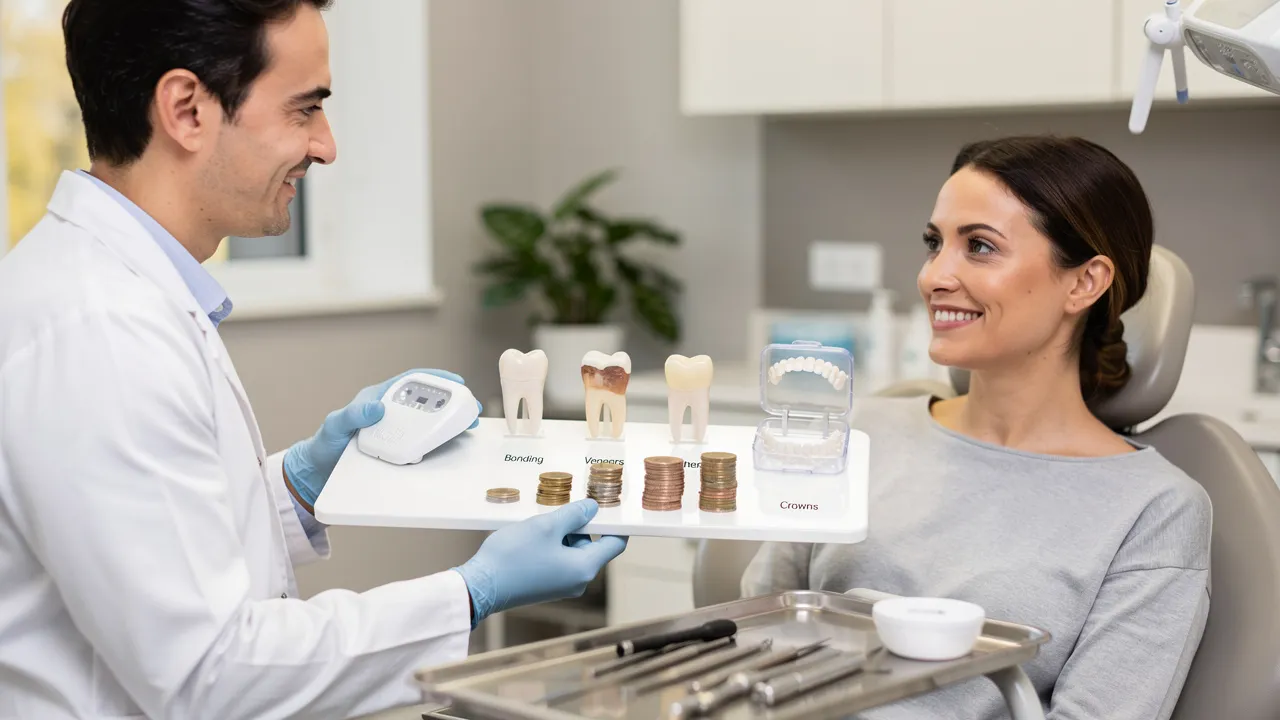
Start with a goal-matched cosmetic dentistry budget
Cosmetic dentistry cost depends on the procedure, the number of teeth involved, the materials used, your oral health, and whether care is restorative rather than cosmetic only. There is no single price for cosmetic dentistry because practices, locations, treatment designs, and clinical findings differ.
Start with the change you want to make, rather than with the treatment name. Write down whether your main concern is:
- Color: natural teeth look darker or more yellow than you would like.
- Chips, small gaps, or spots: a limited area needs reshaping or coverage.
- Shape, length, or several visible teeth: the front surfaces need a broader cosmetic change.
- Position or alignment: teeth need to move rather than be covered.
- Damage or weakness: a tooth may need restoration before an appearance-focused choice is considered.
Professional whitening and limited dental bonding are often among the lower-cost options, but the appropriate choice depends on whether the concern involves color, shape, position, damaged enamel, or an underlying dental problem. That distinction keeps a low starting price from steering you toward a treatment that does not address the actual concern.
A useful budget worksheet has five columns: your goal, the treatment category being discussed, the number of teeth involved, the published planning figure, and the items that could change the final estimate. Add a sixth column for tooth preservation and maintenance. The worksheet is not a quote; it gives you a consistent way to compare options before an examination.
A crown and an implant with a crown belong in a different budget conversation from whitening or limited bonding. A published U.S. cost estimate lists dental crowns at $1,000-$2,500 per tooth and says a crown may be partly covered when it is needed to restore a damaged tooth. The same source lists a dental implant with a crown at $3,000-$7,000 or more per tooth; bone grafting, imaging, extraction, and sedation can add to that total. Those figures describe separate treatment categories, not interchangeable cosmetic choices.
Your first decision is therefore not which advertised price is lowest. Your first decision is which problem the proposed treatment is meant to address, and whether the proposed scope matches that problem.
Use published price bands as planning figures
U.S. planning ranges can help you set a preliminary budget, but they are not treatment quotes. The units matter: whitening and aligner figures are commonly stated as total treatment amounts, while bonding, veneers, and crowns are commonly stated per tooth.
| Option | Published planning figure | What the unit means | Main budgeting caution |
|---|---|---|---|
| In-office whitening | $300-$1,000 | Usually the whitening procedure or course described by the practice | The price may not answer whether maintenance or combination treatment is included |
| Dental bonding | $300-$800 per tooth | Each tooth receiving composite material | The number of teeth, polishing, repairs, and complexity can change the total |
| Porcelain veneers | $900-$2,500 per tooth | Each tooth receiving a veneer | The number of veneers, records, temporaries, laboratory work, and bonding visits matter |
| Tooth-colored crown | $1,000-$2,500 per tooth | Each tooth receiving a crown | Preparation and restorative needs can affect the scope |
| Clear aligners | $3,000-$8,000 total | The stated aligner treatment, not automatically every later retainer | Treatment length, complexity, and included retainers affect the cost |
The $300-$800 bonding band and the $900-$2,500 veneer band are per-tooth figures, so multiplying them by the visible teeth you are considering gives only a rough planning exercise. It does not establish what a particular practice will recommend.
Published national cost data report an average of $431 per tooth for composite bonding, with a range of $288-$915. The average and range come from a separate cost dataset, so they should remain labeled as a separate planning reference rather than blended into the $300-$800 comparison band.
One 2026 planning guide estimates whitening plus bonding on front teeth at $500-$2,500 and 6-8 porcelain veneers at $6,000-$18,000. The first figure is a total for the described combination, while the second is a total for the described number of veneers. Those totals show why the phrase per tooth must stay visible beside a veneer or bonding price.
Use each figure to answer a narrow question: “What budget range should I prepare to discuss?” Do not use it to answer the different question, “What will my treatment cost?” Your treatment scope, dental condition, materials, and included services determine that answer.
Match the concern to the treatment category
Each cosmetic option changes a different part of your smile, so the treatment category should follow the concern.
- Whitening addresses color. Professional whitening brightens natural teeth, but it does not change the color of existing fillings or crowns. Whitening is therefore a poor answer when the visible mismatch comes from a restoration rather than natural enamel.
- Bonding addresses limited shape and surface concerns. Dental bonding uses tooth-colored resin to fix chips, close small gaps, and cover spots. The material is placed and shaped in one visit and involves little to no enamel removal. Composite bonding or composite veneers can address minor shape issues with little to no tooth reshaping, and bonding usually costs less per tooth than porcelain veneers.
- Porcelain veneers address front-surface changes. Porcelain veneers can change the color, shape, length, and small gaps on the front of a tooth. They usually require removal of a thin layer of front enamel, so the discussion includes both appearance and tooth preservation.
- Crowns address a whole-tooth restoration need. Crowns cover the entire tooth, involve much more reshaping on all sides than veneers, and are often considered for cracked, heavily filled, or weakened teeth. A crown should not be treated as a simple substitute for a veneer when the tooth’s structure is the deciding issue.
- Clear aligners address position and alignment. Invisalign changes tooth position and alignment without tooth reshaping. Results last with retainer wear, and the cost varies with the treatment plan.
Your worksheet can turn those categories into a decision path:
- If the concern is only the shade of natural teeth, ask whether professional whitening addresses it.
- If one or a few teeth have small chips, gaps, or spots, ask whether limited bonding addresses the visible problem.
- If several front teeth need coordinated changes in color, shape, length, or small gaps, ask how veneers compare with bonding for your teeth.
- If a tooth is cracked, heavily restored, or weakened, ask what restoration protects it rather than starting with a cosmetic surface treatment.
- If the concern is crowding, spacing, or position, discuss clear aligners separately from treatments that reshape or cover teeth.
This sequence does not select treatment for you. It gives you the right category of question for the examination.
Compare preservation, durability, and maintenance
Tooth preservation, expected durability, reversibility, and maintenance belong beside price in the same comparison.
| Option | Tooth reshaping and reversibility | Published durability or maintenance point | Practical cost question |
|---|---|---|---|
| Bonding | Bonding preserves natural tooth structure and is usually reversible; it involves little to no enamel removal | A published comparison gives composite bonding a typical 3-10-year lifespan; bonding stains more easily than porcelain | What repairs, polishing, or replacement could be needed if the resin chips or stains? |
| Porcelain veneers | Veneers require some enamel removal and are usually not reversible | One comparison says porcelain veneers typically last 10-15 years; porcelain resists stains better than resin | How many veneers are planned, and what replacement or repair assumptions are included? |
| Crowns | Crowns require more reshaping and cover the entire tooth | One comparison says crowns typically last 5-15 years; another estimate says crowns often last 10-15 years or more with good care | What material, preparation, maintenance, and replacement assumptions apply to the estimate? |
| Clear aligners | Clear aligners change tooth position without tooth reshaping | Results last with retainer wear | Are retainers included in the treatment price, and what do replacement retainers cost? |
| Whitening | Whitening does not reshape teeth | Color maintenance may be part of the discussion | Does the estimate include only the initial treatment, or also any maintenance plan? |
Published durability figures are planning context, not a personal forecast. One comparison reports 3-10 years for composite bonding, 10-15 years for porcelain veneers, and 5-15 years for crowns. Another source says porcelain veneers and crowns often last 10-15 years or more with good care. The different crown ranges should remain visible because material, tooth condition, bite, care, and the way lifespan is measured can affect the estimate.
Veneers also carry a commitment that a low initial price can hide. Veneers are not reversible because enamel is removed, and decay or gum disease should be treated first. Veneers may chip, crack, wear down, or loosen over time and may require re-bonding, repair, or replacement.
The practical comparison is not “Which option lasts longest?” It is “What level of tooth alteration, upkeep, repair exposure, and replacement planning belongs beside this price?” Use that question for every option.
A consistent worksheet keeps the comparison from becoming a contest between isolated numbers. Give each option its own row and record the same fields every time:
- Purpose: whether the option addresses color, a limited surface issue, front-surface appearance, structural weakness, or tooth position.
- Price unit: whether the published figure is per tooth, a total treatment amount, or a practice-specific fee with conditions.
- Tooth alteration: whether the plan preserves natural structure, removes some enamel, or reshapes the entire tooth.
- Durability reference: the published time range, including the source’s qualifier such as “with good care.”
- Maintenance exposure: polishing, whitening maintenance, retainer wear, repairs, or replacement questions that belong in the estimate.
- Scope: the number of teeth, visits, records, temporaries, laboratory work, and follow-up appointments included.
For bonding, your row should show the lower per-tooth planning position, limited reshaping, possible staining, and the published 3-10-year comparison. For veneers, it should show the higher per-tooth range, enamel removal, non-reversibility, and the published 10-15-year comparison. For crowns, record the broader restoration scope and the different published lifespan ranges rather than choosing one as a promise. For aligners, record treatment length and retainer assumptions separately. For whitening, record the initial treatment and any maintenance question without treating maintenance as a fixed fee.
This format helps you identify an unanswered question before you mistake an incomplete row for a cheaper option.
Separate a limited fix from a broader smile plan
The number of teeth changes the budget because a limited correction and a coordinated smile plan involve different treatment scopes.
A 2026 planning table lists whitening plus bonding for front teeth at $500-$2,500 total, usually including in-office whitening, 2-4 bonded teeth, and polishing. The same planning table lists 6-8 porcelain veneers at $6,000-$18,000 total, including records, temporaries, laboratory fees, and bonding visits. It lists 10-12 veneers plus whitening at $10,000-$28,000 total.
Those figures are planning totals for the combinations and tooth counts described. They are not interchangeable with a per-tooth price, and they do not establish that you need any particular number of teeth treated.
A single chipped front tooth creates a different comparison. One guide gives bonding at roughly $100-$600 or a porcelain veneer at roughly $900-$2,500 when the chip is large or the shade is hard to match, plus a follow-up polishing visit. The guide’s figures are narrower examples for one chipped tooth, not a universal fee schedule.
Some patients combine treatments, such as whitening and bonding, for a more complete result. If you are considering a combination, list every component separately: whitening, each bonded tooth, polishing, any veneer or crown, and follow-up care. A combined plan becomes easier to understand when each component has its own purpose and price rather than appearing as one unexplained makeover total.
Use the limited-versus-broad distinction to ask whether the proposed number of teeth matches the visible concern. A wider plan may address more areas, but it also creates more line items and more maintenance questions.
Turn the headline price into a complete estimate
A cosmetic dentistry estimate becomes useful when it identifies what the headline price includes and what it leaves outside the quoted amount. An estimate may include records, digital scans, X-rays, photographs, temporary restorations, laboratory work, anesthesia, follow-up visits, retainers, or nightguards.
Ask whether the quote includes:
- the examination and any needed imaging;
- photographs, digital scans, records, and treatment planning;
- a mock-up or trial smile, if the proposed plan uses one;
- tooth preparation, temporary restorations, and the final restorations;
- laboratory, material, shade, and fabrication fees;
- anesthesia or other appointment-related charges;
- bonding, delivery, bite checks, adjustments, and follow-up visits;
- aligner retainers, replacement retainers, or nightguards;
- maintenance, polishing, repairs, replacement assumptions, and any warranty policy; and
- the amount that remains your responsibility after insurance or financing is considered.
A comprehensive plan may include diagnostic records, a mock-up or trial smile, laboratory fees, anesthesia, follow-up adjustments, and a warranty policy, while a lower initial figure may exclude some of those items.
A lower quote may not include the same services or materials as another quote. Ask whether a cosmetic dentistry quote includes the examination, imaging, treatment planning, laboratory fees, restorations, follow-up visits, and required adjustments. Ask for each excluded item to be listed as excluded rather than leaving the scope unclear.
Professional whitening illustrates why a planning figure needs a label. A published whitening estimate reports an average professional whitening cost of $449, with a reported range of $359-$485, while a separate U.S. price comparison lists in-office whitening at $300-$1,000. Those are separate published figures with different source methods and scopes. Keep both as context, not as competing promises about your fee.
The completed estimate should let you answer three questions without guessing: what treatment is proposed, what services are included, and what payment responsibility remains if an included assumption changes.
Start the cost audit with dental findings
Your dental condition can change both the treatment category and the cost. Cosmetic treatment generally works best when your teeth and gums are healthy. Cavities, gum disease, damaged teeth, or other dental problems may need treatment beforehand, which can add to cost and treatment time.
That sequence matters even when your immediate goal is appearance. A plan that begins with a cosmetic surface treatment can change if the examination identifies a health or structural problem underneath it.
A structurally damaged tooth raises a different question from a small cosmetic imperfection. A published clinical comparison says a structurally damaged tooth needs a crown rather than a veneer or bonding, and that cosmetic procedures fail on teeth that need restoration. If a crack runs deep or a tooth has lost real structure, a crown protects it better than resin; an examination can determine which situation applies.
A health-first sequence can change your worksheet in practical ways:
- Add needed dental treatment before elective cosmetic work when decay, gum disease, bite problems, or structural damage are identified.
- Separate a restorative crown discussion from a veneer or bonding discussion when a tooth is cracked, heavily filled, weakened, or missing substantial structure.
- Keep the cosmetic price separate from treatment that addresses the underlying dental problem.
- Ask which findings changed the proposed option, the number of appointments, the materials, or the total estimate.
Bonding can take about 30-60 minutes per tooth, usually needs no enamel removal, and can be reversed among the few cosmetic treatments for which that is possible. That description does not make bonding appropriate for every damaged tooth. The examination still determines whether resin can address the problem or whether the tooth needs stronger restoration.
Keep general estimates separate from Westborough fees
Our practice-specific information belongs in its own section of your worksheet rather than being presented as a U.S. average. We offer porcelain crowns, dentures, Invisalign clear aligners, and bleaching as cosmetic dentistry treatments.
Our same-day porcelain/ceramic crowns cost $2,334. That is our practice-specific published fee for the stated crown service, not a universal crown price and not a substitute for determining whether a crown is appropriate for your tooth. Keep the treatment name and the number of teeth beside the fee when you record it.
Our flat member rate for clear aligners is $6,500 for treatment lasting more than 6 months and $5,250 for treatment lasting less than 6 months. Retainers cost $650 and night guards cost $775. The member-rate qualifier matters: record it with the fee instead of comparing it directly with a general aligner range as though the conditions were identical.
Our new-patient exam costs $209, and our full digital X-ray series costs $274. Those charges are separate practice-specific line items that may affect the amount you budget for the evaluation stage.
We publish UCR fees and provide written treatment plans with cost estimates for free. A written plan gives you a place to record the recommended treatment, alternatives, number of teeth, included services, and payment responsibilities together.
Use general price bands to prepare questions, then keep our fees in a separate practice column. That separation prevents a published national or multi-practice range from being mistaken for our fee and prevents one practice-specific fee from being presented as a universal price.

Calculate insurance and payment responsibility
Insurance should be treated as a separate calculation from the advertised treatment price. Dental insurance rarely covers purely cosmetic procedures such as whitening or elective veneers. Crowns, bonding for chipped teeth, or orthodontics may qualify for partial coverage when they have cosmetic and functional benefits, but eligibility depends on the documented need and the plan’s rules.
Insurance may help pay for part of a crown, implant, or orthodontic plan when there is a documented restorative or functional need. Exclusions, waiting periods, deductibles, annual maximums, and frequency limits still apply. Do not subtract an assumed benefit from a general price band and call the remainder your out-of-pocket amount.
Record these items separately:
- the procedure the insurer is reviewing;
- the documented restorative or functional reason, if applicable;
- your deductible and remaining annual maximum;
- the insurer’s allowed amount and estimated benefit;
- waiting periods, exclusions, frequency limits, and claim conditions; and
- the amount you must pay, including services insurance does not consider covered.
We are out of network with Delta Dental PPO. If that is your plan, record the out-of-network status before estimating your responsibility rather than assuming an in-network benefit applies.
Ask the insurer how the proposed procedure will be classified and how the plan handles out-of-network care. Ask the practice to place the expected treatment, included services, insurance assumptions, financing terms, and your estimated responsibility in the written plan. Confirm pricing and financing before cosmetic work begins.
Keep those decisions separate.
Use a separate payment worksheet for each proposed treatment rather than one blended smile total. Start with the treatment name and number of teeth, then record the quoted amount and every item that is outside it. This prevents a benefit estimate for one procedure from being applied to a different procedure or to services that the plan excludes.
Your payment worksheet should include:
- the practice’s stated fee and whether it is a member, in-network, or out-of-network amount;
- the insurer’s classification of the procedure as cosmetic, restorative, functional, or orthodontic;
- the allowed amount, estimated benefit, deductible, annual maximum, and frequency limit;
- services that may be excluded, such as imaging, laboratory work, retainers, nightguards, follow-up visits, or replacement care; and
- the deposit, financing terms, scheduled payments, and balance that remains your responsibility.
If you compare two practices, place the same fields side by side. A lower headline figure is not comparable when one estimate includes records, laboratory work, follow-up adjustments, or retainers and the other does not. The comparison becomes meaningful only after the scope and payment assumptions are stated in the same terms.
For Westborough Dental Care, keep our out-of-network Delta Dental PPO status in the practice column when it applies to you. Keep any insurer estimate in a separate column because the expected benefit depends on your plan and the documented reason for treatment. Use the written estimate to identify the amount you are agreeing to pay, not a general range or an assumed insurance subtraction.
Ask for alternatives and assumptions in writing
A written consultation question list helps you compare treatment designs instead of comparing unexplained totals. Base a treatment plan on your dental condition and goals rather than price alone.
Ask these questions in order:
- What concern is the proposed treatment addressing? Ask whether the plan is for color, chips, gaps, shape, position, structural damage, or more than one concern.
- What alternatives fit the same concern? Ask whether whitening, bonding, veneers, crowns, clear aligners, staged treatment, or no elective treatment address the goal differently.
- Why is this option appropriate for the tooth or teeth? One comparison says veneers are better suited to cosmetic changes on an otherwise sound front surface, while crowns are suited to heavily broken, cracked, or decayed teeth or root-canal-treated teeth.
- How much natural tooth structure changes? Ask whether enamel is removed, how much reshaping is planned, and whether the treatment is reversible. A thin layer of enamel is usually removed so veneers sit naturally, and the dentist explains which preparation approach fits your teeth.
- How many teeth are included? Ask whether the number is based on the visible concern, shade matching, bite, symmetry, or another treatment consideration.
- Which material is planned? Ask how the material affects appearance, staining, repair, durability, and replacement.
- What is included in the quoted amount? Ask about records, scans, photographs, preparation, temporaries, laboratory work, delivery, follow-up, adjustments, retainers, nightguards, maintenance, and replacement.
- What assumptions could change the estimate? Ask what happens if the examination finds decay, gum disease, bite problems, a deep crack, or lost tooth structure.
- What payment responsibility remains? Ask for the insurance assumptions, out-of-network treatment, financing terms, deposits, and excluded services in writing.
A veneer consultation can include discussing veneer counts, shape, length, shade, and the cost of the options under consideration. A digital scan can capture a detailed 3D model of your teeth without impression trays. Those records can make the proposed scope easier to discuss, but they do not turn a planning figure into a universal fee.
Your final price depends on the treatment, number of teeth, materials, oral health, and case complexity; an examination and written estimate are the most reliable way to know your actual cost. If clear aligners are proposed, one published estimate reports $3,000-$8,000 and commonly 6-18 months, while the written plan should identify the treatment length and whether retainers are included. If crowns are proposed, published estimates report $1,000-$2,500 per tooth and often 10-15 years or longer for tooth-colored crowns, but the material and maintenance assumptions still belong in the plan.
Pause the cost audit for prompt dental care
Do not delay needed care while comparing whitening, bonding, veneers, crowns, or aligners. Do not agree to treatment solely because an advertised price is low. An examination can identify whether the concern is cosmetic, restorative, or both, and it can change the order of care before you commit to a cosmetic plan.
If no urgent symptom or known dental problem is present, bring your goal, budget range, insurance details, and questions to an examination. If you have swelling, signs of infection, or a dental injury, contact a qualified dental professional promptly rather than continuing with cosmetic planning. If in doubt, contact a qualified professional or the responsible authority promptly.
Request an examination with your budget worksheet ready
A realistic cosmetic dentistry budget has three layers: a goal-matched treatment category, a complete line-item estimate, and a clear payment responsibility. Use general price bands to prepare, compare tooth preservation and maintenance beside the price, and keep practice-specific fees in their own column.
Bring these notes to the examination:
- the change you want to make and the teeth involved;
- the options you want compared;
- the published planning figures you used;
- the services you expect the estimate to include;
- your insurance, network, deductible, and annual-limit questions; and
- the amount you can responsibly plan for without treating a low advertised price as the deciding factor.
The examination should resolve whether the concern involves color, shape, position, or structural health. The written treatment plan should then connect the recommendation, alternatives, materials, included services, assumptions, and your payment responsibility. A qualified dental professional must decide individual suitability after evaluating your teeth, gums, bite, and goals.
Bring the worksheet and the questions that matter most to your next conversation about cosmetic care.
Audit a cosmetic dentistry estimate before accepting it
Does dental insurance cover cosmetic dental treatment?
Insurance rarely covers treatment performed only to improve appearance, such as whitening or elective veneers. A crown, bonding for a chipped tooth, implant, or orthodontic treatment may qualify for partial coverage when there is a documented restorative or functional need. Confirm classification, deductibles, annual limits, exclusions, waiting periods, network status, and your estimated responsibility with both the insurer and practice.
What should be included in a written cosmetic dentistry estimate?
The estimate should identify the proposed treatment, alternatives, number of teeth, materials, preparation, examination, imaging, records, laboratory work, temporaries, anesthesia, delivery, adjustments, follow-up visits, retainers, nightguards, maintenance, repairs, replacements, and any warranty terms. It should also state what is excluded and how insurance, financing, deposits, and out-of-pocket responsibility are calculated.
What happens if a tooth needs restoration before cosmetic treatment?
Cavities, gum disease, bite problems, deep cracks, or structural weakness may need attention before elective cosmetic care. A structurally damaged tooth may need a crown rather than bonding or a veneer, and treating the underlying problem can change the cost and sequence.
Are Westborough Dental Care’s published fees the same as general U.S. cost ranges?
No. General ranges describe planning context, while practice-specific fees depend on the stated service and its conditions. As of November 24, 2026, Westborough Dental Care lists a same-day porcelain or ceramic crown at $2,334 and member clear-aligner rates of $5,250 for treatment under six months or $6,500 for treatment over six months; retainers and night guards are separate listed fees. Verify current eligibility, scope, and payment terms before relying on these figures.
Need help applying this?
Talk to a billing specialist who knows your payer mix.
Westborough Dental Care welcomes new patients in South San Francisco. Book a visit to meet Dr. Zoulas and the team.
Schedule a meeting