
dentist near me
Dentist Near Me in South San Francisco and Daly City: How to Choose a Local Practice

Find out whether Westborough Dental Care fits your local search
Searching for dental care in South San Francisco or Daly City gives you a starting point, not a complete answer. The useful question is whether Westborough Dental Care fits the care you need, the way you want a first visit handled, and the practical questions you have about comfort, insurance, and payment.
Westborough Dental Care offers family, cosmetic, and restorative dentistry in South San Francisco. If you are looking for routine care, arranging an appointment for a child, or beginning a conversation about a restorative concern, those documented services give you a reason to include the practice in your local comparison.
We treat patients of all ages, and we are accepting new patients as of October 26, 2026. We allow appointment requests through online booking or by calling us directly. Those facts give you a defined way to begin asking questions, but they do not decide whether the location or care is suitable for your circumstances.
If you live in Daly City, include the South San Francisco location in your fit check. Think about travel time, the ease of returning for future care, and whether the first-visit time window works with your schedule. A nearby search result is useful only when the practice is practical for you to reach and use.
Use this guide to sort your decision into five parts:
- Whether the documented services match your reason for looking.
- What a preventive visit and first visit are expected to include.
- How to raise comfort and dental-anxiety concerns before care begins.
- Which insurance, fee, and payment questions need answers for your situation.
- Whether South San Francisco works as your ongoing dental location.
A broad service list can help you start. Your own needs, practical limits, and unanswered questions should determine what you do next.
Use your dental needs as the first fit check
Your reason for seeking dental care should shape the first questions you ask. A routine examination, a child’s appointment, a filling concern, a gum-care question, a damaged tooth, a cosmetic goal, or a restorative need can lead to different conversations even when you use the same local search.
Start by naming the care category that matters most to you:
- Preventive care: You want examinations, cleanings, screening, or guidance for care between visits.
- Family care: You want one local practice for children and adults, while recognizing that each person still needs an individual evaluation.
- General dentistry: You want to discuss concerns such as fillings, crowns, or gum care.
- Restorative care: You need to discuss a damaged, decayed, or missing tooth and the available treatment paths.
- Cosmetic care: You want to discuss an appearance-related concern separately from preventive or functional needs.
This list sorts your questions. It does not diagnose a condition or determine which treatment you should receive.
We offer general dentistry services including fillings, crowns, gum care, and more, along with family, cosmetic, and restorative dentistry in South San Francisco.
Those services can help you decide whether to make an initial inquiry. They do not tell you which service applies to your particular teeth. Write down the concern you want to discuss, how long it has affected you, and what you want the first conversation to clarify. A short description of what you have noticed is more useful than trying to diagnose the problem yourself.
Before contacting a practice, separate your immediate reason for looking from the questions that can wait for an evaluation. For example, you may want to find out whether a routine visit is available, whether a child can be seen, whether a damaged tooth can be discussed, or whether the practice can explain restorative options. Each question gives the office a clearer starting point.
You can also identify the boundary of your decision. You may be looking for a practice to discuss a concern, not committing to treatment. You may want a written plan before making a financial decision. Or you may need to understand the first visit before you decide whether to proceed. State that boundary plainly when you make contact.
Match preventive, family, general, and restorative needs to documented care
Westborough Dental Care describes its services as including preventive, reparative, and cosmetic dentistry for patients from children to seniors.
You can use that information as a service map:
- If maintenance is your priority, ask about the preventive visit and what to bring.
- If you are arranging care for several ages, ask how each appointment will be organized and what each person should expect.
- If you are concerned about a filling, crown, or gum issue, identify that concern when you make contact.
- If you are considering restorative or cosmetic care, ask what an evaluation would need to clarify before you compare treatment paths.
The category helps you begin the right conversation. It does not replace an examination.
Family care can be a practical fit question when more than one person needs a local dental practice. If you are arranging appointments for several family members, ask how the practice wants you to provide each person’s information and whether separate concerns should be raised at the time of booking.
Your treatment preference is another fit question. If preserving as much healthy tooth structure as possible matters to you, say so plainly and ask how the options relevant to your situation would be compared. You can ask what each option would change, what alternatives would be considered, and what maintenance each path could require.
These questions do not assume that a particular treatment is appropriate. They make your priorities visible before a recommendation is made. A useful first conversation should separate your goal from the clinical decision that follows.
Check what a preventive visit is expected to include
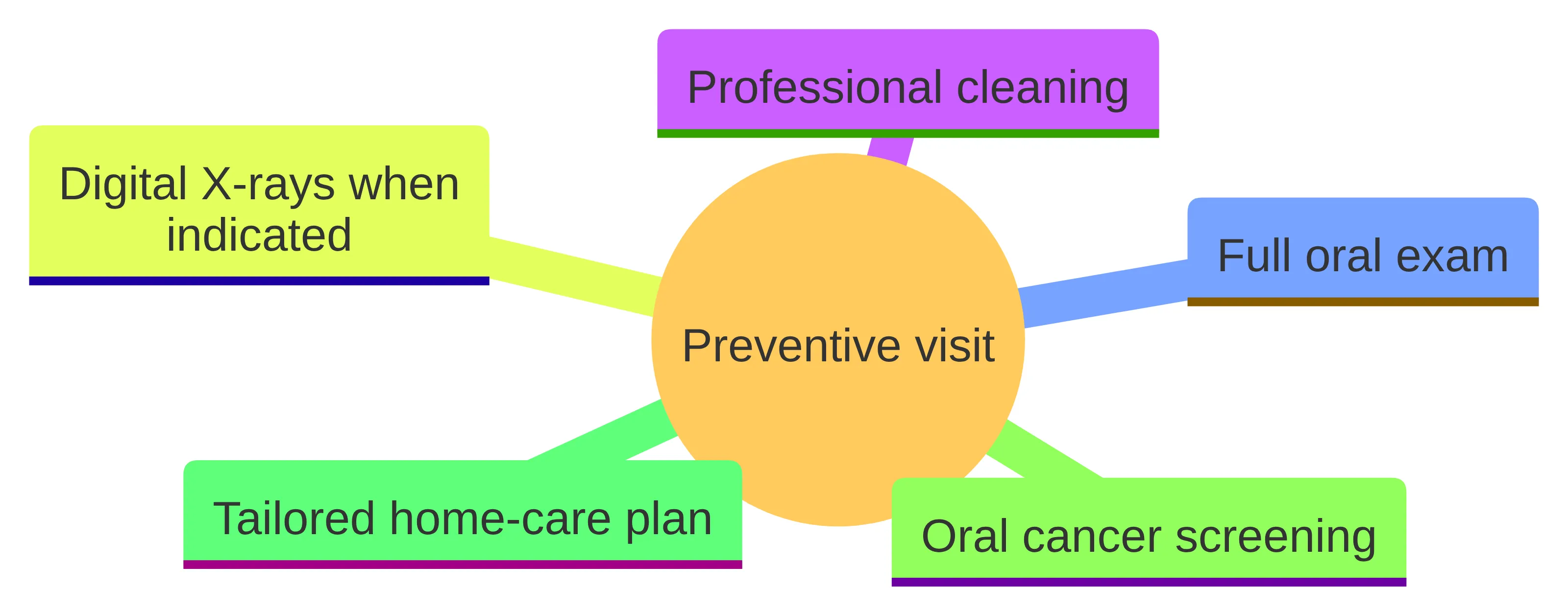
Every preventive visit with us includes a professional cleaning, a full oral exam, digital X-rays when indicated, oral cancer screening, and a home-care plan tailored to your specific risk factors. That description gives you a clear picture of the expected components of a preventive appointment without predicting what your examination will find.
The individual components have different purposes in the conversation:
- A professional cleaning addresses the cleaning portion of the visit.
- A full oral exam gives the dental team an opportunity to assess your mouth.
- Digital X-rays are included when indicated rather than automatically described for every situation.
- Oral cancer screening is listed as part of the preventive visit.
- A tailored home-care plan connects the visit with care you provide between appointments.
Use the list to decide what you want to ask about. You may want a routine check, guidance about daily care, help understanding a recurring concern, or a clearer explanation of what should be watched between visits.
A preventive appointment may fit your needs when you want examination, cleaning, screening, and home-care discussion in one planned visit. Before you contact us, identify the part that matters most to you and describe any concern you want addressed.
You can ask what information the dental team needs from you, what the visit will address, and what the next discussion would be if the examination identifies a concern. The documented visit components describe the process, not a diagnosis or a promised result.
Use the documented descriptions to distinguish two planning questions: what a preventive appointment is expected to contain and how the practice structures a first visit. The preventive description is most useful when your main goal is ongoing examination, cleaning, screening, and home-care guidance. The first-visit description is more useful when you are new to the practice, have a particular concern to explain, or want to understand when a written plan will be discussed. The descriptions can overlap, but they should not be read as a guarantee that every appointment will follow the same sequence.
That distinction gives you a practical question to ask when you contact the office: should your request be arranged as a preventive visit, a first visit, or a conversation about a specific concern? You can also ask whether the cleaning component is expected in your situation, since the practice states that cleaning during the first visit depends on gum health. If the answer affects your schedule, ask before confirming the appointment rather than assuming that the published description settles the details for you.
The goal is not to choose a treatment from a checklist. It is to make sure the appointment type, time commitment, and questions you want addressed are aligned before you begin. A service list tells you which broad categories the practice describes; an appointment description helps you assess how the initial conversation may fit your practical needs. Neither one determines what an examination will show or which care, if any, will be recommended.
Compare the first-visit process with your practical needs
That format gives you several practical points to consider before you request an appointment:
- Can you set aside the stated 60- to 90-minute window?
- Do you want the first visit to focus on a specific concern as well as a general assessment?
- Would a written treatment plan help you organize later questions?
- Do you need to discuss the length of the visit in advance?
A cleaning is conditional on gum health, so do not treat it as an automatic part of every individual visit.
A written treatment plan can give you a basis for discussion. Ask what the plan is intended to address, which choices are optional or staged, and what questions should be answered before you decide. You can ask for the proposed care to be explained in terms you understand, especially if several services or visits may be involved.
The first visit may not fit your schedule if you need a very short appointment or cannot make time for the stated range. That identifies a scheduling question to raise before arranging the visit. Your local search should account for the care itself and the practical conditions under which you can participate.
Think about what would make the first visit useful for you. You may want to leave with a clearer understanding of a concern, a written plan to consider, or a list of questions for a later discussion. You may also need to tell the office in advance that you have limited time, feel anxious about X-rays, or want the visit explained step by step.
These preferences do not guarantee that every requested part can happen in a particular appointment. They help the team understand what you need to discuss and help you decide whether the visit structure is workable.
Include comfort and dental anxiety in your choice
Dental anxiety can involve physical, cognitive, emotional, and behavioral responses, including canceling, delaying, or rescheduling appointments. One selected source reports that nearly 80% of adults feel anxiety before dental treatment, 20% fear dental treatment, and 5% fully avoid it. Those figures come from that source’s discussion of dental anxiety; they are not a prediction about your experience.
Your concern may relate to a previous experience, fear of treatment, the possibility of bad news, cost, a gag reflex, or the setting itself. You do not need to describe it with clinical language. Explain what makes dental care difficult for you and what you want the team to understand before the visit.
Our staff work to make patients feel at ease. That describes our stated approach, but it does not guarantee how any particular appointment will feel for you.
Tell us about anxiety when you make contact and ask how the concern can be included in the visit conversation. You can ask who should know about it, how you can signal discomfort, and what will be explained before an examination or procedure. Clear communication gives the practice useful information without requiring you to predict the clinical solution.
Include it alongside location and services rather than treating it as a private concern you must manage alone.
A simple opening can be enough: explain that dental visits cause anxiety, name the part that worries you, and ask what the first visit will involve. If you are arranging care for a child or another family member, describe that person’s concern directly and ask what information the office needs before the appointment.
Ask how anxiety concerns will be handled individually
A literature review states that dental-anxiety management should be customized after evaluation of the individual and clinical situation. Anxiety level, age, cooperation, and the type of care under discussion can affect what needs to be addressed, so a general promise about comfort cannot answer every question.
Use the first conversation to ask practical questions such as:
- How can you describe your anxiety before the appointment?
- Who should you tell if you are worried about an examination or procedure?
- What will be explained before the dental team begins?
- How can you communicate that you need a pause or clarification?
- Which parts of the visit can be discussed before you decide whether to continue?
These questions prepare the conversation. They do not decide whether a specific approach is suitable for you.
Your comfort priorities should be specific enough for the practice to respond to them. Instead of saying only that you are nervous, describe whether the difficulty is the sound, the examination, injections, a prior experience, uncertainty about what will happen, or the possibility of treatment costs.
You can also ask for the first visit to be explained in stages: what information is gathered, what the examination involves, and when treatment choices are discussed. If you need an individualized plan for anxiety, the evaluation with the dental team is where that plan must be determined.
A local practice can be worth contacting when you have a clear way to raise your concern and ask what the visit will involve. The answer you receive can help you decide whether the communication style and proposed process fit your needs.
Do not treat a reassuring description as a clinical promise. Use the conversation to learn what can be explained before care, how your concerns can be recorded, and which decisions require an evaluation.
Prepare the information that makes a first contact useful
Use this list to organize the information you want to discuss before the appointment.
A short preparation list can also include:
- The main dental concern you want to discuss.
- Any comfort or anxiety concern you want the team to know before treatment is discussed.
- The names of previous dental offices if prior records may be relevant.
- Questions about the visit length, examination, cleaning, X-rays, or treatment plan.
- Insurance or payment questions that affect your decision to proceed.
This preparation supports the first-visit conversation. They do not determine your diagnosis, treatment, or coverage.
We accept new patients and allow appointment requests through online booking or by calling us directly. When you make contact, lead with the information that changes the conversation: your location, the type of care you are seeking, whether you are arranging care for a child or adult, and any concern about comfort.
You can keep the opening simple: explain that you are looking for dental care in the South San Francisco area, identify your main question, and ask what information the office needs from you. If you live in Daly City, include the location question in your own planning so you can decide whether South San Francisco works for your routine.
Before you contact the office, put your questions in the order that affects your decision. Start with the reason for the visit, then mention timing, comfort, insurance, or payment concerns. This gives the conversation a clear path and reduces the chance that a practical issue is left until the end.
Give the information requested, describe what you want to discuss, and ask what should be brought or arranged before the first visit.
Ask clear questions about insurance, fees, and payment
We provide verification of benefits before treatment, accept 14 in-network PPO carriers, file out-of-network claims for patients, and publish our UCR fees openly. These are our financial and insurance policies as of October 26, 2026.
Those policies can make the financial conversation more concrete, but they do not establish what your plan will pay or what you will owe.
Use specific questions to understand the financial side of care:
- Is your insurance plan included among our in-network PPO carriers?
- If your plan is out of network, how will the claim process work for you?
- What does benefit verification address before treatment?
- Which fee applies to the examination, cleaning, X-rays, or proposed treatment?
- What portion is expected from insurance, and what portion may remain your responsibility?
- Could the financial estimate change if the examination changes the proposed treatment?
- Which payment timing or payment arrangements apply to the care being discussed?
Treat the answers as details for your situation, not as a general promise about coverage or final cost. Insurance payment and patient responsibility can vary by plan and treatment.
Financial fit is easier to assess when you separate three questions: what care is being discussed, what your insurance plan may contribute, and what you may need to pay. Ask for those parts to be explained separately if the conversation combines them.
You can also ask whether a written treatment plan and a financial estimate are available before treatment begins. That does not fix the final amount in every circumstance, but it gives you information to consider before making a treatment decision. Ask which details are estimates and which charges are tied to services actually provided.
Clarify financing without assuming affordability
Third-party dental financing may be an alternative to traditional loans, and some programs may have more accommodating credit requirements. Terms and approval criteria vary by provider, so the existence of a financing category does not establish that you will qualify or that a particular program will fit your budget.
If financing comes up in a treatment conversation, ask:
- Is the program provided by the practice or by a separate financing company?
- Who makes the approval decision?
- What amount would be financed, and under what repayment terms?
- What happens if the proposed treatment changes after evaluation?
- Which costs, fees, or services are included in the arrangement?
Do not treat financing as a substitute for a complete discussion of treatment cost, insurance contribution, and your expected responsibility.
Your financial fit depends on more than whether a payment option exists. Consider the proposed care, the amount you can reasonably manage, the timing of payments, the coverage information available for your plan, and any terms attached to a third-party program.
You can ask financial questions before committing to treatment. You do not need to decide on a loan or payment arrangement during an initial contact. The purpose of the conversation is to identify the information you need before making a treatment decision.
When comparing payment choices, write down the total amount discussed, the timing of each payment, the party providing the financing, and the conditions that could change the arrangement. This keeps a monthly payment from becoming the only figure you consider.
If the proposed care is still being evaluated, keep the financing discussion separate from the clinical decision. First understand what care is being considered. Then ask how insurance and payment options relate to that care.
Use the documented facts to decide what still needs confirmation
A fit decision becomes clearer when you separate documented practice information from questions that depend on your circumstances. Use this final checklist:
- Location: We offer care in South San Francisco. Decide whether that location works for your routine, especially if your search began in Daly City.
- Care category: We document family, cosmetic, restorative, preventive, and general dentistry, including fillings, crowns, and gum care.
- Preventive visit: We describe cleaning, a full oral exam, digital X-rays when indicated, oral cancer screening, and tailored home-care planning.
- First visit: We describe a 60- to 90-minute visit with a comprehensive exam, digital X-rays, a cleaning if gum health allows, and a written treatment plan.
- Contact: We accept new patients and permit online booking or direct calls.
- Financial process: We provide benefit verification before treatment, publish UCR fees, accept 14 in-network PPO carriers, and file out-of-network claims.
Your remaining questions concern your circumstances rather than the general practice description. You still need to determine whether the location is convenient, whether the care you want is appropriate for your needs, how your anxiety will be addressed, how your insurance applies, what your expected responsibility may be, and whether the proposed visit length works for you.
Write those questions down before making contact. A short list can include your main concern, the type of appointment you want, the comfort information the team should know, the records or X-rays you have, and the financial details you need explained.
Use your answers to sort the decision into one of three paths:
- Contact the practice: The South San Francisco location works, the documented care categories match your reason for looking, and you are ready to ask about your remaining questions.
- Ask for more information first: The services appear relevant, but you need clarity about the first visit, anxiety communication, insurance handling, fees, or payment before deciding.
- Keep comparing local options: The location, visit structure, or documented care does not fit a practical requirement you cannot change.
An evaluation is needed before anyone can determine treatment needs or recommend an individual plan. The first contact is a way to find out whether the practice can address the questions that matter to you.
To use the three paths consistently, separate requirements from open questions. Requirements are conditions that determine whether a practice can work for you at all, such as being able to reach South San Francisco or set aside the stated first-visit window. Open questions are details you can ask the office to clarify, such as how your concern will be discussed, how benefit verification applies to your plan, or which current fee information relates to the proposed service. Keeping these categories separate prevents an unanswered question from being mistaken for a negative answer.
If a requirement does not work, continued research may not solve the fit problem. If the requirements work and only open questions remain, a focused inquiry is the logical next step. Ask the questions in the order that affects your decision: first the visit type and timing, then comfort and communication, then insurance and payment. This order helps you learn whether the practice is workable before spending time comparing financial details for care you may not pursue.
For a family, repeat the check for each person rather than assuming that one person’s needs answer everyone else’s. The practice reports care for all ages, but the appropriate appointment, concern, and questions still belong to the individual. For restorative or cosmetic discussions, keep the same boundary: use the contact process to learn how an evaluation works, not to decide in advance which procedure is right.
A good outcome from the first contact is not necessarily a treatment decision. It may simply be confirmation that the location, process, and communication fit justify an evaluation, along with a clear list of questions to carry into that evaluation. That makes the contact useful even when you still need more information about coverage, fees, or the care options that may follow.
Take the next step when the practice matches your priorities
Westborough Dental Care may fit your local search when South San Francisco is a practical location and the documented service range, first-visit structure, comfort conversation, and financial questions align with what you need to discuss. We are accepting new patients as of October 26, 2026, and provide online booking or direct-call appointment requests.
Prepare your main concern, your comfort priorities, your insurance questions, and the requested first-visit information before you contact us. A qualified dental professional must determine your individual suitability and treatment needs after evaluation. Use the initial conversation to decide whether the practice is a workable next step for you.
What should you confirm before contacting a nearby dentist?
What types of dental services does Westborough Dental Care offer?
Westborough Dental Care provides a range of services including preventive, general, restorative, and cosmetic dentistry, catering to patients of all ages.
How long does the first visit typically last at Westborough Dental Care?
The first visit at Westborough Dental Care lasts about 60 to 90 minutes and includes a comprehensive exam, digital X-rays, a professional cleaning if gum health allows, and a written treatment plan.
What steps can I take if I have dental anxiety?
If you have dental anxiety, communicate your concerns to the staff when you contact the practice.
Does Westborough Dental Care accept insurance, and how does the verification process work?
Westborough Dental Care accepts 14 in-network PPO carriers and provides verification of benefits before treatment.
Can I schedule an appointment online at Westborough Dental Care?
Yes, Westborough Dental Care allows appointment requests through online booking or by calling directly.
Need help applying this?
Talk to a billing specialist who knows your payer mix.
Westborough Dental Care welcomes new patients in South San Francisco. Book a visit to meet Dr. Zoulas and the team.
Schedule a meeting